Small Business Exit Strategy: From
Succession Planning to Successful
Sale

Stop leaving your business exit to chance. Master proven exit strategies from family

 succession to business sale with valuation calculators, timelines, and frameworks to

 maximize your life’s work.


7+

Exit Strategies

5

Free Templates

24

Months to Prepare

The Exit Dilemma: Planning vs. Crisis

The Unplanned Exit

Health issues, burnout, or market changes force a rushed sale at discounted valuations. Without preparation, you leave 20-40% of potential value on the table and face complicated transitions that damage business performance.

The Golden Handcuffs

Building a business so dependent on you that it's unsellable. Buyers discount heavily when the owner IS the business—no systems, no management team, no recurring customers without your personal relationships.

The Strategic Exit

Plan your exit 2-5 years ahead, systematically increase business value, build transferable systems, and create competitive tension among multiple buyers. Maximize value while maintaining optionality and control over timing.

What's Your Business Worth?

Understanding your current business valuation is the foundation of exit planning. Our 

calculator uses industry-standard methods to estimate your business value.


Business Valuation Calculator

Calculate your business value using multiple methods—revenue multiples, EBITDA multiples,

 and asset-based approaches.

Over 2,200 business owners have used this calculator to understand their business value. Get your 

estimate in 15 minutes.


Your Exit Planning Timeline: From Decision to Close

Follow this proven framework to prepare for and execute a successful exit over 24-36 months.

 
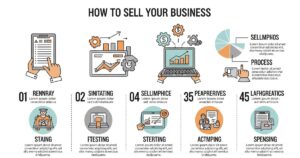
CHOOSE YOUR EXIT PATH

✔ Evaluate family succession vs. third-party sale options
✔ Consider franchising or licensing your business model
✔ Explore ESOP (Employee Stock Ownership Plan) alternatives
✔ Assess timeline and personal financial readiness

UNDERSTAND YOUR VALUATION

✔ Get professional business valuation baseline
✔ Understand what buyers actually look for and pay for
✔ Identify value drivers and detractors in your business
✔ Calculate realistic exit value expectations

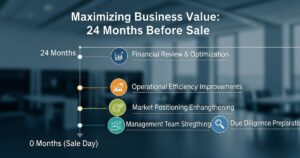
MAXIMIZE VALUE (24 MONTHS OUT)

✔ Systematize operations to reduce owner dependency
✔ Build strong management team that can operate without you
✔ Increase recurring revenue and customer diversification
✔ Clean up financials, contracts, and legal structure

PREPARE FOR SALE (12 MONTHS OUT)

✔ Complete comprehensive pre-sale business audit
✔ Prepare financial statements, tax returns, and documentation
✔ Address red flags that could derail deals
✔ Build data room with all due diligence materials

EXECUTE SUCCESSION OR SALE

✔ For family transfer: Implement succession planning framework
✔ For sale: Engage business broker or M&A advisor
✔ Negotiate deal structure: cash, earn-outs, seller financing
✔ Plan transition period and post-exit involvement

Complete Exit Strategy Resource Library

From business valuation to succession planning, these guides cover every aspect of planning 

and executing a successful business exit.


Free Exit Planning Templates & Tools

Get instant access to our complete library of exit planning templates, valuation calculators,

and strategic frameworks no signup required.


Business Valuation Calculator

Calculate your business value using multiple industry-standard methods—revenue multiples, EBITDA, and asset-based approaches.

Exit Readiness Checklist

Comprehensive 40-point assessment covering financials, operations, legal, team, and market readiness for exit.

Succession Planning Template

Complete framework for family succession including timeline, training plan, ownership transfer, and conflict resolution.

Franchise Feasibility Assessment

Evaluate if your business model is ready for franchising—systemization, profitability, replicability, and market demand.

Pre-Sale Business Audit Checklist

Due diligence checklist covering financial, legal, operational, and customer areas buyers will scrutinize during sale.

Continue Your Growth Journey

Strategic Planning & Goal Setting

Build a 3-5 year strategic plan that positions your business for a successful exit at maximum value.

Team Building & HR Foundations

Build a strong management team that can operate without you—critical for sellability and valuation.

Customer Value & Revenue Growth

Increase recurring revenue and customer lifetime value to improve business quality and exit multiples.

Funding & Capital Strategy

Understand how your capital structure and investor relationships impact exit options and timing.

Starting exit planning 3 years early was the best decision I made. We systematized everything, built a management team, and increased EBITDA by 85%. The result? We sold for 2.3x the original valuation estimate.
Patricia Williams
Former Owner of Williams Manufacturing Sold for $8.2M
after 3-year value maximization plan

Frequently Asked Questions About Business Exit Strategy

When should I start planning my business exit?

Ideally, start planning 3-5 years before your target exit date. This gives you time to: systematize operations, build a management team, clean up financials, increase recurring revenue, and maximize valuation. Even if you don’t plan to exit for 10+ years, start building transferable value now—it makes your business more valuable and less dependent on you regardless of exit timing.


Most small businesses sell for 2-4x EBITDA (earnings before interest, taxes, depreciation, and amortization) or 0.5-2x annual revenue, depending on industry, growth rate, customer concentration, and recurring revenue. SaaS businesses can fetch 4-10x revenue. Use our valuation calculator for industry-specific estimates, but get a professional valuation when you’re serious about selling—buyers will scrutinize every number.


Each has trade-offs: Family succession preserves legacy but may lack capital and create family conflict. ESOP rewards employees and provides tax benefits but requires profitable businesses with 20+ employees. Third-party sale maximizes value but means less control over legacy. Consider: your financial needs, business complexity, employee loyalty, family interest/readiness, and timeline flexibility. Many owners explore all options before deciding.


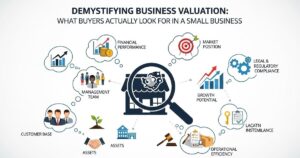
Buyers pay premiums for: (1) Recurring revenue and customer retention, (2) Business that operates without owner, (3) Diversified customer base (no customer >10% of revenue), (4) Strong management team, (5) Clean financials and growth trajectory, (6) Proprietary processes or competitive advantages, (7) Documented systems and SOPs. Red flags that kill deals: owner dependency, customer concentration, declining revenue, messy financials, legal issues.


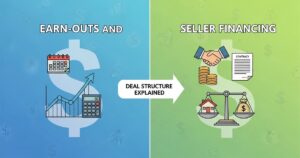
An earn-out pays part of the purchase price based on future performance—typically 20-40% of total deal value paid over 1-3 years if revenue/profit targets are met. Pros: Bridges valuation gap, can increase total payout. Cons: You don’t control the business but your payout depends on its performance. Accept earn-outs when: you’re confident in growth trajectory, you’ll stay involved, metrics are clearly defined and achievable, and the base cash payment meets your minimum needs.


Expect 6-12 months from listing to close: 1-2 months preparing materials, 2-4 months marketing to buyers, 1-2 months negotiating letter of intent, 2-3 months due diligence, 1 month final negotiations and closing. Add 3-6 months if you need to improve business first. Rushed sales leave money on the table. Market conditions, business quality, and asking price affect timeline—overpriced businesses can sit for 18+ months.


Ready to Plan Your Exit?

Start with our Business Valuation Calculator to understand your baseline value. Then use our

 Exit Readiness Checklist to identify what to improve before exit.