
Building Your Team: The Complete Guide to Hiring for Small Business Growth

Thinking about hiring your first employee or growing a small team? Start by checking your workload and budget, then use the guides, calculators and templates below to plan the role, recruit and onboard with clear expectations.

8+

Hiring Frameworks

5

Free Templates

3

Cost Calculators

The Hiring Crossroads: Why This Decision Matters

The Cost of Waiting Too Long

Burning out, losing customers, missing growth opportunities. Waiting to hire can cost you more than the salary itself. Your time has value, and opportunity costs compound quickly when you're stretched too thin.

The Risk of Hiring Too Early

Cash flow strain, management overhead, and cultural mismatch. Premature hiring can destabilize your foundation. Without proper systems and revenue, you're adding complexity you can't afford.

The Data-Driven Approach

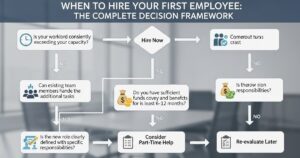
Use the readiness and budget calculators to compare options before making an offer. Look at recurring workload, full hiring costs and how much time you can spend managing and training.

Are You Ready to Hire? Take the Assessment

Use the readiness worksheet to review recurring workload, revenue, cash flow and your capacity to train someone. The result can help you decide whether to hire now, simplify the role or revisit the decision later.

Interactive Hiring Readiness Calculator

Calculate your hiring readiness score based on revenue, workload, and cash flow metrics.

Use your readiness score as a starting point. Before making an offer, check whether you can cover the ongoing cost in a quieter month and set aside time to train your new hire.

Your Hiring Journey: From Planning to Onboarding

Work through these five stages in order. Define the role before you recruit, and plan the first 90 days before your new team member starts.

READINESS & PLANNING
  • Define company values early before they’re needed
  • Document expected behaviors and cultural principles
  • Create remote/hybrid policies that support flexibility
  • Establish communication norms and meeting rhythms
ONBOARDING & INTEGRATION
  • Create structured 90-day onboarding plan

  • Set clear expectations, goals, and KPIs

  • Provide necessary training and resources

  • Schedule regular check-ins and feedback sessions

Complete Team Building & HR Resource Library

Use these guides to define a role, estimate hiring costs and build the processes that support your team as it grows.

Free Hiring & HR Templates

Use the calculators online. For downloadable templates and checklists, enter your name and email to get the file.

First Employee Readiness Checklist

Use this 25-point checklist to assess whether you have enough ongoing work, budget and time to support your first employee.

Job Description Template Library

Proven templates for 5 common small business roles: Admin, Sales, Marketing, Operations, Technical.

Employee Handbook Template

Complete handbook framework covering policies, culture, benefits, and expectations.

Onboarding Process Workflow

Visual timeline and checklist for the first 90 days of employee integration.

Hiring Budget Calculator

Calculate total first-year costs including salary, taxes, benefits, equipment, and training.

Continue Your Growth Journey

Funding & Capital Strategy

Learn how to fund your growing team with bootstrapping strategies and capital options.

Strategic Planning & Goal Setting

Set clear quarterly goals for hiring milestones and team development.

Customer Value & Revenue Growth

Increase revenue to support team expansion and hiring budgets.

Exit Strategy & Business Transitions

Build a sellable business by documenting HR processes and building a strong team.

The biggest mistake I made was waiting too long to hire. I thought I was saving money, but I was actually losing revenue and burning myself out. Using the readiness framework helped me time my next two hires perfectly.
Marcus Thompson
Founder of Summit Consulting
Built team from 0 to 12 employees in 3 years

Frequently Asked Questions About Hiring

How much revenue should I have before hiring my first employee?

Start with the full monthly cost of the role and compare it with your cash flow in both a typical month and a quiet one. Use the hiring budget calculator to test what you can afford before committing.

Start by defining the work, how it will be supervised and whether it is ongoing or project-based. Check the employment and contractor classification rules in your location before choosing how to engage someone.

Budget for the base pay plus applicable employer contributions, insurance and other employment costs. Add recruitment, equipment, software, training and the time you’ll spend onboarding and managing the person.

Work backwards from your ideal start date. Allow time to write the role description, advertise, interview, check references and accommodate the successful candidate’s notice period.

A handbook gives your team a reference for day-to-day expectations, workplace policies and who to ask for help. Use the template as a starting point and adapt it to your business and location.

An operations manager typically oversees day-to-day workflows and team coordination. A COO typically owns broader operational strategy and execution. Start with the decisions and responsibilities you need someone to take on.

Ready to Build Your Team?

Start with the First Employee Readiness Checklist, then use the hiring budget calculator to estimate the full cost of the role. Once you’re ready to recruit, use the job description and onboarding templates below.