Adopting 3D Printing for Prototyping and Production
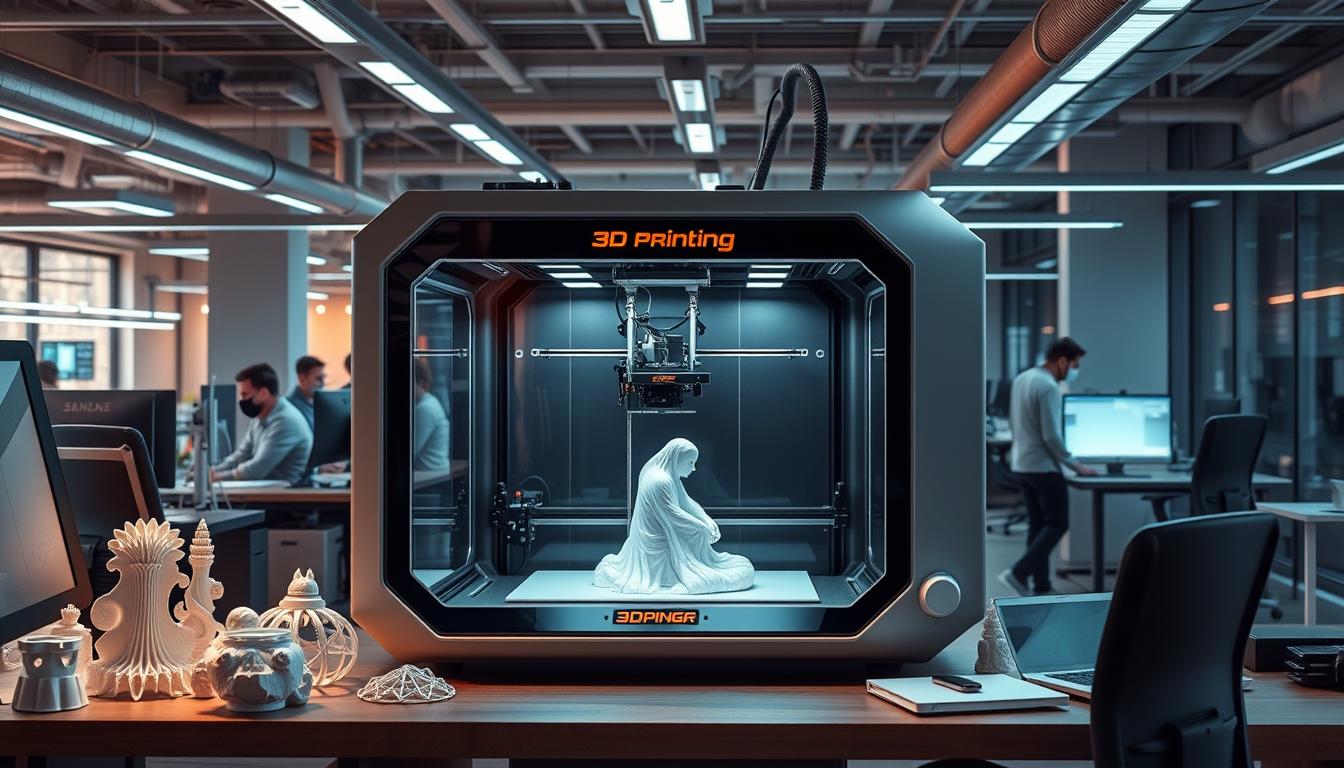
Have you ever thought about how 3D printing has changed the game in business? It’s now key for quick prototyping and production. This technology is not just a passing trend; it’s crucial for staying ahead.
Additive manufacturing can support prototypes, tooling and some finished products. Its value depends on the part, material, production volume and quality requirements. This guide focuses on how to assess a useful small-business application.
Key Takeaways
- Use a prototype to test fit, function or customer feedback before committing to production.
- Compare the full cost of printing with machining, moulding or outsourcing.
- Allow for finishing, failed builds, inspection and staff training.
- Validate material properties and tolerances for the intended use.
Understanding Rapid Prototyping
Rapid prototyping is key in today’s product development. It lets companies quickly make early versions of products. This helps test designs and gather data for future improvements.
Using 3D printing, rapid prototyping has changed design and production. It’s a big leap forward.
Definition and Importance
Rapid prototyping means making early product versions fast and cheap. It lets teams quickly try out designs. This way, they can see if ideas work before spending a lot of time and money.
With 3D printing, making prototypes takes hours or days. This makes the design process faster. It helps check if products are easy to use and make before full production.
Historical Context and Evolution
Before, making products took a long time and was expensive. Old methods like injection molding needed a lot of money for tools. This made changing designs hard.
Now, with 3D printers, making prototypes is much faster and cheaper. Companies like Centor and Caldwell use tools like the Digital Forge. This lets them make parts quickly and on demand. It speeds up innovation and saves money.
| Aspect | Traditional Methods | 3D Printing |
|---|---|---|
| Lead Time | Weeks to Months | Hours to Days |
| Cost | High Tooling and Setup Costs | Low Prototyping Costs |
| Design Iteration | Limited Iterations | Multiple Iterations Easily |
| Material Flexibility | Limited Material Choices | Wide Range of Materials |
| Usability Testing | Difficult to Test Early | Easy and Immediate Testing |
Benefits of Utilizing 3D Printing for Prototyping
3D printing is changing how businesses make prototypes. It makes things cheaper and faster, which is great for today’s factories. This tech helps companies make models quickly and test them right away, saving money and time.
Cost Efficiency and Time Savings
3D printing may reduce tooling costs for some prototypes or short runs, but it is not automatically cheaper. Compare design preparation, materials, machine time, support removal, finishing and rejected parts with the alternative process.
It also saves a lot of time. Old ways of making things need many machines and take a long time to set up. But 3D printing can make parts in just hours, speeding up the whole process.
Flexibility in Design Iterations
A design team can print and test several versions of a part before choosing a final design. Record what each iteration is testing so the process produces useful evidence rather than simply more prototypes.
This makes it easier to get products to market faster. It also helps make spare parts and tools on demand. This cuts down on downtime and saves money, making companies more self-sufficient and profitable.
How 3D Printing Enhances Product Development
3D printing changes how we make products, making it faster to get new items to market. Old ways took too long, but now we can see ideas come to life quickly. This means teams can test and improve designs in days, not weeks.
Faster Iteration Cycles
With 3D printing, companies can make things faster. Designers can create complex shapes and parts that were hard before. This lets them keep trying and improving, leading to better products.
Increased Innovation Opportunities
3D printing lets teams think differently, leading to new ideas. It breaks free from old ways, making room for creativity. This tech also helps the planet by using less material and making things closer to where they’re needed.
3D printing is key for staying ahead in business. To see how it changes things, check out its effects in different fields.
3D Printing in Business: Revolutionizing Manufacturing
The world of 3D printing in business has changed a lot lately. Big names like GE, Lockheed Martin, and BMW are using it for making lots of products. This new way helps companies make things just when they need them, saving money and making things faster.
There are many materials for 3D printing now, like plastics, resins, ceramics, and metals. The field is moving from just making prototypes to making strong products for sale. This change is making manufacturing better and helping design products more easily.
Assess 3D printing from your own use case rather than a market-growth forecast. Obtain quotes for the same part, quantity and quality standard from more than one process. NIST’s 2016 review of additive-manufacturing costs explains why cost comparisons depend on scope; it is background research, not a current market estimate.
Managers need to think about how 3D printing can make products better and work more efficiently. New methods like binder jetting are leading the way. They can use different materials, making production even better. Companies like Stratasys and ADDiTEC are showing us what the future of 3D printing in business could be like.
Choosing the Right 3D Printing Technology
Choosing the right 3D printing technology is key for making prototypes and products. Each technology has its own strengths and fits different needs.
Fused Deposition Modeling (FDM)
FDM is known for being affordable and easy to use. It’s great for beginners. It’s fast and cheap to make parts that fit right.
FDM works by layering melted plastic. It’s good for parts that aren’t too complex. Both hobbyists and pros like it for its simplicity.
Stereolithography (SLA)
SLA is known for making models with fine details and smooth surfaces. It uses UV light to cure resin layer by layer. This makes it perfect for detailed designs.
SLA is used in fields like dentistry and jewelry. It’s great for prototypes that need to look perfect. Its precision is unmatched.
Selective Laser Sintering (SLS)
SLS is great for making strong parts from powder. It uses a laser to fuse the powder. This makes parts that are both strong and reliable.
SLS is best for engineering parts. It can make complex shapes without needing supports. It’s perfect for small batches of parts.
| Process | What to confirm with the supplier |
|---|---|
| FDM | Material, layer orientation, supports, surface finish and tested dimensional tolerance |
| SLA | Resin suitability, support removal, washing, curing and dimensional tolerance |
| SLS | Powder and part properties, cooling, depowdering, finishing and dimensional tolerance |
Build size, layer thickness and achievable accuracy depend on the machine, material, geometry and settings. Obtain a process-specific quote and test part instead of assuming one tolerance applies to every printer.
Materials for 3D Printing Prototypes
Choosing the right materials for 3D printing is key to success. The right mix of function and beauty is crucial. Here, we look at different materials and their benefits.
Common Thermoplastics
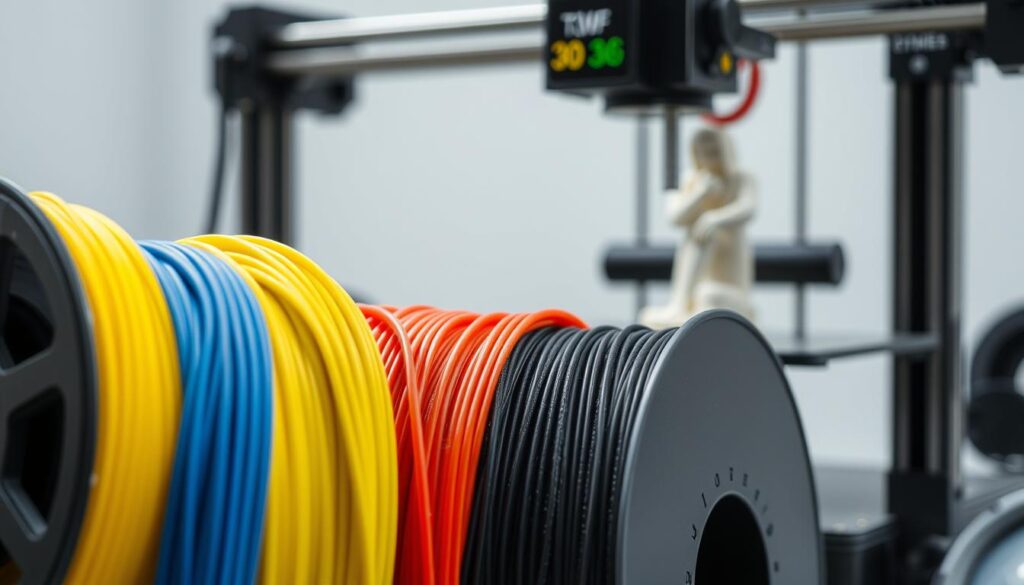
Thermoplastics are a top pick for 3D printing. They work well with FDM printers because they’re versatile and easy to find. Here are some common ones:
- PLA: A green plastic for simple models, easy to print and smooth.
- ABS: Strong and heat-resistant, great for prototypes that need to last.
- PETG: Strong and flexible, perfect for clear and tough prototypes.
Resins for Detailed Prototyping
Resins are vital for detailed prints. SLA printers are best for them, offering many types like:
- Standard Resins: Good for everyday use, shows off design details well.
- Engineering Resins: Durable and heat-resistant, ideal for real-world use.
- Flexible Resins: Makes soft and bendable prototypes, great for parts that need to move.
Metal Printing for Functionality
Metal printing, like DMLS, makes strong and useful prototypes. It’s a game-changer for industries like aerospace and cars. Its big wins are:
- Strength: Metal prototypes are super stable, perfect for tough jobs.
- Precision: Can make complex designs easily, no need for extra support.
- Material Variety: Offers many metals for different needs.
| Material Type | Common Applications | Properties |
|---|---|---|
| Thermoplastics (PLA, ABS) | Basic models, proof-of-concept | Durable, low-cost, easy to print |
| Resins (Standard, Engineering) | Highly detailed prototypes | High resolution, smooth finishes |
| Metal (DMLS) | Functional prototypes, end-use parts | High strength, precision, complex geometries |
Knowing about these materials helps designers and engineers make better choices. This boosts the success of their 3D printing projects.
Integrating 3D Printing into Your Workflow
Adding 3D printing to your business workflow can really boost your production. You need to decide between doing it yourself or outsourcing. Each choice has its own set of challenges and benefits that you must weigh carefully.
In-house Printing vs. Outsourcing
Deciding between printing in-house or outsourcing can be a big decision. Printing yourself lets you control the process and make quick changes. This can help you meet market demands faster. But, it means you’ll need to spend money on equipment and materials.
Outsourcing can save money, especially for small projects. It might not cost as much to maintain, but it can take longer because of shipping. The choice depends on how often you need to print and how complex the projects are.
Training and Skill Development
Getting your team trained is key to using 3D printing well. You need to make sure your employees know how to use the technology. Good training helps them work smoothly with 3D printing.
Investing in training can really pay off. Studies show that with the right skills, 3D printing can save a lot of money. It can also make your company more productive and efficient. For more on using 3D printing in factories, check out this resource.
| Aspect | In-house Printing | Outsourcing |
|---|---|---|
| Initial Costs | High | Low |
| Control Over Production | High | Medium |
| Turnaround Time | Fast | Slow |
| Technical Skill Requirements | High | Low |
| Flexibility in Design Changes | High | Medium |
Challenges in Implementing 3D Printing
As more companies start using 3D printing, they face many hurdles. These include quality control problems and material limits. Knowing these challenges is key to getting the most out of this technology.
Quality Control Issues
Quality control is a practical concern. Agree the required dimensions, surface finish, strength and testing method before printing. NIST’s part-qualification programme identifies measurement and qualification challenges that require attention.
Post-processing adds time and cost through support removal, curing, heat treatment, sanding or machining, depending on the process. Ask suppliers to include these steps and inspection in their quotes.
Material Limitations and Costs
Material choices are another big challenge in 3D printing. Not all materials work for every job, limiting design options and function. Healthcare and automotive sectors find this very limiting.
Buying and keeping up with 3D printing tech and materials is also expensive. This adds to the financial hurdles of using this technology. Companies need to find new ways to pay for it and get more materials. This will help make 3D printing more efficient and useful.
Conclusion
3D printing is changing the business world fast. It lets companies make more products quickly and in bigger amounts. This makes it easier to create complex items and switch between different products.
3D printing can help a business test ideas or produce suitable custom parts. Start with a defined pilot and compare total cost, lead time, repeatability and customer value before investing in equipment.
Adding 3D printing to business helps improve efficiency and innovation. It helps companies stay ahead in a competitive market. By using 3D printing, businesses can meet changing customer needs better.
Read the article: How to Navigate Better Payment Terms with Suppliers