
When to Hire Your First Employee: The Complete Decision Framework
You started your business to be free.
Free from a boss. Free to set your own schedule. Free to build something that matters.
But right now, it probably doesn’t feel like freedom. It feels like you created a job for yourself where you work 80 hours a week and the boss is a tyrant (that’s you).
You are the CEO, the janitor, the marketing department, and the customer support rep. You are answering emails at 11 PM. You are skipping lunch to pack orders. You are exhausted.
You know you need help. Your spouse keeps telling you to get help. But the thought of hiring your first employee is terrifying.
What if you can’t afford them? What if they mess up your client relationships? What if you run out of work for them?
These are valid fears. Hiring your first employee is the single biggest psychological hurdle you will face as a business owner. It changes your identity from “Solopreneur” to “Employer.”
It is a leap of faith. But it shouldn’t be a blind leap.
There is a math to this. There is a logic. And if you follow the right framework, hiring isn’t a risk. It is the only way to get your life back.
Let’s break down exactly how to know it is time to make that first hire.
The “Solopreneur Ceiling”
Here is the problem with doing it all yourself. You don’t scale.
You have a finite number of hours in the week. Let’s say you can work 60 hours before you burn out. If you are selling your time (services) or your physical labor (making products), your revenue is capped by your energy.
You hit a ceiling. You can’t take on new clients because you are too busy servicing the old ones. You can’t work on strategy because you are too busy with admin.
This is the “Solopreneur Trap.” You are working in the business so much that you can’t work on the business.
When you hit this ceiling, your quality starts to slip. You miss a deadline. You forget to reply to a lead. You make a mistake on an invoice.
That isn’t just stress. That is your business telling you it is breaking.
Deep Dive: The Three Signals
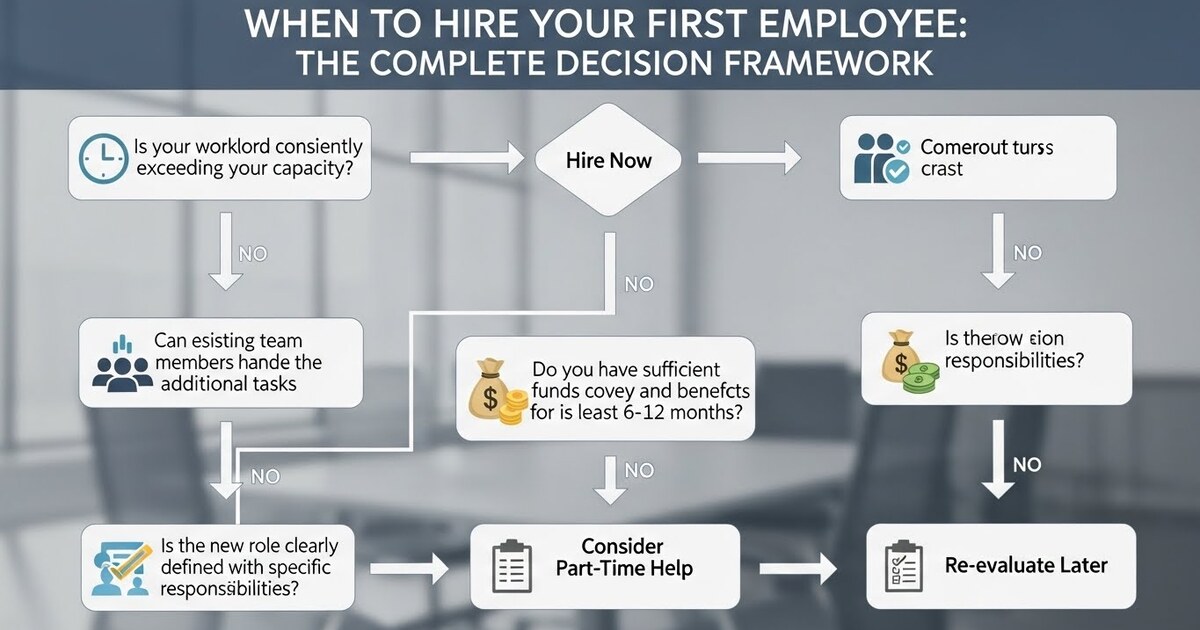
How do you know if you are just having a busy month or if you truly need a body? Look for these three signals.
1. You are turning away revenue
This is the clearest sign. If you are saying “no” to new customers because you don’t have the capacity to serve them, you are literally losing money. If a new employee costs $4,000 a month, but they allow you to take on $8,000 in new work, the hire pays for itself immediately.
2. You are doing “$10/hour” work
As the owner, your time is worth at least $100 to $500 an hour. That is the value you create when you are selling, strategizing, or building. But if you are spending 10 hours a week scheduling social media posts, filing receipts, or answering basic support tickets, you are losing money. You are paying a CEO salary to do admin work.
3. You have stopped growing
If your revenue has been flat for six months despite high demand, it is because you are the bottleneck. You can’t push the gas pedal because you are too busy steering.
The Financial Fear Factor
Let’s talk about the money. This is what keeps you up at night.
“Can I actually afford this?”
Most owners look at their bank account and say, “I have $10,000 in the bank. I can pay someone for two months. What happens after that?”
That is the wrong way to look at it. You don’t pay employees out of your savings. You pay them out of the future revenue they help you generate.
However, you do need a safety net. Before you hire, you should run the numbers. We actually have a specific tool for this. You should check out our calculator for the true cost of hiring your first employee. It helps you see beyond the salary to things like taxes and software licenses.
The “3-Month Rule”
A good rule of thumb is to have 3 months of the new employee’s salary saved in cash reserves before you sign the offer letter. This gives you a runway. It gives them time to ramp up and start generating value before you start sweating about payroll. If you are unsure how to build that buffer, look at our business cash reserve strategy guide.
Solutions: The “Buy Back Your Time” Framework
Don’t just hire “help.” Hire to buy back your time.
Step 1: The Time Audit
For one week, track everything you do. Every 30 minutes, write it down. At the end of the week, highlight every task that:
- You hate doing.
- You are bad at doing.
- Someone else could do for $20/hour.
Group these tasks. Is it mostly admin? Is it mostly fulfillment? Is it mostly marketing? Congratulations. You just wrote your first job description.
Step 2: The “Who” (Contractor vs. Employee)
You don’t always need a full-time W-2 employee right away.
- The Contractor: If you need specific skills (bookkeeping, graphic design) for 5 to 10 hours a week, hire a freelancer. It is low risk.
- The Employee: If you need someone to manage the core operations, handle customer service daily, and build culture with you, hire an employee.
If you are debating whether they should be in your office or working from home, you should review our remote vs. on-site HR framework to see what fits your business model.
Step 3: Document Before You Delegate
You cannot hire someone to fix your chaos. If you hire someone into a messy business, you just multiply the chaos. Before they start, write down the steps for the tasks you are handing over. Make a Loom video. Write a checklist. If you don’t have Standard Operating Procedures (SOPs), your new hire will fail, and you will blame them. But it will be your fault.
Actionable Tips for the First Hire
1. Hire for Attitude, Train for Skill For your first hire, you need flexibility. You need someone who says, “I will figure it out.” You can teach them your software. You can’t teach them work ethic or curiosity.
2. Start with a Trial Period Make the first 90 days a probation period. Be clear about it. “We are going to try this for 90 days. We will review it then and decide if it is a long-term fit.” This protects both of you.
3. Don’t Micromanage This is hard. It is your baby. But if you hover over their shoulder, you are wasting the time you just paid to save. You have to let them make small mistakes so they can learn. If you struggle with this, we have a guide on how to manage a small team without micromanaging that might save your sanity.
4. The “Revenue Replacement” Goal Give your new hire a goal that relates to revenue. “By taking over customer support, I need you to free up 10 hours of my week so I can close 2 new deals a month.” Make the connection between their work and the company’s growth clear.
The FAQ Section
Q: What if I train them and they leave? A: The only thing worse than training them and having them leave is not training them and having them stay. Turnover happens. But if you treat them well and give them purpose, they will stay longer than you think.
Q: Should I hire a friend or family member? A: Be very careful. It works sometimes, but it usually ends with you losing a friend or having an awkward Thanksgiving. If you do it, you need strict boundaries.
Q: How do I handle payroll? A: Do not try to do this manually. Use a service like Gusto or QuickBooks. The tax penalties for messing up payroll are not worth the $50 a month you save doing it yourself.
The Bottom Line
Hiring your first employee isn’t just about offloading work. It is about buying your future.
It is about acknowledging that your vision is bigger than your two hands can build.
Yes, it is scary. Yes, it costs money upfront. But the moment you see your business running while you are not in the room… that is magic. That is when you stop owning a job and start owning a business.
So look at your audit. Check your bank account. And if the signs are there, post the job. You are ready.
Ready to calculate the risk? Before you post that job ad, take five minutes to run the numbers. Use our true cost of hiring calculator to make sure your budget is bulletproof.