How to Create Professional Invoices That Get Paid Faster
An invoice is not merely a request for payment. In the psychology of business, it is the final handshake of a transaction, the closing argument for the value you provided, and the first impression of your administrative competence. A slapdash, generic invoice sent as an afterthought communicates that you view the transaction—and by extension, the client—as an afterthought. It lands in an inbox as a nuisance, destined for the “I’ll get to it later” pile. A professional invoice, however, does the opposite. It functions as a strategic business tool designed with one explicit, secondary goal: to make paying you the easiest, most logical next step for your client. Getting paid faster is not about being a better collector; it is about being a better communicator. It is about removing every possible point of friction, confusion, and delay between your completed work and the funds landing in your account. This is the art and science of crafting invoices that are not just sent, but settled.
The Foundation: Clarity as Your Greatest Asset
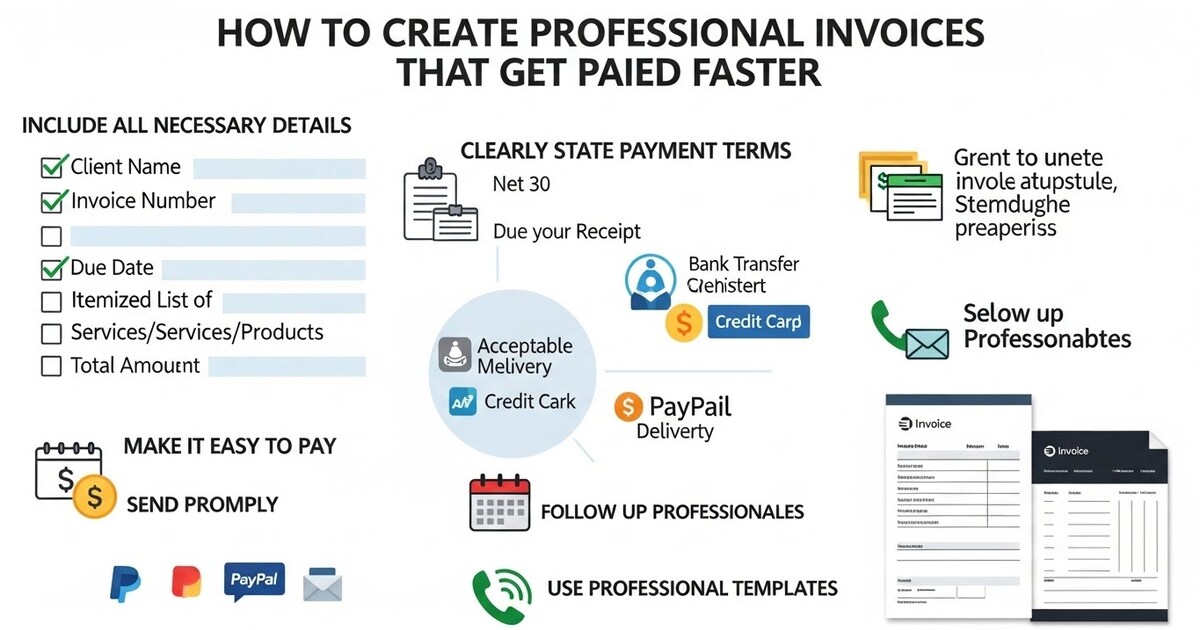
Before a single design element is considered, the information architecture of your invoice must be impeccable. Ambiguity is the enemy of prompt payment. Every line item, every date, and every term must answer a question before it is asked.
1. The Unmistakable Identifier: Your Branding
Your invoice is an extension of your brand. It must feature your professional logo, your business name, and your contact information (physical address, phone, professional email). This immediately signals legitimacy and permanence. It transforms the document from a faceless bill into a communication from a reputable entity.
2. The Critical Path: Dates and Numbers
- Invoice Number: A unique, sequential number (e.g., INV-2024-001). This is non-negotiable for your records and your client’s accounting department. It allows for easy reference in all communications.
- Invoice Date: The date the invoice is issued.
- Payment Due Date: The single most important piece of information after the total. Do not hide it. State it clearly: “Payment Due: NET 15” is good. “Payment Due: October 26, 2024” is better. Clarity eliminates the “I thought I had 30 days” excuse.
3. The Story of Value: The Line Item Breakdown
Vague descriptions like “Services rendered” or “Project fee” invite scrutiny and delay. Instead, tell the story of the work. For a consulting project: “Strategic Discovery Workshop: 8 hours @ $150/hr.” For a product: “Premium Widget (Model X) – Quantity: 2 @ $199/unit.” This detailed breakdown justifies the total, preempts questions, and reminds the client of the specific value they received. It turns an invoice from a demand into a receipt of value.
4. The Destination and The Terms: No Guessing Games
- Client Details: The full, correct name of the individual or department, the company name, and the billing address. An error here can stall payment for weeks.
- Clear Payment Terms: State your terms prominently. Are you NET 15, NET 30, or due upon receipt? What payment methods do you accept? Are there late fees for overdue payments? (e.g., “A 1.5% monthly finance charge will be applied to balances over 30 days past due.”) Setting this expectation upfront, preferably in your initial contract, establishes professionalism and consequences.
The Engine of Speed: Digital and Frictionless Payment
The single most effective feature you can add to an invoice is a mechanism to pay it instantly. Every step a client must take between receiving your invoice and completing payment is a point where they can stop.
Integrate Online Payment Links Directly
Using invoicing software like QuickBooks, FreshBooks, Wave, or Hello Bonsai, you can embed a “Pay Now” button directly on the PDF invoice. When the client views the email or opens the attachment, they can click to pay via credit card, debit card, or ACH bank transfer in less than a minute. This reduces the payment cycle from 30+ days to 48 hours. The psychological shift is profound: the invoice is no longer a document to be filed for later action; it is an interactive bill to be settled immediately.
Offer Multiple, Modern Payment Options
Different clients prefer different methods. Offering only a bank transfer for manual deposit adds friction. Ensure your system can accept:
- Major Credit/Debit Cards (Visa, Mastercard, Amex)
- ACH/Direct Bank Transfer (lower fees for you and the client)
- Digital Wallets (like PayPal or Stripe) if relevant to your client base.
The goal is to meet the client where they are, with the method most convenient for them.
The Psychology of Timing and Communication
How and when you send the invoice influences how it is perceived and prioritized.
Invoice Immediately Upon Delivery
Send the invoice the moment the project is complete, the milestone is hit, or the product is delivered. The value of your work is freshest in the client’s mind. Delay invoicing, and you dilute that perceived value, turning your work into a distant memory and your invoice into an unexpected surprise.
Use a Professional, Consistent Subject Line
Your invoice email should not have a subject like “Invoice.” Use a consistent, clear format: “Invoice [Number] from [Your Business] for [Project Name] – Due [Date].” This helps the client file it and find it later.
Include a Polite, Personalized Message
The email body should not be empty. Write a brief, warm note: “Hi [Client Name], attached please find invoice [Number] for the [Project Name] work completed last week. It was a pleasure collaborating with your team on this. As a reminder, payment terms are net 15. Please let me know if you have any questions. Best, [Your Name]” This personal touch reinforces the relationship and opens a channel for questions.
The System of Follow-Up: Polite, Automated Persistence
Silence after an invoice is sent is not golden; it is a warning sign. You need a system, not a sporadic memory, for follow up.
Schedule Automated Payment Reminders
Most invoicing software allows you to set up automatic, polite reminder emails. You can configure: “Send a friendly reminder 3 days before the due date,” “Send a first notice 2 days after the due date,” and “Send a second notice 7 days after the due date.” This automation ensures consistency and removes the emotional labor of chasing money. The reminders are factual, not personal.
Have a Clear, Escalating Process
Know your steps before a payment is late.
- The Gentle Nudge (1-3 days overdue): A short, friendly email: “Just circling back on invoice [Number] sent on [Date]. Wanted to ensure you received it and see if you have any questions.”
- The Direct Inquiry (7-10 days overdue): A more direct phone call or email. “I’m following up on invoice [Number], which is now [X] days past due. Can you provide an update on the payment status so I can update my records?”
- The Formal Notice (15+ days overdue): Refer to your contract terms. Send a formal letter or email stating that late fees are now accruing per your agreement, and payment is required immediately to avoid further action.
The Ultimate Tool: Invoicing Software as Your Partner
Attempting to manage this process with Word templates and manual spreadsheets is a guarantee of inefficiency and error. Professional invoicing software is the engine that powers this entire strategy.
Templates & Branding: Create a beautiful, branded template once and reuse it forever.
Automation: Set up recurring invoices for retainers, automated reminders, and late fees.
Tracking: See at a glance which invoices are paid, overdue, or outstanding.
Reporting: Understand your cash flow with reports on average days to pay.
Integration: Connect directly to your accounting software (like QuickBooks or Xero) so payments are logged automatically, reconciling your books with zero manual entry.
A professional invoice is a closed loop system. It begins with a clear agreement, is delivered with impeccable detail and frictionless payment options, and is followed by polite, systematic communication. It treats the payment process with the same care and strategy as the service delivery itself. By investing in this process, you do more than get paid faster. You build a reputation for professionalism, you improve your client relationships by eliminating awkward financial conversations, and you secure the predictable cash flow that is the lifeblood of a healthy, growing business. Your invoice stops being a request and becomes a reliable transaction, paving the way for the next project, and the next, with trust and efficiency.