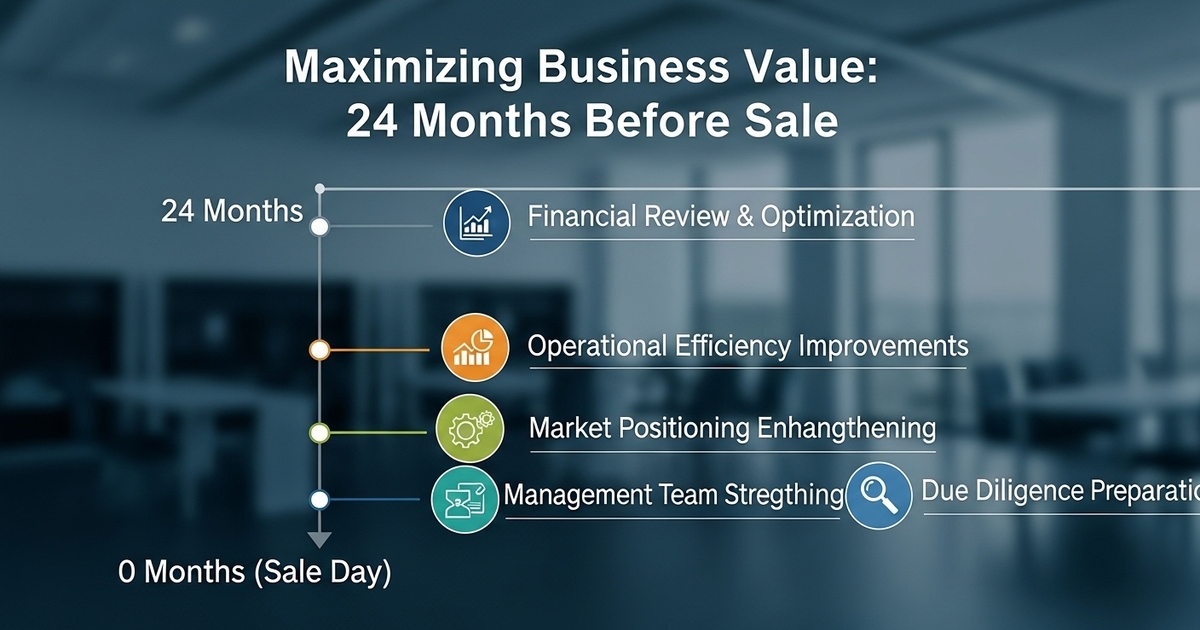
Maximizing Business Value: 24 Months Before Sale
There is a huge difference between selling a used car and selling a vintage classic.
A used car is sold based on utility. “It runs, it has four wheels, here is the Blue Book value.”
A classic car is sold based on story, condition, and documentation. “This is a pristine machine, fully restored, with every service record since 1968.”
Most business owners sell their companies like used cars. They get tired. They decide to sell. They take whatever the market offers based on last year’s profit and don’t maximize business value to get more.
But smart owners sell like it is a classic. They spend 24 months polishing the chrome, tuning the engine, and organizing the records so that when a buyer looks under the hood, they are blown away.
If you plan to sell your business in 2 years, you have a golden opportunity. You can literally double the value of your exit by making specific operational and financial changes now.
Let’s talk about how to maximize business value that turn your business into an irresistible asset that buyers will fight over.
The “EBITDA Multiple” Game
To maximize business value, you have to understand the math of the buyer.
Most businesses are valued as a multiple of EBITDA (Earnings Before Interest, Taxes, Depreciation, and Amortization).
- Formula: Value = EBITDA x Multiple.
You have two levers to pull here.
- Increase EBITDA: Make more profit.
- Increase the Multiple: Reduce risk.
Buyers pay higher multiples for businesses that are safe, predictable, and scalable. If your business is risky (e.g. depends entirely on you), you might get a 2x multiple. If it is a well-oiled machine, you might get a 5x or 6x multiple.
That difference is millions of dollars.
Deep Dive: The 4 Value Drivers
Focus your energy here for the next 24 months. These are the things that push that multiple up.
1. Recurring Revenue (The Holy Grail)
Buyers love predictability. If you start every month at zero revenue, you are risky.
- The Fix: Can you add a subscription component? A service contract? A retainer model? Even converting 20% of your revenue to recurring can bump your multiple significantly. If you aren’t sure how to do this, look into creating recurring revenue models for ideas.
2. Customer Concentration
If one customer accounts for 30% of your revenue, a buyer will panic. They will think, “What if that client leaves the day after I buy?”
- The Fix: Aggressively hunt for new, smaller clients to dilute the big one. Aim for no single customer to be more than 10% to 15% of revenue.
3. Management Depth
If you get hit by a bus, does the business stop? If the answer is yes, the business is worth very little without you.
- The Fix: Build a “Second Line” of management. Train them to make decisions. Stop being the hero. A business that runs without the owner is the most valuable asset of all.
4. Financial Hygiene
Messy books kill deals. If a buyer cannot verify your numbers easily, they will walk away or lower their offer.
- The Fix: Upgrade from “shoebox accounting” to a professional CPA audit or review. Clean up your balance sheet so assets and liabilities are crystal clear.
The 24-Month Countdown Checklist
Months 1-6: The Clean Up
- Audit Financials: Identify “add-backs” (personal expenses run through the business) so you can show true Adjusted EBITDA.
- Legal Review: Ensure all IP belongs to the company, not you personally. Check employee contracts.
Months 7-12: The Systems Build
- Document Processes: Write the SOPs. If a key employee leaves, the knowledge shouldn’t leave with them.
- Tech Stack: Modernize your CRM and inventory systems.
Months 13-18: The Growth Sprint
- Show Momentum: Buyers pay for future growth. You want your revenue trend line pointing up right now. Launch a new marketing initiative.
- Optimize Margins: Cut dead weight expenses to boost that EBITDA number.
Months 19-24: The Market Prep
- Assemble the Team: Hire an M&A advisor, a transaction attorney, and a wealth planner.
- Create the “Book”: Your advisor will help create the Confidential Information Memorandum (CIM) to market the business.
Actionable Tips for the Home Stretch
1. Don’t Stop Running the Business The biggest mistake sellers make is getting distracted by the sale. If your revenue dips during due diligence, the buyer will re-trade (lower the price). Keep your foot on the gas.
2. Normalize Working Capital Buyers expect a certain amount of cash and inventory to be left in the business. Manage your cash reserves strategy efficiently so you don’t have to leave excess cash on the table.
3. Check Your Lease If your facility lease expires right when you want to sell, that is a risk. Renew it or negotiate a transferrable lease now.
The FAQ Section
Q: Is 24 months really necessary?
A: You can sell faster, but you won’t maximize value. It takes time to show a trend of improved profitability. A buyer wants to see 12 months of clean data after you fixed the problems.
Q: Should I tell my employees I’m planning to sell?
A: Generally, no. Uncertainty causes good people to look for other jobs. Tell your key management team if you need their help, but secure them with a stay bonus.
Q: What if my profit is low because I reinvest everything?
A: That is fine, but you need to prove it. Switch your accounting to show “growth capex” vs “maintenance capex.” Show the buyer that if you stopped growing, the profit would be there.
The Bottom Line
You only sell your business once. Do it right.
Spending two years deliberately increasing your value is the highest ROI work you will ever do. It is the difference between a “nice retirement” and “generational wealth.”
So, stop acting like an owner and start acting like a seller. Look at your business through a stranger’s eyes. Fix the cracks. Polish the chrome. And get ready for a record-breaking sale.
Ready to start the process? The first step is knowing where you stand. Our pre-sale checklist breaks down the specific financial metrics you need to hit before listing. Also, understanding business valuation basics will help you set a realistic target price.