How to Run Quarterly Business Reviews (QBR Template)
You blink, and another three months have flown by.
You had big plans for this quarter. You were going to launch that new marketing campaign, fix the inventory system, and finally hire that operations manager. But then… the daily whirlwind took over.
Now, you are staring at the calendar, realizing you are about to start a new quarter with the exact same to-do list as the last one.
It’s frustrating. It feels like you are running a race but the finish line keeps moving. Your team is working hard—you see them grinding every day—but it feels disjointed. Like everyone is rowing the boat, but not necessarily in the same direction.
This is why you need a Quarterly Business Review (QBR).
Now, I know what you’re thinking. “I don’t have time for a two-day retreat.” Or, “I’m not a Fortune 500 company; we don’t need a formal review.”
But here is the truth: A QBR isn’t about corporate bureaucracy. It’s about alignment. It’s the one time every 90 days where you press pause, look up from the weeds, and make sure you are actually heading where you want to go.
If you are tired of the “start-stop-start” cycle of business growth, let’s talk about how to run a Quarterly Business Review that is actually useful, energetic, and—dare I say it—fun.
The “Drift” Problem
Without a regular reset, businesses drift.
It starts small. A project gets delayed by a week. A sales target is missed by 5%. A new hire isn’t quite working out. In the moment, these seem like minor blips. But over 90 days, they compound.
Suddenly, you are 20 degrees off course.
The Quarterly Business Review is your course correction. It’s the moment you get honest about what’s working and what’s broken. It forces you to stop lying to yourself about “next week” and deal with reality today.
Most small business owners skip this because they are afraid of what they’ll find. They are afraid to admit they missed their goals. But ignoring the data doesn’t fix the problem. Facing it does.
Deep Dive: What Makes a Good QBR?
A successful Quarterly Business Review isn’t just a meeting where you read spreadsheets to each other. That is a waste of time. A good QBR has three distinct phases:
- The Look Back (Accountability): What did we say we would do? Did we do it? Why or why not?
- The Look Forward (Strategy): What is the ONE main thing we need to achieve in the next 90 days?
- The Action Plan (Execution): Who is doing what, and by when?
It’s about conversations, not presentations.
If you spend 4 hours showing PowerPoint slides and 10 minutes discussing them, you have failed. Flip that ratio. Spend 20 minutes on data and 3 hours on debate, problem-solving, and planning.
The Agenda (Your Template)
Here is a simple, 4-hour agenda you can use with your leadership team (or just yourself and a mentor) to run a killer QBR.
Hour 1: The Review (The “Truth” Hour)
Start with the hard numbers. Pull up your profit and loss statement and your cash flow statement.
- Financials: Revenue vs. Goal. Profit vs. Goal. Cash in bank.
- Wins: What went right? Celebrate this! Did you land a big client? Did you launch a product?
- Misses: What didn’t happen? Be specific. “We missed the sales target because leads were down 20%.”
Hour 2: The “Retrospective” (The “Feelings” Hour)
Data tells you what happened. People tell you why. Use a simple “Start / Stop / Continue” framework:
- Start: What should we begin doing? (e.g., “Weekly sales training.”)
- Stop: What is wasting our time? (e.g., “That Tuesday status meeting that nobody listens to.”)
- Continue: What is working well? (e.g., “The new customer onboarding email sequence.”)
Hour 3: The 90-Day Plan (The Strategy)
This is where you set your focus for the next quarter. Don’t pick 10 goals. Pick 3. If everything is a priority, nothing is.
- Example: “Our main goal this quarter is to increase customer retention by 5%.” If you need help defining this, check out our guide on customer retention strategies.
Hour 4: Resources & Rocks (The Execution)
Now, assign owners.
- Who owns the retention goal? (Sarah).
- What resources does Sarah need? (Budget for a new CRM tool).
- When do we review progress? (Weekly check-ins).
Actionable Tips for a Better Quarterly Business Review
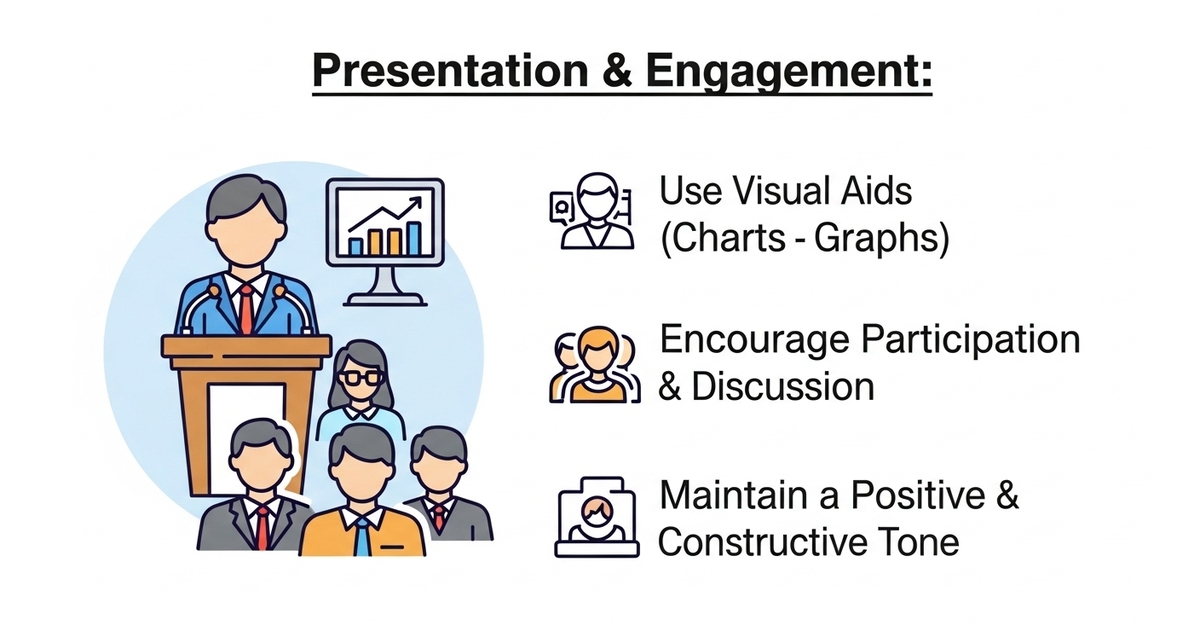
1. Send “Pre-Work” 3 Days Before Do not let people show up unprepared. Ask everyone to fill out a simple form: “Top 3 Wins, Top 3 Challenges, 1 Idea for next quarter.” This saves an hour of brainstorming during the meeting.
2. Get Off-Site (If Possible) There is magic in changing your environment. Go to a coffee shop, a rented meeting room, or even just a park. Getting away from the office distractions (and the printer noise) signals that this meeting is different.
3. No Laptops (Except the Scribe) Laptops are distraction machines. Ask everyone to close them. Use paper and pens. Eye contact builds trust. Have one person designated to take notes on a laptop, but everyone else stays analog.
4. Focus on “Who,” Not “How” When planning the next quarter, don’t get bogged down in how you will do everything. Focus on who is responsible for figuring it out. If you try to solve every problem in the room, you will never finish.
5. Schedule the Next One NOW Before you leave the room, put the next Quarterly Business Review on the calendar. Seriously. Do it now. If you don’t, 90 days will slip by again.
FAQ: Common QBR Questions
Q: Who should I invite?
A: Keep it small. Your leadership team or key decision-makers. If you have more than 5-6 people, it becomes a lecture, not a discussion. If you are a solopreneur, invite a mentor or a business peer to hold you accountable.
Q: What if we missed all our goals last quarter?
A: Be honest about it. Was the goal unrealistic? Did you lose focus? Or did the market change? Use the QBR to reset expectations, not to beat yourself up.
Q: How detailed should the plan be?
A: The 90-day goals should be clear (SMART goals). The weekly tactics can be flexible. You need a compass, not a turn-by-turn GPS for every single day.
The Bottom Line
A Quarterly Business Review is the difference between working in your business and working on your business.
It’s a discipline. It’s hard to stop the machine for half a day to check the engine. But if you don’t, you risk driving 100 miles in the wrong direction.
So, look at your calendar. Find a 4-hour block in the next two weeks. Send the invite. And get ready to take control of your quarter.
Ready to set better goals? Once you have run your Quarterly Business Review, you’ll need a framework to track your progress. Check out our guide on setting OKRs for small business to turn your quarterly plan into weekly wins.