Built to Sell: Why You Need an Exit Strategy Even If You Don’t Plan to Leave Yet.
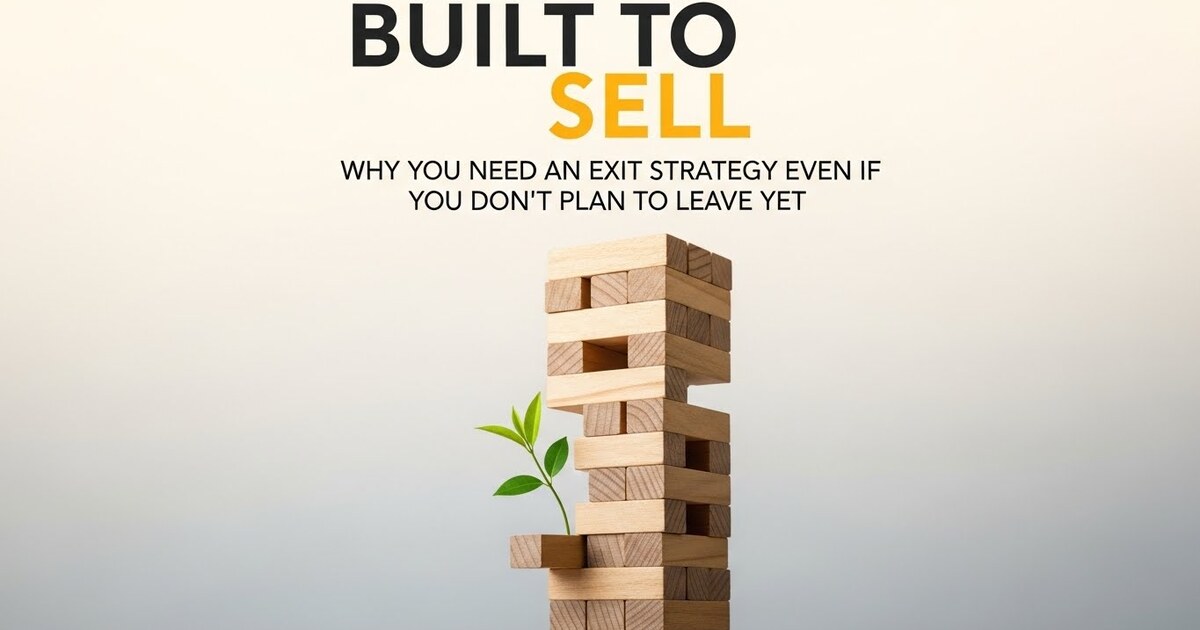
There is a dangerous myth in the world of entrepreneurship. It whispers that an “Business Exit Strategy” is something you create six months before you retire. It suggests that if you love your business and plan to run it for the next 20 years, you don’t need to worry about selling.
This myth is the reason thousands of successful founders find themselves trapped in a “high-paying prison” of their own design.
They have built a business that relies entirely on them. They are the rainmaker, the chief firefighter, and the final decision-maker. If they step away for a month, the business crumbles. While this might stroke the ego, it destroys value.
Here is the counter-intuitive truth: The things that make a business valuable to a buyer are the exact same things that make a business fun to own.
Building a business that is “Built to Sell” does not mean you have to sell it. It means you have the option to sell it. That option is the ultimate form of freedom. This guide explores why treating your company like a product to be sold is the single best operational strategy you can adopt today.
I. The “Owner’s Trap”: Why Most Businesses Are Worthless
Let’s start with a brutal reality check. According to the Exit Planning Institute, nearly 80% of businesses put on the market never sell.
Why? Because they aren’t businesses; they are jobs.
When a professional investor or a strategic acquirer looks at a company, they are looking for an asset that generates cash flow without the current owner. If the revenue stops when you go on vacation, you don’t have a business; you have a practice.
The Hub-and-Spoke Problem
In many small businesses, the owner is the “Hub.” Every decision, every client relationship, and every technical problem travels through them (the “Spokes”).
- The Risk: If the Hub gets sick, burned out, or hit by a bus (the morbid but famous “Bus Test”), the wheel collapses.
- The Valuation: Buyers discount “Hub-and-Spoke” businesses heavily. They know that once you leave, the customers might leave too.
The Paradox of Importance
Most entrepreneurs derive their self-worth from being indispensable. “My clients only want to talk to me.” “Nobody else knows how to handle the legacy code.” While this feels good, it is a financial liability. To build a sellable asset, you must systematically fire yourself from every job in the company.
II. The “Built to Sell” Philosophy: 3 Pillars of Transferable Value
To shift from a “Lifestyle Business” to a “Value Asset,” you need to focus on what M&A (Mergers and Acquisitions) experts call Transferable Value. This is value that exists independently of you.
It rests on three pillars:
1. Process (The Playbook)
If your business operations exist in your head, they cannot be sold. You cannot sell your brain. You can only sell a system.
- The Goal: Every repetitive task from answering the phone to manufacturing the widget must be documented in a Standard Operating Procedure (SOP).
- The Test: Can a new hire with average skills achieve an excellent result by following your instructions without asking you a question?
- The Result: A buyer sees a “Turnkey Operation.” They aren’t buying a mystery; they are buying a machine that prints money.
2. People (The Management Team)
A sellable business has a “Second Layer” of management.
- The Goal: You need a lieutenant (or a team) who can make decisions. If you are the only one who can sign a check or authorize a refund, you are the bottleneck.
- The Test: Take a 4-week vacation without checking email. If the revenue is the same (or higher) when you return, you have passed.
- The Result: This proves to a buyer that the “brain” of the company remains even after the founder exits.
3. Profit (The Quality of Revenue)
Not all revenue is created equal.
- Bad Revenue: One-off projects. “Eat what you kill.” Highly customizable work that requires the owner’s genius.
- Good Revenue: Recurring contracts. Subscriptions. Standardized products.
- The Goal: Shift your business model toward recurring revenue. A buyer will pay 5x-10x more for $1M of recurring revenue than for $1M of one-off project revenue.
III. The “Teachable” Product: Why Customization Kills Valuation
One of the hardest pills for service providers to swallow is the need to standardize.
You might pride yourself on being a “Jack of all trades” who can solve any problem for any client. But customization is the enemy of scale. Customization requires high-level expertise (usually yours) to execute.
The “Productization” Strategy
To build to sell, you must narrow your focus.
- Instead of being a “Marketing Agency” that does SEO, Billboards, and TV Ads, be the “SEO Agency for Dentists.”
- Why?
- It is teachable: You can train junior employees to do one specific thing perfectly.
- It is scalable: You can replicate the process a thousand times.
- It is defensible: You become the world expert in that niche.
The Valuation Impact: A specialized agency with a repeatable process might trade at 8x EBITDA (Earnings Before Interest, Taxes, Depreciation, and Amortization). A generalist agency might trade at 3x EBITDA. The difference is in the reliability of the future cash flow.
IV. Reducing Customer Concentration: The 15% Rule
Imagine you have a loyal client who accounts for 40% of your revenue. You love them. They pay on time. They invite you to their Christmas party. To a buyer, this client is a terrifying risk.
The Concentration Discount
If that client leaves, your business collapses. Therefore, a buyer will look at your 40% concentration and demand a massive discount on the purchase price (or an “Earn-out” where you only get paid if that client stays for 3 years).
The Rule: No single customer should account for more than 15% of your gross revenue.
- If you have a “Whale” client, your number one strategic priority this year should be to aggressively acquire smaller clients to dilute the Whale’s percentage.
V. The Financial Hygiene: Stop “Living Out of the Business”
Small business owners often treat their company bank account like a personal piggy bank. They run personal cars, family vacations, and country club memberships through the business to reduce taxable income.
While this saves you tax dollars today, it costs you millions tomorrow.
The “Add-Back” Battle
When you sell, you will try to tell the buyer, “Oh, ignore that expense, that was my personal car.” Sometimes they will accept it (these are called “Add-backs”). But often, they will view your books as messy and untrustworthy.
The Strategy: Two years before you even think about selling, clean up your books.
- Get a real CFO or a high-level CPA.
- Move to accrual-based accounting (GAAP compliant).
- Stop running personal expenses through the P&L.
- Why? Clean, audited financials signal professional management. It builds trust, and trust increases the multiple a buyer is willing to pay.
VI. Why “Ready to Sell” Means “Better to Keep”
Let’s go back to the premise: You don’t want to leave yet. Why go through all this trouble?
Because a business that is “Built to Sell” is a joy to own.
1. You Get Your Life Back When you build SOPs and hire a management team, you stop working 60-hour weeks. You can attend your child’s soccer game without checking Slack. You achieve “Time Freedom.”
2. You Make More Money Scalable, standardized businesses are more profitable. By firing yourself from the $20/hour tasks, you can focus on the $500/hour strategic tasks (or just relax).
3. You Have Security If you get sick, the business pays you. If the market shifts, you have cash reserves (because you built a profitable machine). You are no longer living on the edge.
4. You Have Leverage When you don’t need to sell, you are the most dangerous negotiator in the room. If a Private Equity firm offers you a lowball price, you can laugh and say, “No thanks, I’m making $500k a year working 10 hours a week. Why would I sell?” This leverage is usually what forces the buyer to offer the “godfather offer” you can’t refuse.
VII. The Types of Exits (It’s Not Just Selling to Strangers)
Exit planning isn’t just about selling to a competitor. Once you have a valuable asset, you have a menu of options:
1. The Internal Sale (MBO)
Management Buy-Out. You sell the company to your key managers. They usually don’t have the cash, so you finance it (they pay you out of future profits). This preserves your legacy and rewards your team.
2. The ESOP (Employee Stock Ownership Plan)
You sell the company to a trust owned by the employees. This has massive tax benefits in the US and creates a culture of ownership.
3. The Private Equity Recap
You sell 60% of the business to a PE firm, take millions of dollars “off the table” (into your personal bank account), but stay on as CEO with 40% equity. This is “taking two bites of the apple.”
4. The Strategic Sale
Selling to a competitor or a large company in your industry. These buyers usually pay the highest price because they can realize “synergies” (e.g., selling your product to their massive customer list).
Conclusion: Start Packing Your Parachute
You do not buy insurance after the house catches fire. You do not build an exit strategy after you burn out or get a terminal diagnosis.
Building a sellable business takes time usually 2 to 3 years of deliberate restructuring.
Start today. Look at your To-Do list. Which of these tasks can only be done by you? Which of these tasks are undocumented? Pick one. Write the process down. Train someone else to do it. You just increased the value of your company.
Whether you sell in 2026, 2036, or pass it down to your children, the discipline of “building to sell” is the discipline of building a great company. It transforms your business from a demanding toddler that needs constant attention into a mature, independent adult that supports you.