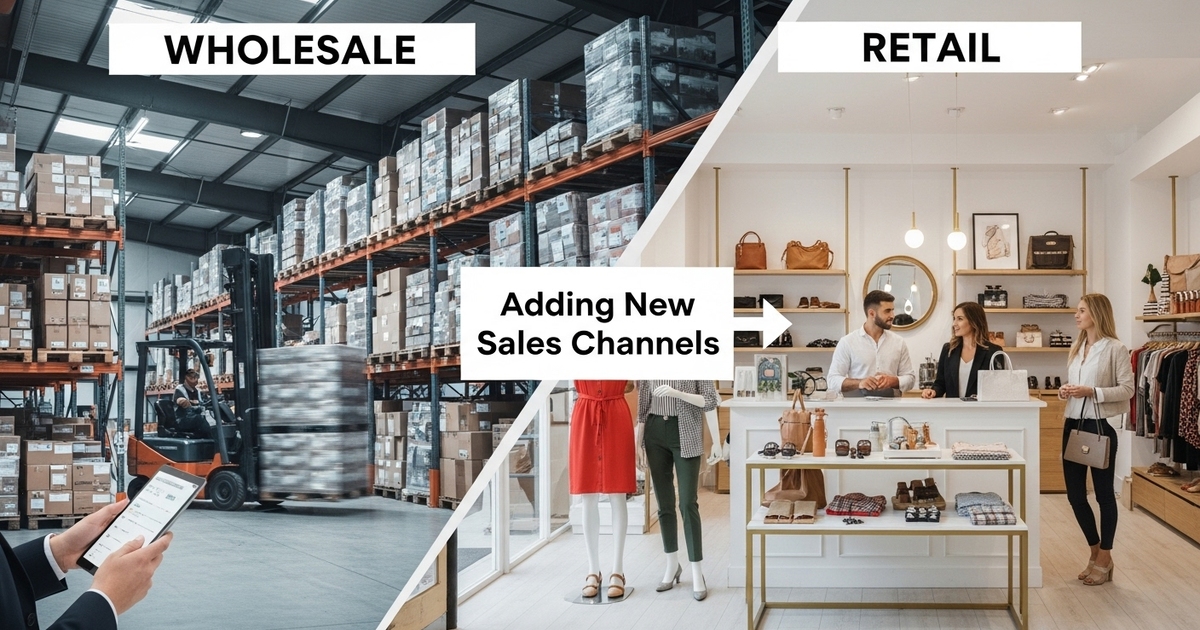
Wholesale vs. Retail: Adding New Sales Channels
You have a product. People love it. You are making sales.
But now you are hitting that inevitable ceiling. You are packing boxes until 2 AM, your ads are getting more expensive, and you are wondering, “How do I get to the next level?”
This is the crossroads where every product business eventually stands: Wholesale vs. Retail.
Do you double down on selling directly to your customers (Retail/DTC), keeping all the profit but doing all the work? Or do you start selling in bulk to other stores (Wholesale), taking a smaller cut but moving massive volume?
It feels like a simple math problem, but it’s actually an identity crisis.
Choosing the wrong path can wreck your cash flow, dilute your brand, and leave you with a warehouse full of inventory you can’t move. I have seen businesses explode (in a good way) by getting into Target, and I have seen others go bankrupt trying to fulfill that same order.
Let’s break down the real differences—beyond just the margins—so you can decide which channel deserves your energy right now.
The “Margin” Myth
Let’s get the money talk out of the way first.
In Retail (DTC), you sell a widget for $100. You keep $100. In Wholesale, you sell that same widget to a shop for $50. They sell it for $100. You keep $50.
On paper, Retail looks like the winner. Why would you give away half your money?
But that “$100” in retail isn’t really $100. You have to subtract credit card fees, shipping costs, packaging, returns, and—the big one—marketing. If it costs you $40 in Facebook ads to acquire that customer, your real take-home is $60.
In Wholesale, you don’t pay for ads. You don’t pay for shipping to individual houses. You ship one big pallet to a retailer, and they do the work of finding the customer.
Suddenly, that $50 vs. $60 gap doesn’t look so scary. Wholesale is about volume and simplicity. Retail is about margin and control.
Deep Dive: The Retail (Direct-to-Consumer) Path
This is the modern default. You build a Shopify store, run ads, and own the relationship.
The Pros:
- Data: You know exactly who your customer is. You have their email. You can upsell them later.
- Speed: You can launch a new product tomorrow. You don’t have to ask a buyer for permission.
- Brand Control: You control the unboxing experience, the customer service, and the story.
The Cons:
- The Treadmill: You have to fight for every single sale. If you turn off your ads, revenue stops.
- Logistics: Shipping 1,000 individual packages is infinitely harder than shipping 10 cartons.
- Customer Service: You deal with every complaint, every lost package, and every return.
Deep Dive: The Wholesale Path
This is the traditional scaler. You get your product onto shelves (digital or physical) where customers are already shopping.
The Pros:
- Volume: One purchase order (PO) from a mid-sized retailer can equal three months of your DTC sales.
- Credibility: Being “Sold at Nordstrom” or “Available at Whole Foods” gives your brand instant legitimacy.
- Cash Flow (Eventually): Once you establish relationships, orders become predictable. You can plan your inventory better.
The Cons:
- Payment Terms: This is the killer. Retailers often pay “Net 30” or “Net 60.” That means you ship the product today, but you don’t get paid for two months. You are effectively lending them money.
- Loss of Control: You don’t know who bought your product. You can’t email them. If the retailer displays your product messily, your brand suffers.
- The “Chargeback” Game: Big retailers have strict rules. If you put the label in the wrong spot, they fine you. It’s brutal.
Which One Fits Your Stage?
You don’t have to pick just one forever. But you should pick one to master first.
Choose Retail/DTC if:
- You are still figuring out your product-market fit. You need feedback fast.
- Your margins are thin (under 50%). You literally cannot afford to sell wholesale.
- You have a strong content/social media game and can acquire customers cheaply.
Choose Wholesale if:
- You have a manufacturing capacity that is sitting idle. You need to move units.
- Your product is an “impulse buy” that works better on a physical shelf than a website.
- You have enough cash to fund inventory upfront and wait 60 days to get paid.
Actionable Tips for Entering Wholesale
If you decide to take the plunge into wholesale, don’t just email Walmart. Start small.
1. Create a “Line Sheet” This is your wholesale menu. It needs to look professional. Product photos, wholesale pricing, minimum order quantities (MOQ), and terms. Don’t send a messy email; send a polished PDF.
2. Start with Boutiques Local, independent shops are the best training ground. They usually pay faster (sometimes on delivery!), they are forgiving of small mistakes, and they will give you honest feedback on packaging.
3. Attend a Trade Show (or Stalk One) Trade shows (like NY NOW or Magic) are expensive. Before you buy a booth, just walk the floor. See what competitors are doing. See how buyers interact.
4. Protect Your Margins Do not offer wholesale pricing that bankrupts you. A standard rule of thumb is: Cost to Make: $5 Wholesale Price: $10 (2x cost) Retail Price: $20 (4x cost / 2x wholesale) If your math doesn’t work, you aren’t ready for wholesale.
The Hybrid Model: The Holy Grail
The most resilient businesses do both. They use Wholesale to build brand awareness and move volume, which lowers their manufacturing costs. Then, they use Retail/DTC to capture high-margin sales and build a community.
It’s called “Omnichannel,” and it’s the future.
But don’t try to be omnichannel on Day 1. Nail one channel. Build the systems. Then, and only then, expand to the next.
The Bottom Line
Adding a sales channel isn’t just “more sales.” It’s a new business model.
Wholesale requires you to be a logistics company. Retail requires you to be a media company.
Look at your team. Look at your bank account. Look at your patience. Which game are you better equipped to play right now?
Pick a lane, dominate it, and then—when you are ready—open the next door.
Ready to manage the cash flow gap? Wholesale orders are great, but waiting 60 days for payment is hard. Check out our guide on cash flow forecasting to ensure you can survive the wait.