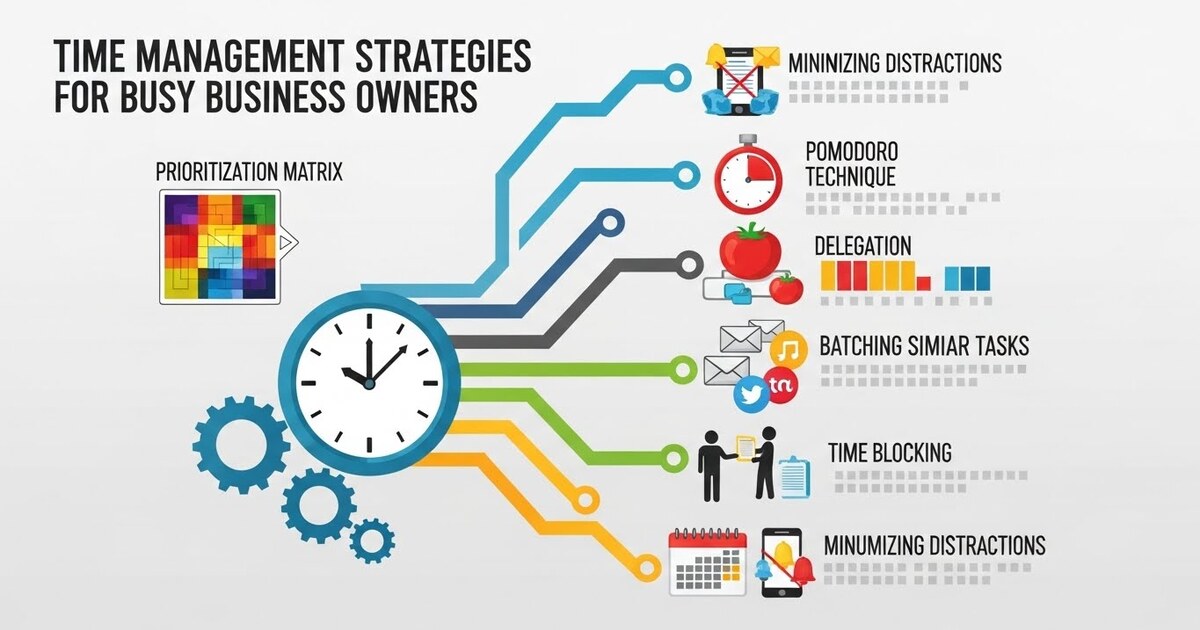
Time Management Strategies for Busy Business Owners
For the business owner, time is not merely a resource; it is the very currency of creation, decision, and growth. Yet, it is a currency that feels perpetually devalued, slipping through fingers pulled in a dozen directions at once. The inbox pings, the phone rings, an employee has a question, a client needs reassurance, and the strategic work the work that truly moves the needle is perpetually relegated to “later.” This state is not a badge of honor, but a systemic failure of personal governance. The busyness is real, but it is often a sign of being reactive, not proactive. The path forward, therefore, is not about finding more hours a futile quest but about exercising absolute sovereignty over the minutes you have. It is about shifting from being a servant of the urgent to becoming the architect of your own focused energy. This requires not just tips, but a fundamental philosophy and a set of strategic disciplines designed to protect your attention, your most sacred business asset.
The Foundational Audit: Understanding Your Time Currency
Before you can manage time, you must first understand where it goes. Most business owners operate on perception, not data. The first, non-negotiable strategy is to conduct a Time Audit. For one standard workweek, track your time in fifteen or thirty minute increments. Use a simple notebook, a spreadsheet, or a time tracking app. Categorize each block: Client Work, Administrative Tasks, Team Management, Strategic Planning, Marketing, Interruptions, etc.
The results are often illuminating. You may discover that what you believed was two hours of strategic work per day is, in reality, twenty minutes fractured across the day. You might find that “quick” administrative tasks consume an entire afternoon. This audit is not about judgment; it is about intelligence gathering. It reveals the leaks in your reservoir. It shows you the difference between what is urgent (loud, demanding immediate attention) and what is important (quiet, moves the business forward). This data forms the bedrock of all effective strategies to come, moving you from a vague feeling of being overwhelmed to a clear map of where your sovereignty is being surrendered.
The Cornerstone Strategy: The Themed Day Architecture
The greatest enemy of deep work is context switching. Every time you shift from a creative task to a managerial one to a financial review, your brain pays a “switching tax,” losing focus and efficiency. The most powerful defense is to stop scheduling tasks and start scheduling types of thinking.
This is the Themed Day strategy. Instead of a chaotic daily to do list with every type of task, you dedicate each day of the week to a core pillar of your business. For example:
- Monday: Leadership and Planning. This day is for setting the week’s vision, analyzing key metrics, and working on the business. Hold your team meetings, review financials, and map out quarterly goals.
- Tuesday: Deep Creation and Development. This is for uninterrupted work on your core product or service. Writing, designing, developing, or strategizing for key clients. Communications are minimized.
- Wednesday: External Focus and Marketing. Dedicate this to client meetings, sales calls, partnership conversations, and focused marketing activities like content creation or campaign analysis.
- Thursday: Operations and Administration. Process invoices, refine systems, update documentation, handle legal or logistical matters, and tackle the necessary but non creative glue that holds the business together.
- Friday: Growth and Learning. Review the week, clean loose ends, invest in professional development, and experiment with new ideas. This is a lighter day focused on reflection and future oriented thinking.
The power of this architecture is profound. It reduces daily decision fatigue (you know what “type” of day it is), allows you to enter the appropriate mental state more deeply, and sends clear signals to your team about your availability. It transforms your calendar from a battleground of competing priorities into a structured sanctuary for different kinds of work.
The Discipline of Defense: Batching and Time Blocking
Within your themed days, you must protect your focus from the constant siege of small tasks. This is done through two intertwined disciplines: batching and time blocking.
Batching is the practice of grouping similar, small tasks together and doing them in a single, dedicated session. Instead of checking and responding to emails ten times a day, you schedule two or three specific “email batches.” You do the same for returning phone calls, reviewing reports, or processing paperwork. This prevents these tasks from acting as constant interruptions throughout your day, preserving long stretches for concentrated effort.
Time Blocking is the act of translating your priorities into non negotiable appointments on your calendar. You do not leave your most important work to chance. If Tuesday is Deep Creation day, you block out 9 AM to 12 PM as “Product Development Project Alpha.” You treat this block with the same respect as a meeting with your most important client. It is scheduled, it has a purpose, and it is not to be moved except for true emergencies. You time block your batches as well: “Email Process: 4 PM to 4:30 PM.” Your calendar becomes your command center, a visual representation of your intentional plan, not just a record of external demands.
The Art of Strategic Neglect: Delegation and Elimination
A business owner cannot and should not do everything. Holding onto tasks out of habit, perfectionism, or a misplaced sense of control is a direct theft from your strategic time bank. You must become adept at the art of strategic neglect.
First, eliminate. Review your Time Audit and ask of every recurring task: “Does this need to be done at all?” Many reports, meetings, and processes continue out of inertia. Have the courage to stop doing what no longer serves the business’s core goals.
Second, systematize. Can the task be turned into a documented process? If so, create a clear standard operating procedure (SOP). This is a form of delegation to the system itself, ensuring consistency and freeing you from being the sole source of knowledge.
Third, delegate. This is the most critical lever for scaling your time. For any task that must be done but does not require your unique skill set, ask: “Who else can do this?” Effective delegation is not dumping; it is the clear transfer of responsibility and authority. Provide context (“This is why this task matters”), resources, and the “what good looks like” standard, then let go. Use tools like shared project boards (Trello, Asana) so you can monitor progress visually without needing status update meetings. Delegation multiplies your effectiveness and develops your team’s capabilities.
The Technology of Attention: Managing Tools Before They Manage You
Technology promises efficiency but often delivers fragmentation. Your devices and applications are engineered to capture attention. You must engineer your own countermeasures.
Begin with notification triage. Turn off every non essential notification on your phone and computer. The default setting for most apps is “interrupt me.” Change it to “I will decide when to engage.” Batch checking communication, as outlined above, is only possible if you are not a slave to the ping.
Next, curate your digital workspace. Have a single, clean homepage for your browser that opens to your primary work dashboard, not a news site. Use browser tab management extensions to prevent tab overload. The goal is to reduce digital clutter, which directly contributes to mental clutter.
Finally, embrace single tool dominance where possible. Resist the urge to use five different apps for similar functions. Choose one primary tool for communication (e.g., Slack), one for project management (e.g., ClickUp), and one for documentation (e.g., Google Workspace). Master them. This reduces the cognitive load of switching contexts and learning new interfaces, preserving mental energy for substantive work.
The Rhythm of Renewal: The Non Negotiable Pause
Perhaps the most overlooked strategy is the intentional pause. The business owner’s mind is a high performance engine; it cannot run at redline indefinitely without failure. Scheduling downtime is not a luxury; it is a strategic performance enhancer.
This includes micro pauses throughout the day. The Pomodoro Technique, working in focused 25 minute sprints followed by a 5 minute break to stand, stretch, and look away from a screen, combats mental fatigue. It respects the brain’s natural attention rhythms.
It also includes macro pauses. Defend your nights and weekends with vigor. The world’s most pressing business problem will almost always look different after a full night’s sleep. Schedule time for hobbies, family, and pure idleness. This is not lost time; it is the incubation period where subconscious connections are made, creativity is restored, and resilience is built. A perpetually exhausted leader makes poor decisions. A renewed leader sees opportunities and solutions.
The Weekly Review: The Command and Control Session
All these strategies are integrated and reinforced in one weekly ritual: The Weekly Review. This is a sacred, 60 to 90 minute block, ideally on Friday afternoon or Monday morning. In this session, you:
- Process and Clear: Empty your inbox, your notebook, and your mind. Capture every lingering task into your master system.
- Review and Reflect: Look at your past week’s calendar and time tracking. What went well? Where did your plan fall apart? What did you learn?
- Plan and Prioritize: Look at the upcoming week. Set your 3-5 most important priorities. Align them with your Themed Day architecture and time block them into your calendar first, before anything else can intrude.
- System Check: Ensure your delegation systems are running smoothly. Check in on delegated tasks via your project board without micromanaging.
This ritual closes the loop on the past week and sets a confident, intentional course for the next. It prevents small tasks from becoming emergencies and ensures you are consistently steering the business toward your long term vision, not just reacting to its immediate demands.
Becoming the Sovereign
Time management for the business owner, therefore, is ultimately about reclaiming sovereignty. It is the deliberate practice of saying “no” to the unimportant so you can thunderingly say “yes” to the vital. It is the courage to structure your days around your energy and priorities, not the whims of others. It is the wisdom to know that your attention is the most valuable input your business has, and it must be guarded with fierce intention.
By implementing these strategies auditing, theming, batching, delegating, curating technology, pausing, and reviewing you move from a state of reactive busyness to one of proactive leadership. You stop being a passenger in your own business, frantically putting out fires, and become its pilot, navigating deliberately toward the horizon you choose. Your minutes cease to be something that happens to you and become the very substance with which you build your legacy.