Unlocking LTV: 5 Strategies to Double Your Customer Lifetime Value
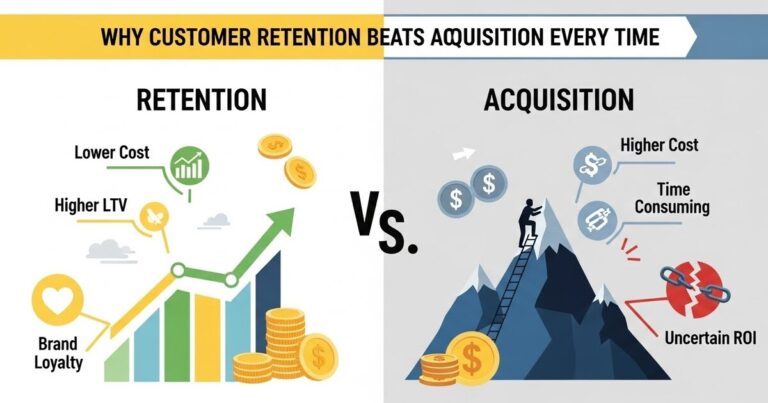
In the high-stakes world of modern business, there is an obsession with the “new.” New leads. New clicks. New signups. New logos.
Companies pour millions into Facebook Ads, Google Search, and influencers, celebrating every time the “Customer Acquisition Cost” (CAC) stays within budget. But while acquisition captures the headlines, retention captures the profits.
The most dangerous trap for a growing company is the “Acquisition Treadmill.” This is where you run faster and faster spending more on ads just to replace the customers flowing out the back door without ever actually gaining ground.
The metric that breaks this cycle is LTV (Customer Lifetime Value).
LTV is not just a vanity metric; it is the north star of profitability.1 It tells you exactly how much a customer is worth to you from the first “hello” to the final “goodbye.”
- If your LTV is low, your business is fragile. You are at the mercy of ad algorithms.
- If your LTV is high, you are invincible. You can afford to outspend your competitors on acquisition because you know you will make that money back ten times over on the backend.
Doubling your LTV is not about finding a “hack.” It is about systematically pulling three specific levers: Frequency (how often they buy), Monetary Value (how much they spend), and Recency/Retention (how long they stay).
This guide provides the blueprint to unlock the hidden gold mine in your existing customer base.
I. The Anatomy of LTV: Understanding the Levers
Before we fix it, we must define it. Many businesses vaguely assume LTV is “total revenue divided by customers.” While true, that is too broad to be actionable.
To double LTV, you must understand the components:
$$LTV = (\text{Average Order Value} \times \text{Purchase Frequency}) \times \text{Customer Lifespan}$$
To double the result, you don’t need to double one variable (which is hard). You just need to incrementally improve all three.
- Increase AOV by 25%.
- Increase Frequency by 25%.
- Increase Lifespan by 25%.
- Result: Your LTV nearly doubles ($1.25 \times 1.25 \times 1.25 = 1.95$).
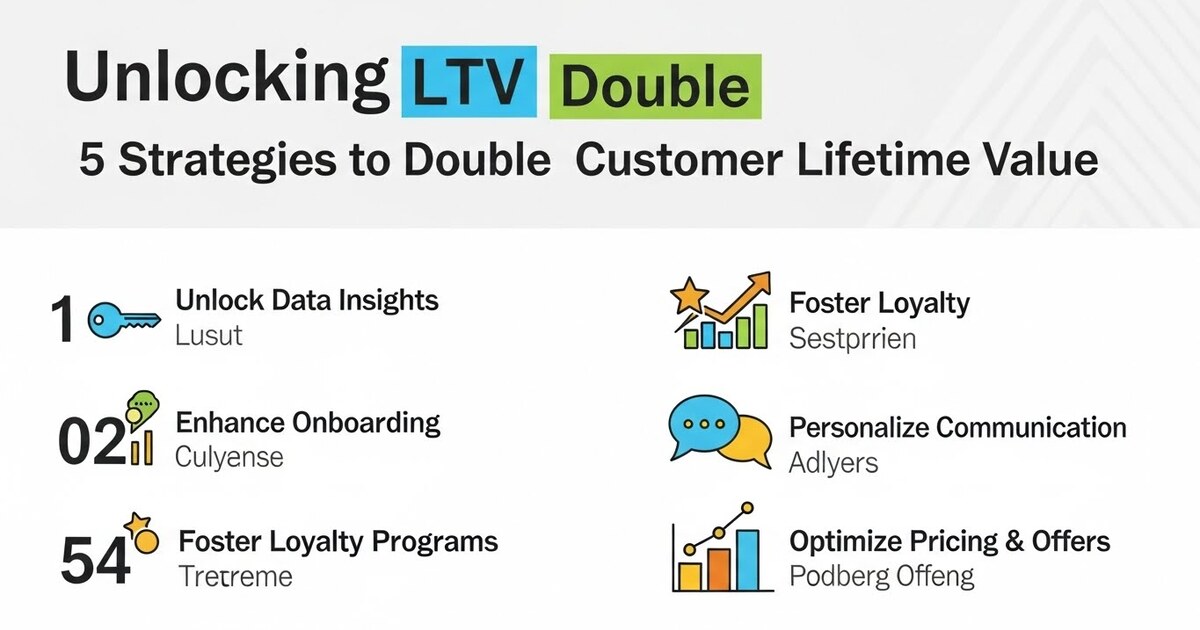
Here are the five strategies to move these needles.
Strategy 1: The “First 90 Days” Optimization (Fixing Time-to-Value)
The seeds of churn are planted early. Most customers who leave don’t leave because the product broke in Year 2; they leave because they never fully understood how to use it in Week 1.
This is the concept of Time to Value (TTV). How quickly does your customer experience that “Aha!” moment where they realize your product was worth the money?
The “Velvet Rope” Onboarding
If you treat a new customer like a transaction, they will treat you like a vendor. If you treat them like a VIP, they become a partner.
- SaaS: Do not just send a “Verify your email” link. Trigger a guided tour that forces them to complete the one core action that correlates with retention (e.g., for Dropbox, it was “upload one file”).
- E-commerce: The experience isn’t over when they click buy; it’s over when they unbox. Invest in the “Unboxing Experience.” A generic brown box screams commodity. A branded box with a personalized “Thank You” note screams brand.
The Actionable Tactic: Implement a “30-Day Check-in” that is purely human (or looks like it).
- Email Subject: “One quick question, [Name]…”
- Body: “Hey, you’ve been with us for a month. I’m not trying to sell you anything. I just want to know: What is the one thing we could do better?”
- Why it works: It catches dissatisfaction before it becomes a cancellation.
Strategy 2: RFM Segmentation (Stop Treating Everyone the Same)
The biggest mistake in retention marketing is “Batch and Blast.” Sending the same 20% OFF coupon to your best customer (who would have paid full price) and your worst customer (who only buys on discount) is burning money.
To double LTV, you must use RFM Analysis:
- Recency: When was the last time they bought?
- Frequency: How often do they buy?
- Monetary: How much do they spend?
The “Champion” Strategy (High R, High F, High M)
These are your top 5%.
- Goal: Make them feel special.
- Tactic: Give them early access to new products. Invite them to a private Slack group or focus group. Do not send them discounts; send them exclusivity.
The “At-Risk” Strategy (Low R, High F, High M)
These were great customers who haven’t bought in a while. They are drifting away.
- Goal: Reactivation.
- Tactic: This is where you use the heavy artillery. A steep discount, a “We miss you” gift, or a personal phone call. You have already paid to acquire them; spending margin to win them back is cheaper than finding a new one.
Strategy 3: The Value Ladder (Systematic Expansion)
Increasing Average Order Value (AOV) is the fastest way to spike LTV because it requires zero extra shipping or acquisition effort.
However, simply asking “Do you want fries with that?” is annoying. You need to build a Value Ladder a logical progression of products that solves the next problem the customer faces.
Cross-Selling vs. Upselling
- Upsell: Buying a better version of the same thing (iPhone 15 -> iPhone 15 Pro).
- Cross-sell: Buying a related item (iPhone -> AirPods).
The “Next Logical Step” Automation
Map out your customer journey.
- Scenario: A customer buys a high-end camera from your store.
- Wrong Move: Emailing them next week with a discount on… another camera.
- Right Move: Emailing them next week with a guide on “Portrait Photography” and a link to your best Portrait Lens.
- Month 2: They have the lens. Now they need a Tripod.
- Month 3: They have the gear. Now they need a Camera Bag.
The Actionable Tactic: Use your CRM to trigger post-purchase flows based on the category of item purchased, not just a generic newsletter.
Strategy 4: Manufacture Habit (The Subscription Shift)
The holy grail of LTV is recurring revenue. If you have to fight for every single transaction, your LTV will always be capped by your marketing budget. If the transaction happens automatically, LTV becomes infinite (until churn).
But what if you aren’t a SaaS company? What if you sell coffee, soap, or consulting?
The “Subscribe & Save” Model
Amazon mastered this. Anything consumable should have a subscription option.
- Incentive: Offer 10-15% off for subscribing.
- Psychology: You are selling convenience, not just savings. The customer doesn’t want to run out of coffee on a Tuesday morning. You are solving that anxiety.
The Membership Model (Community as a Moat)
If your product isn’t consumable (e.g., clothing), create a membership.
- Example: Restoration Hardware (RH) charges a yearly fee for their membership.3 In exchange, members get 25% off everything.
- The Math: Members pay the fee to get the discount, but because they paid the fee (Sunk Cost Fallacy), they buy exclusively from RH to maximize their savings. Their LTV skyrockets compared to non-members.
Strategy 5: Proactive Churn Defense (Closing the Back Door)
You can pour water into the bucket all day, but if there is a hole in the bottom, you will never reach high LTV.
There are two types of churn, and you need a strategy for both.
1. Involuntary Churn (The “Technical” Fail)
This happens when a credit card expires or a payment fails. It is tragic because the customer wanted to stay.
- The Fix: Use a “Dunning Management” tool (like Churn Buster or Baremetrics). These tools automatically retry cards at smart times and send polite emails asking to update billing info.
- Impact: This alone can recover 20-30% of lost revenue immediately.
2. Voluntary Churn (The “I Quit” Button)
This is when the customer clicks cancel.
- The Fix: The “Exit Offer.”
- When they click cancel, do not just let them go. Present a modal: “Is it too expensive? Pause for 3 months instead.”
- Or: “Stay for one more month at 50% off.”
- Many customers don’t want to leave forever; they just have a cash flow issue right now. A pause option saves the LTV.
VI. Measuring the Success: LTV:CAC Ratio
As you implement these strategies, how do you know if you are winning? You track the LTV:CAC Ratio.
$$\text{Ratio} = \frac{\text{Lifetime Value}}{\text{Customer Acquisition Cost}}$$
- 1:1 Ratio: You are losing money (after operating costs).
- 3:1 Ratio: This is the industry standard for a healthy business. For every $1 you spend on ads, you get $3 back over time.
- 5:1 Ratio: You are growing too slowly. You are so profitable per customer that you should likely spend more on marketing to capture more market share.
Cohort Analysis:
Do not just look at “Average LTV.” Look at LTV by Cohort (the month they signed up).
- Goal: You want to see that the “January 2025 Cohort” has a higher 6-month LTV than the “January 2024 Cohort.” This proves your retention strategies are actually improving the product value over time.
VII. Conclusion: Relationship Economics
Doubling your Customer Lifetime Value is not a marketing task; it is a business philosophy.
It requires shifting your focus from the “transaction” to the “relationship.” It requires realizing that the sale is not the finish line; it is the starting line.
When you invest in onboarding, personalization, and retention, you are building a financial fortress. While your competitors panic over rising ad costs, you can sit back, knowing that your existing customers are funding your growth, your innovation, and your profit.
Unlock the LTV, and you unlock the freedom to scale on your own terms.