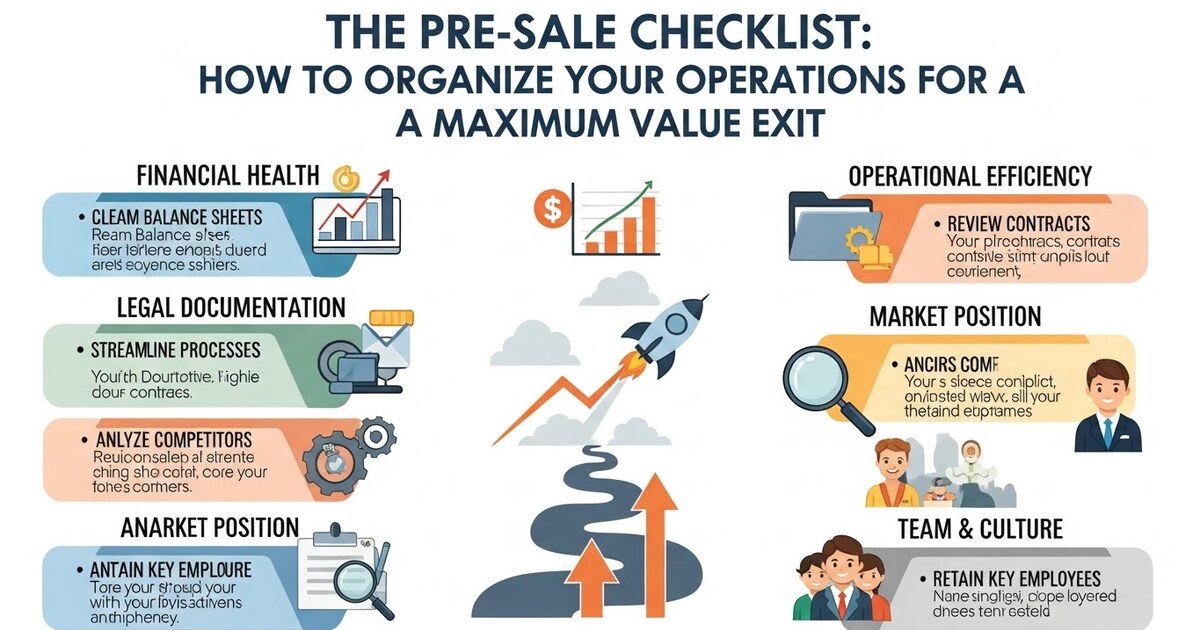
The Pre-Sale Checklist: How to Organize Your Operations for a Maximum Value Exit
The decision to sell your business is emotional. The process of selling it, however, is purely forensic.
When a potential buyer looks at your company, they are not just admiring the brand you built or the culture you fostered. They are deploying a team of accountants, lawyers, and consultants to tear your operations apart looking for risk. This process is called Due Diligence, and it is where deal value is destroyed.
Most founders wait until they have a Letter of Intent (LOI) to start organizing their house. This is a catastrophic mistake. If you wait until the buyer asks for a document to go find it, you have already lost leverage. Every delay signals incompetence. Every missing contract signals risk. Every “messy” financial month gives them ammunition to lower the price.
To get the “Maximum Value Exit”the kind where you sell at the top of the market multiple you must treat the preparation for the sale as a project in itself. You need to audit your own business before they do.
This guide is your operational roadmap. It is the comprehensive pre-sale checklist designed to transform your business from a “risky bet” into a “turnkey asset.”
I. Phase 1: Financial Hygiene (The Bedrock)
The first thing a buyer looks at is your Profit and Loss (P&L) statement. If they cannot understand your numbers in 5 minutes, they will assume you don’t understand your business.
1. Switch to Accrual Accounting
Many small businesses run on Cash Basis accounting (recording revenue when cash hits the bank) to save on taxes.
- The Problem: Cash basis makes revenue look “lumpy” and hides liabilities. Sophisticated buyers (Private Equity, Strategics) operate on Accrual Basis (recording revenue when it is earned).
- The Fix: Convert your books to GAAP-compliant accrual accounting at least 12–24 months before listing. This allows buyers to compare your performance apples-to-apples with other companies.
2. The “Quality of Earnings” (QofE) Pre-Audit
Do not wait for the buyer to run a Quality of Earnings report. Hire a third-party CPA firm to do a “Sell-Side QofE” first.
- Why? This audit validates your EBITDA (Earnings Before Interest, Taxes, Depreciation, and Amortization). It proves your revenue is real. A sell-side QofE is a “suit of armor” during negotiations. If a buyer challenges your numbers, you can point to the audit.
3. Clean Up the “Owner Lifestyle” Expenses
We all do it. The company car, the “business trip” to Hawaii, the country club membership.
- The Action: Stop running personal expenses through the business 12 months before the sale.
- The Alternative: If you can’t stop, document them meticulously as “Add-Backs.” Create a schedule showing exactly what these expenses are so they can be added back to the bottom line to show the “Adjusted EBITDA.”
Warning: If your Add-Backs are vague (e.g., “Miscellaneous Travel”), buyers will reject them. If they are clear (e.g., “Owner Personal Auto Lease – BMW X5”), they will accept them.
II. Phase 2: Operational Transferability (Removing the “You” Factor)
A business that relies on its owner to function is worthless. A business that operates independently of its owner is an asset.
1. The “Hit by a Bus” Manual (SOPs)
Does your office manager know how to run payroll? Does your sales lead know how to approve a quote?
- The Checklist: Ensure every critical function has a written Standard Operating Procedure (SOP).
- The Test: Pick a random process (e.g., “Customer Onboarding”). Ask a junior employee to execute it using only the documentation. If they fail, rewrite it.
2. Secure the Key Management Team
Buyers are often terrified that the management team will quit once the founder cashes out.
- Stay Bonuses: Implement “Stay Bonuses” for key lieutenants that pay out 6-12 months after the sale. This guarantees the buyer stability and increases their confidence in the deal.
- Non-Competes: Ensure your key staff have signed reasonable non-compete and non-solicitation agreements (where legal). A buyer will not buy a company if the Head of Sales can leave and take the client list across the street.
3. Diversify Customer Concentration
- The Red Flag: If one customer is >15% of revenue.
- The Fix: Spend the year before the sale aggressively acquiring smaller customers to dilute the “Whale.” If you can’t, prepare to accept an “Earn-out” structure on the deal to mitigate the buyer’s risk.
III. Phase 3: The Legal “Skeleton” Closet
Nothing kills a deal faster than a surprise lawsuit or a missing signature from three years ago.
1. Intellectual Property (IP) Assignment
This is a classic oversight. Did you hire a freelancer to design your logo or write your code 5 years ago?
- The Risk: Without a signed “IP Assignment Agreement,” that freelancer might technically own your copyright.
- The Fix: Audit every contractor and employee agreement. Ensure every line of code and every brand asset is explicitly assigned to the company.
2. Contract Transferability
Read the fine print of your biggest client and vendor contracts.
- Look for: “Change of Control” clauses.
- The Issue: Some contracts state that if the company is sold, the contract is void or requires client consent.
- The Fix: Renegotiate these clauses now, while you have leverage, rather than frantically asking clients for permission during the sensitive closing week.
3. Corporate Good Standing
It sounds basic, but ensure you are in “Good Standing” in every state where you operate. Pay the $50 annual franchise fees. Dissolve old entities you aren’t using. A buyer’s legal team will look up your status in every jurisdiction on Day 1.
IV. Phase 4: The Growth Story (Selling the Future)
You are selling the past (financials), but the buyer is buying the future (growth). You need to package your potential.
1. The Unlocked Opportunities
Create a strategic document listing specific growth levers you haven’t pulled yet.
- “We haven’t launched on Amazon yet.”
- “We haven’t expanded to the West Coast.”
- “We haven’t implemented email marketing automation.”
- Why: This shows the buyer “low hanging fruit.” It tells them, “I built the foundation; you can easily double the revenue by doing X, Y, and Z.”
2. The Pipeline Validity
If you are B2B, your CRM is your evidence.
- Clean up your Salesforce/HubSpot data. Remove “dead” leads from the forecast.
- A buyer will audit your sales pipeline. If they find it full of junk, they will discount your future revenue projections.
V. Phase 5: The Virtual Data Room (The VDR)
This is the tactical centerpiece of the sale. The VDR is the secure cloud folder where you put all your documents for the buyer to review.
Do not start building the VDR after you get an offer. Build it now.
Recommended VDR Folder Structure:
- Corporate: (Articles of Incorporation, Cap Table, Org Chart).
- Financials: (3 Years of Tax Returns, P&L, Balance Sheets, A/R Aging Reports).
- Legal: (Standard Client Contracts, Vendor Contracts, IP Registrations, Lease Agreements).
- Employee: (Anonymized Census, Benefits Plans, Org Chart, Handbook).
- Sales & Marketing: (Top 20 Customer List masked, Churn Data, CAC Metrics).
- Technology: (Software Licenses, IT Architecture Diagram, Disaster Recovery Plan).
The Psychological Advantage: When a buyer asks, “Can we see your employee handbook?” and you send them a link to a perfectly organized VDR folder within 10 minutes, you signal that you are a professional operation. This builds trust and speeds up the closing process.
VI. Conclusion: The “Ready for Sale” Mindset
The ultimate irony of the Pre-Sale Checklist is this: If you execute everything on this list, you might decide not to sell.
Why? Because a business with clean financials, independent operations, tight legal contracts, and a clear growth strategy is a joy to run. It prints money without the chaos.
But if you do decide to sell, this preparation is the difference between a “Fire Sale” price and a “Strategic Multiplier.”
Buyers pay for certainty. They pay for organization. They pay for a machine that works. The checklist above is how you build that machine. Start today. It will take longer than you think, but the ROI on this “admin work” will be the highest hourly rate you ever earn.