
Partnership Strategies: Joint Ventures and Strategic Alliances
You’ve probably heard the saying, “If you want to go fast, go alone. If you want to go far, go together.”
It’s a nice quote for a poster. But in business, I’d argue it’s slightly wrong. In business, if you want to go fast and far, you go with a partner who already has the map.
Most small business owners try to do everything themselves. We build our own audiences from scratch. We create every product in-house. We spend thousands on ads trying to find new customers one by one. It’s effective, but it’s slow. And frankly, it’s exhausting.
Imagine if, instead of fighting for every single lead, you could just open a door and find a room full of 10,000 people who are already perfect for your product. That is the power of Partnership Strategies.
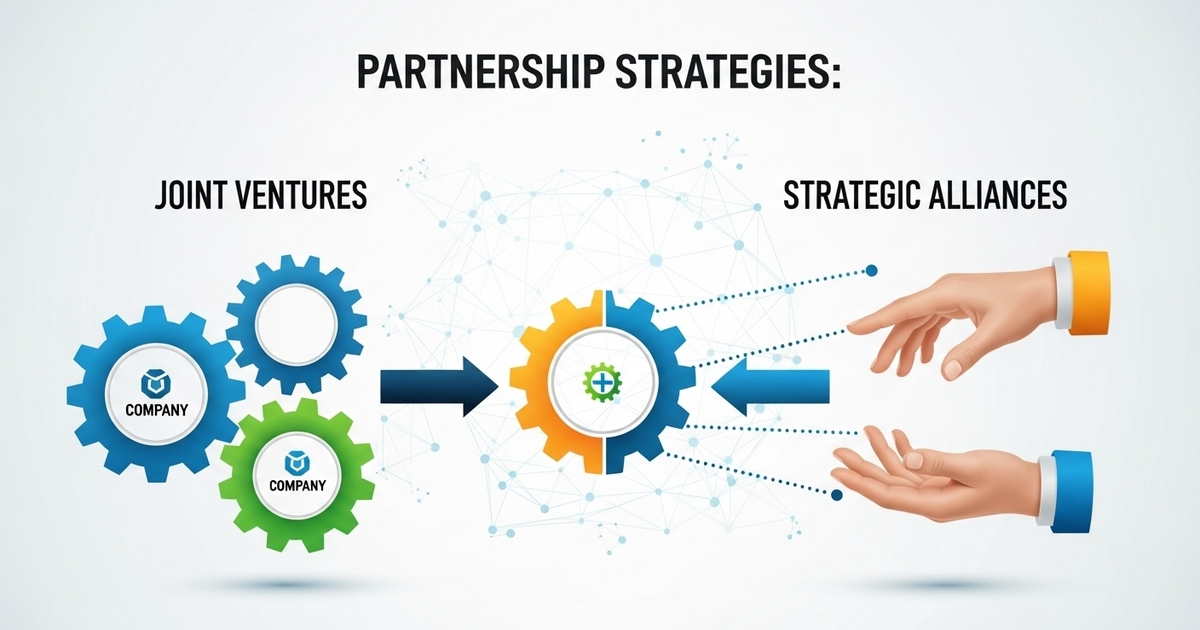
Specifically, Joint Ventures (JVs) and Strategic Alliances are the growth hacks that big corporations use all the time, but small businesses often ignore. They are the fastest way to borrow trust, access new markets, and double your reach without doubling your budget.
If you are tired of the “slow grind” of organic growth, it’s time to stop playing solo and start building alliances.
The “Zero-Sum” Mindset
Why don’t more small businesses partner up? Usually, it’s because we view other businesses as competition, not collaborators. We hoard our customers like dragons hoarding gold.
“If I promote their product, my customers will spend money with them instead of me!”
This is the zero-sum mindset, and it kills growth. The reality is that your customers buy from dozens of businesses. They buy coffee, and software, and consulting, and shoes. Introducing them to a great partner doesn’t make them leave you; it makes them trust you more because you solved a problem for them.
When you shift from “protecting your slice” to “growing the pie,” everything changes.
Deep Dive: What’s the Difference?
People use these terms interchangeably, but they are different. Knowing the difference protects you legally and strategically.
1. Strategic Alliance (The “Steady Dating” Phase)
This is a collaborative agreement where two businesses agree to work together for mutual benefit, but they remain independent. No new entity is created.
- Example: A wedding photographer agrees to refer a specific florist, and the florist refers the photographer. Or, a software company integrates with a CRM tool so their products work better together.
- Commitment: Low to Medium.
- Risk: Low. If it doesn’t work, you just stop referring each other.
2. Joint Venture (The “Marriage” Phase)
This is more formal. Two companies come together to create a new, separate entity or project. They share the costs, the risks, and the profits.
- Example: A local brewery and a coffee shop team up to create a “Coffee Stout” brand that they both sell. They split the cost of brewing and canning, and they split the revenue 50/50.
- Commitment: High. Contracts, shared bank accounts, and shared IP are usually involved.
- Risk: Medium to High. If the product flops, you both lose money.
How to Find Your Perfect Partner
You don’t just partner with anyone. You need alignment. Look for businesses that have:
- The Same Audience: They sell to the same people you do.
- Non-Competing Products: They sell something that complements what you do, not replaces it.
- Similar Values: If you are a high-end luxury brand, don’t partner with a discount warehouse. It confuses your customers.
The “Before and After” Technique Think about your customer journey.
- Who do they buy from before they need you? (Partner with them for leads).
- Who do they buy from after they are done with you? (Partner with them for referrals).
Example: If you sell high-end road bikes, partner with a local cycling coach (Before) and a physical therapist (After).
Actionable Strategies to Launch a Partnership
1. The “List Swap” (Simplest Strategic Alliance) You have an email list. They have an email list.
- The Play: You send an email to your list promoting their product with a special discount. They do the same for you.
- The Result: Instant exposure to thousands of qualified leads for free.
2. The “Bundle” (Product Alliance) Create a package deal. “Buy my course and get 3 months of their software for free.”
- The Play: This increases the value of your offer without you having to build anything new. It makes your product a “no-brainer.”
3. The “Co-Hosted Event” (Webinar or Workshop) Host a webinar or a live event together. “The Ultimate Guide to [Topic A + Topic B].”
- The Play: You both market the event. You split the leads. You establish yourselves as the two experts in the space. This is great for community events and brand authority.
How to Pitch a Partner (Without Sounding Desperate)
Don’t send an email saying, “Hey, will you promote me?” That gets deleted.
Focus on WIIFM (What’s In It For Them).
- “I love your work. My audience struggles with [Problem], and your product fixes that perfectly. I’d love to feature you in my newsletter next week. No strings attached.”
Give first. Build the relationship. Once they see the value you bring, proposing a formal JV becomes easy.
FAQ: The Legal Stuff
Q: Do I need a contract? A: For a simple referral swap? Probably not. For a Joint Venture involving money? Absolutely. You need to define who owns the customer data, how profits are split, and what happens if one person wants to quit.
Q: What if the partnership fails? A: Define the “exit clause” upfront. “If we don’t hit X sales by Y date, we dissolve the partnership.” It saves friendships.
The Bottom Line
Partnerships are leverage. They allow you to punch above your weight class.
Instead of banging your head against the wall trying to find customers one by one, find the person who already has the key to the room.
So, look at your industry. Who has the audience you want? Who shares your values? Reach out today. One good partnership can change the trajectory of your business overnight.
Ready to formalize your partnership? If you are moving into a serious Joint Venture, make sure you have your legal ducks in a row. Check out our guide on essential business documents to ensure you are protected before you sign.