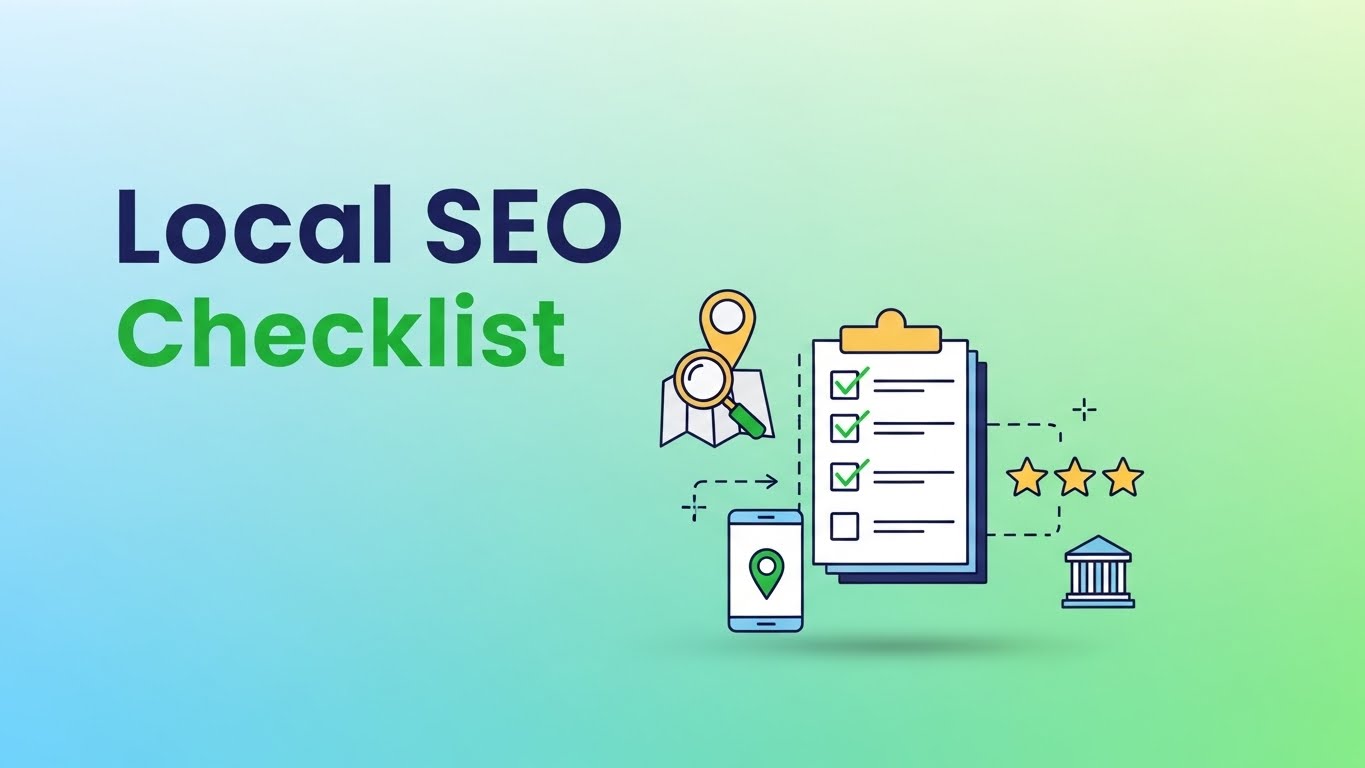
The Local SEO Checklist: Ranking #1 in Your City Without Ads
In the modern digital landscape, the battle for customer attention is fierce. For local businesses whether you are a plumber in Portland, a boutique in Boston, or a dentist in Dallas the competition isn’t just the shop down the street; it’s the entire internet.
Many business owners believe the only way to win is to pay. They pour thousands of dollars into Google Ads (PPC) or Facebook campaigns, renting attention that disappears the moment the budget runs dry. But there is a more sustainable, profitable, and authoritative way to dominate your market: Local SEO.
Local Search Engine Optimization (SEO) is the art and science of optimizing your online presence to attract business from relevant local searches. When someone types “best pizza near me” or “emergency electrician [City Name],” Google isn’t looking for the business with the deepest pockets; it is looking for the best answer.
This comprehensive, 12-month roadmap will guide you through the exact steps required to claim the coveted #1 spot in the “Local Map Pack” and organic search results without spending a dime on ads.
Part 1: Understanding the Battlefield (The Local Pack)
Before diving into the tactics, you must understand the goal. When a user performs a local search, Google typically displays three distinct sections:
- The Ads: Marked with “Sponsored,” these sit at the very top.
- The Local Map Pack (The “3-Pack”): A map view accompanied by three business listings. This is the holy grail. It captures the vast majority of clicks because it provides immediate information: reviews, distance, and hours.
- The Organic Results: The traditional blue links below the map.
Your goal is to appear in the Map Pack. Ranking here signals to the user that Google trusts your business as a top-tier local provider.
Part 2: The Foundation – Google Business Profile (GBP)
Your Google Business Profile (formerly Google My Business) is no longer just a listing; it is your second homepage. For many customers, it is the only thing they will look at before calling you.
1. Claim and Verify If you haven’t claimed your profile, do it immediately. Google will likely mail a postcard with a verification code to your physical address to prove you actually exist there.
2. The “Perfect Name” Rule Ensure your business name on GBP matches your real-world signage exactly.
- Bad: “Smith Plumbing | Best Plumber in Chicago | Cheap Drains” (This is keyword stuffing and can get you suspended).
- Good: “Smith Plumbing & Heating.”
3. Category Selection This is the single most significant ranking factor.
- Primary Category: Be specific. If you are a “Pizza Restaurant,” choose that, not just “Restaurant.”
- Secondary Categories: Add as many as relevant. A law firm might be a “Personal Injury Attorney” (Primary) but also a “Legal Services” provider and “Trial Attorney” (Secondary).
4. The Business Description Write a description that sounds human but includes your main keywords and city name early on. Highlight your unique selling proposition (USP). Are you 24/7? Family-owned? Award-winning?
5. Photos are Engagement Bait Google knows that profiles with photos get 42% more requests for directions.
- Upload high-quality photos of your exterior (to help people find you).
- Show your team (to build trust).
- Show your work (before/after shots).
- Pro Tip: Geo-tag your photos before uploading them to embed location data directly into the image file.
Part 3: On-Page SEO (Your Website)
While your GBP is crucial, your actual website acts as the anchor that holds your ranking in place. Google “crawls” your site to verify the information on your GBP.
1. NAP Consistency NAP stands for Name, Address, and Phone Number. It must be identical everywhere.
- If your GBP says “St.” your website shouldn’t say “Street.”
- If your GBP uses (555) 123-4567, your website shouldn’t use 555.123.4567.
- Place your NAP clearly in the footer of every page on your website.
2. Structure Your Service Pages Don’t list all your services on one page. Create a dedicated page for each service you offer.
- Example: A roofing company should have separate pages for “Roof Repair,” “Roof Installation,” and “Gutter Cleaning.”
- This allows you to optimize specific H1 headers and meta descriptions for unique keywords like “Roof Repair in [City].”
3. Location Pages (For Multi-Location Businesses) If you serve multiple cities, do not just list them in a comma-separated line in your footer. Create a unique landing page for each city (e.g., domain.com/plumber-austin and domain.com/plumber-round-rock).
- Each page needs unique content. Do not copy-paste text and swap the city name. Talk about specific landmarks, neighborhoods, or projects you’ve done in that specific town.
4. Embed a Google Map On your contact page (and location pages), embed the actual Google Map of your business listing. This sends a strong signal to search engines connecting your website to your physical location.
Part 4: The Citation Ecosystem (Digital Footprint)
A “Citation” is any mention of your business NAP on the web, even if it doesn’t link to you. Google uses these to verify that you are who you say you are. If Yelp says you are in New York but Facebook says you are in New Jersey, Google loses trust and drops your ranking.
1. The “Big Four” Aggregators Most smaller directories get their data from four major data aggregators in the US: Foursquare, Localeze, Data Axle, and Factual. Ensure your data is correct with these four, and it will trickle down to hundreds of smaller sites.
2. Tier 1 Directories Manually claim and optimize listings on high-authority sites:
- Yelp
- Bing Places
- Apple Maps
- Facebook Business
- YellowPages
- Better Business Bureau (BBB)
3. Niche Directories Find directories specific to your industry.
- Lawyers: Avvo, FindLaw.
- Contractors: Angi, Thumbtack, Houzz.
- Doctors: Healthgrades, Zocdoc. These carry more “topical authority” weight than general directories.
Part 5: The Reputation Engine (Reviews)
Reviews are a direct ranking factor. Google explicitly states that “high-quality, positive reviews from your customers will improve your business’s visibility.”
1. Velocity and Volume Getting 50 reviews in one day looks suspicious. Getting 2 reviews every week for a year looks like a healthy, thriving business. Consistency (velocity) is key.
2. Keywords in Reviews This is a hidden gem. If a customer writes, “They did a great job on my kitchen remodel in Denver,” those bolded words help you rank for “Kitchen remodel Denver.”
- Tactic: When asking for a review, prompt the client: “Would you mind mentioning the specific service we did for you in your review?”
3. The Response Strategy Reply to every review.
- Positive: Thank them and reinforce your values.
- Negative: Be polite, professional, and take it offline. “I’m sorry to hear this, please call the manager at [Number].”
- Google sees owner responses as a sign of an active, engaged business.
Part 6: Local Content Strategy
Most local business blogs are graveyards of generic content like “5 Tips for Plumbing.” To rank locally, you must write locally.
1. “Best Of” Guides Write content that positions you as a local concierge.
- Example: A local realtor could write “The Top 5 Coffee Shops in [Neighborhood]” or “A Guide to the [City] School District.”
- This attracts local traffic that might not be ready to buy yet but is now in your funnel.
2. Local Project Showcases Instead of a generic gallery, create case studies.
- “Emergency Tree Removal in [Neighborhood] after Storm [Name].”
- Include photos, the specific problem, and the solution. This targets hyper-local keywords (“tree removal [Neighborhood]”).
3. Local News and Events Sponsor a local charity run? Write about it. Attend the Chamber of Commerce gala? Post photos. This connects your brand entity with the location entity in Google’s Knowledge Graph.
Part 7: Link Building (The Local Way)
You don’t need backlinks from Forbes or the New York Times. You need links from your community. In Local SEO, relevance beats authority. A link from a local church or high school is often more valuable than a link from a generic national blog.
1. Sponsorships Sponsor a Little League team, a 5K run, or a high school theater production. These organizations usually have “Sponsor” pages on their websites where they will link to you. These are potent, hyper-local .org or .edu links.
2. The Chamber of Commerce Join your local Chamber. It costs money, but the link from their member directory is one of the most trusted local signals you can get.
3. Vendor Partnerships Do you supply materials to other businesses? Or do you hire a specific photographer? Ask for a link exchange or a “preferred vendor” listing on their site.
Part 8: Technical SEO & Schema Markup
Technical SEO ensures the robot (Google) can read your site easily.
1. Local Business Schema Schema markup is code you put on your website to help search engines understand your content. Use LocalBusiness Schema to wrap your NAP data. It tells Google explicitly: “This is our phone number, this is our opening hour, and this is our latitude/longitude.”
2. Mobile-First Optimization 57% of local search queries are submitted from a mobile device or tablet. If your site is slow or hard to navigate on a phone, users will bounce back to Google results. This “pogo-sticking” tells Google your site isn’t a good answer, and your rankings will tank.+1
Part 9: Tracking Your Success
You cannot improve what you do not measure. Use these tools to track your climb to #1.
1. Google Business Profile Insights: Tracks how many people called you, requested directions, or visited your website directly from the listing. 2. Google Search Console: Shows you exactly what keywords people are typing to find your site. 3. Local Rank Trackers: Tools like BrightLocal or Whitespark allow you to see your ranking on a map grid. You might be #1 for a user standing outside your shop, but #10 for a user three miles away. Your goal is to turn that entire grid green.
Conclusion: The Compound Effect
Ranking #1 in your city without ads is not an overnight trick. It is the result of doing 100 small things correctly and consistently.
It starts with a verified Profile. It grows with a website that speaks the language of the locals. It solidifies with a web of citations and backlinks that prove your existence. And it sustains itself with a steady stream of glowing reviews.
The beauty of Local SEO is the compound effect. Unlike ads, where the traffic stops the second you stop paying, SEO builds momentum. The work you do today to earn a review or build a local link will continue to pay dividends in free traffic for years to come. Start checking off this list today, and claim your territory.