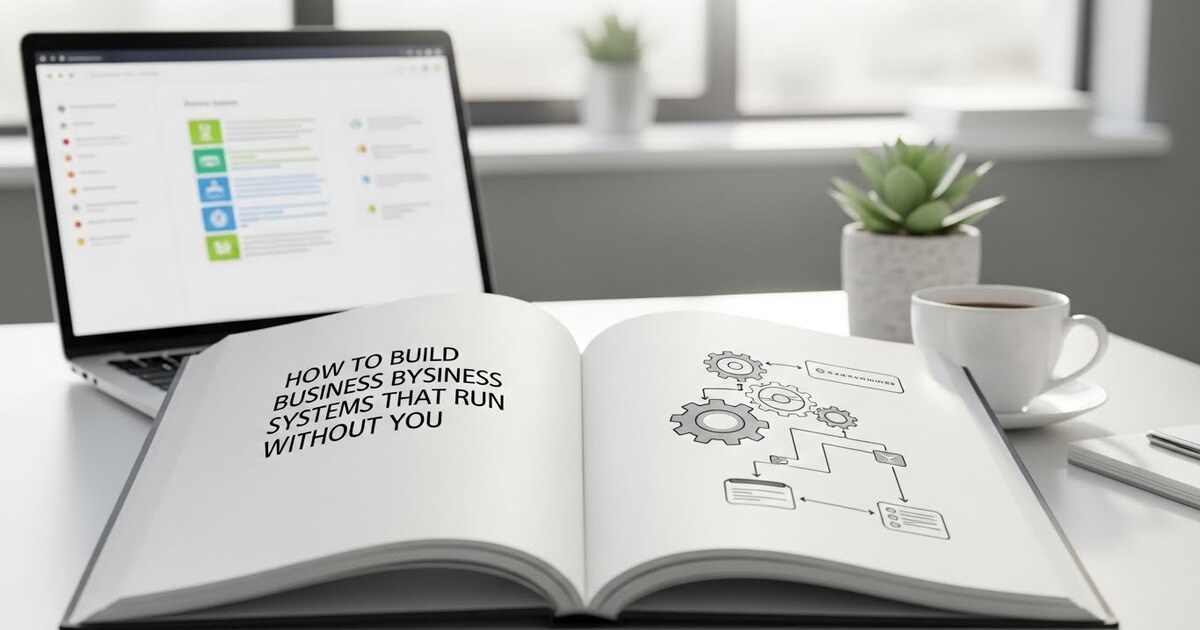
The Architect’s Blueprint: How to Build Simple Business Systems That Run Without You
The ultimate dream of entrepreneurship is rarely just about money. It is about freedom. Most founders start a business to escape the constraints of a 9 to 5 job only to realize they have simply created a more demanding job for themselves. They become the bottleneck. They are the chief problem solver and the primary decision maker. If they stop working then the revenue stops flowing. This is not a business. It is high stress self employment.
True business ownership involves building an asset that functions independently of the owner. It requires shifting your identity from the artist who does the work to the architect who designs the blueprint for how the work gets done. This transition is difficult. It requires letting go of the ego that says nobody can do it as well as you can. It demands patience to slow down now so you can speed up later.
Building a business that runs without you is not about hiring an army of expensive consultants or implementing complex enterprise software. It is about creating simple, repeatable systems. A system is just a documented way of doing things that produces a consistent result. When you stack these systems together you create a machine that generates value whether you are in the office or on a beach. This guide will walk you through the practical steps to audit your operations, document your processes, and empower a team to run the machine you built.
Phase 1: The Mindset of the System Builder
Before you write a single procedure you must change how you view your role. The biggest obstacle to systemization is the founder who believes they are indispensable. You might think that your clients only want to talk to you or that your specific touch is the secret sauce. While your vision is unique your daily tasks are likely not.
You must embrace the concept of working on the business rather than in the business. Working in the business means handling customer support tickets, writing copy, or packing boxes. Working on the business means creating the protocol for how support tickets are answered, designing the templates for copy, and optimizing the logistics workflow.
There is a concept known as the Pareto Principle which states that 80 percent of your results come from 20 percent of your efforts. In a systems context this means that a small number of core processes drive the majority of your revenue. You do not need to systemize every single exception or rare occurrence immediately. You need to identify the repetitive core activities that keep the lights on and the customers happy.
Phase 2: The Great Time Audit
You cannot automate or delegate what you do not understand. The first tactical step is to perform a rigorous audit of your own time. For two weeks you must track everything you do. Do not rely on your memory. Use a notepad or a simple spreadsheet to log every activity.
Write down the task. Note how long it took. Then assign a value to that task. You can categorize tasks into four value buckets:
- Administrative Tasks: These are low value activities like checking email, scheduling meetings, or organizing files. These are worth minimum wage or less.
- Technician Tasks: These are the specialized jobs like coding, designing, or cooking. These are worth a market salary.
- Managerial Tasks: These involve overseeing projects, hiring staff, or reviewing metrics. These are high value activities.
- Strategic Tasks: These include long term planning, partnership deals, and system building. This is where your value as a founder truly lies.
At the end of two weeks look at your log. You will likely find that you are spending the majority of your time on administrative and technician tasks. This is the danger zone. Your goal is to move those tasks off your plate so you can focus entirely on strategy. The items that appear most frequently on your list are your first targets for systemization. If you find yourself answering the same client question five times a week that is a system waiting to be built.
Phase 3: The Three Strike Rule and Documentation
Many people fail at systemization because they try to write a massive operations manual overnight. This is overwhelming and ineffective. Instead you should adopt the Three Strike Rule. If you have to do a task three times or if you have to answer the same question three times then you must create a system for it.
A system does not need to be a boring text document. In fact text is often the worst way to explain a process. The best modern systems are visual and dynamic. Here is a simple framework for creating a Standard Operating Procedure or SOP.
The Title: Give it a clear name like “How to Process a Refund” or “Weekly SEO Reporting Protocol.”
The Goal: State clearly what a successful outcome looks like. For example the goal of the refund process is to return the money within 24 hours and retain the customer goodwill.
The Tools: List every piece of software or login credential needed to complete the task.
The Method: This is the core. The most efficient way to capture this is to record yourself doing it. Use a screen recording tool to film your screen while you narrate the steps. Talk through your decision making process. Explain why you are clicking where you are clicking.
Once you have the video you can use AI tools to transcribe it and turn it into a checklist. This gives you a hybrid SOP with a video for context and a checklist for execution.
The Troubleshooting Guide: Anticipate what could go wrong. If the software crashes what should they do? If the client is angry who should they escalate it to?
Store these documents in a central knowledge base. It could be as simple as a shared Google Drive folder or a dedicated tool like Notion. The key is that it must be searchable and accessible to everyone on the team.
Phase 4: Automation Before Delegation
Before you hire a human to run your systems you should see if a robot can do it. Automation is cheaper, faster, and more reliable than human labor. It never calls in sick and it never gets tired.
Look at your list of repetitive tasks. Can any of them be solved with software? If you send the same onboarding email to every new client you should use an email automation tool. If you manually copy data from your payment processor to your spreadsheet you should use an integration tool like Zapier or Make to connect them.
Automation acts as the connective tissue of your business. It moves data from one place to another without human intervention. By automating the low level logic you reduce the workload for your future team. This allows you to hire people for their judgment and creativity rather than their ability to copy and paste.
However you must be careful not to over automate. Automation handles logic well but it handles nuance poorly. Do not automate personal client interactions where empathy is required. Use automation to support the relationship but not to replace it completely.
Phase 5: The People Layer
Eventually you will run out of things that software can do. This is where you bring in people. Hiring is often scary for founders because they fear a loss of quality. This fear is valid only if you delegate without a system. If you delegate with a system you are simply installing an operator into a machine you designed.
When you hire someone do not just give them a job title. Give them a packet of SOPs. Your job is to train them on the systems you have built. Walk them through the checklists. Watch them execute the task while you observe.
There is a vital distinction here between abdicating and delegating. Abdicating is throwing a task at someone and hoping they figure it out. Delegating is handing over a well defined process with clear expectations and resources.
You must also build a system for feedback. Your employees are the ones using the systems every day. They will see inefficiencies that you missed. You should encourage them to suggest improvements. If a step in the checklist is outdated they should have the authority to flag it. This creates a culture of continuous improvement where the business gets smarter over time.
A crucial concept in this phase is the “Bus Factor.” The Bus Factor represents the number of people who would have to be hit by a bus for your business to fail. If that number is one then you are in trouble. Cross train your team so that multiple people know how to run the mission critical systems.
Phase 6: The Management System
Once you have people running your SOPs you need a system to manage the people. You cannot just hope they are doing the work. You need visibility.
This is achieved through a cadence of meetings and reporting. You should implement a simple weekly scorecard. This is a spreadsheet that tracks the 5 to 10 most important numbers in your business. These might include leads generated, sales closed, support tickets resolved, or cash in the bank.
Every week your team should update these numbers. If a number is off track you discuss it. This removes the emotion from management. You are not criticizing the person. You are looking at the data.
Combine this with a weekly team meeting. Keep it short and focused. Review the scorecard. Discuss any stuck points where the team needs help. Share wins. Then break. This rhythm keeps the team aligned without requiring you to hover over their desks all day.
Phase 7: The Stress Test
You have documented your processes. You have automated the logic. You have hired the team. Now you must test the machine.
The only way to truly test a system is to remove yourself from it. Start small. Take a Friday off and do not check your email. Did the business survive? Did anything break? If something broke that is good news. It reveals a hole in your system that you can fix.
Gradually increase the time away. Take a week off. Then two weeks. The ultimate goal is to be able to vanish for a month and return to find the business growing. This is often called the Vacation Test.
When errors happen, and they will, resist the urge to blame the employee. Ask yourself if the system failed. Was the checklist unclear? Was the training insufficient? Did the automation break? Fix the system first. This psychological safety allows your team to be honest about mistakes rather than hiding them.
Phase 8: Refinement and Evolution
A business system is never finished. It is a living entity. The market changes. Technology changes. Your business model evolves. If your systems are rigid they will become a liability.
You should schedule a quarterly review of your core systems. Look at your SOPs. Are they still accurate? Is there a new tool that could do this better? Is this process even necessary anymore?
As you scale you will need to add layers to your systems. What worked for a team of two will break for a team of ten. You will need to introduce systems for communication, for hiring, and for culture. But the fundamental principle remains the same. Document the process. execute consistently. and iterate based on feedback.
The Value of the Boring
Building systems is not glamorous work. It is often tedious. It involves writing lists and recording videos and setting up software integrations. It lacks the adrenaline rush of closing a big deal or launching a new product.
But this boring work is what creates wealth. A business that relies on the founder is difficult to sell. A buyer does not want to buy a job. They want to buy a cash flow stream that works without them. By building systems you are increasing the enterprise value of your company. You are turning it into a tradable asset.
Furthermore you are buying back your life. Every system you build is a claim on your future time. It is an investment that pays dividends in the form of hours. You can use those hours to start a new business or spend time with your family or simply rest.
Conclusion
The journey from self employment to business ownership is a journey of discipline. It requires the discipline to stop doing and start designing. It asks you to value your time enough to protect it with protocols.
Start today. You do not need to overhaul your entire company at once. Pick the one task that frustrates you the most. The one thing that eats up your time every week. Document it. Automate it if you can. Delegate it if you cannot.
Then move to the next task. Step by step you will dismantle the cage you built for yourself. You will replace the chaos with order. You will stop being the engine that powers the business and become the engineer who maintains it.
The freedom you seek is found in the systems you build. It is waiting for you on the other side of a documented process. Build the machine so you can stop being the cog. This is the path to true independence.
Summary Checklist for Implementation
To ensure you take action here is a summarized path to follow.
Week 1: Perform the time audit. Log every activity. Identify the low value repetitive tasks that consume your day.
Week 2: Select the top three recurring tasks. Record a video of yourself performing them. Talk through the details.
Week 3: Transcribe those videos into checklists. Create a central folder for these documents.
Week 4: Research automation tools. Connect your email or forms to your database. Remove manual data entry where possible.
Week 5: Delegate one major responsibility to a team member or a freelancer. Hand them the SOP. Watch them do it.
Week 6: Implement the weekly scorecard. define the metrics that matter. Tell the team they are responsible for reporting these numbers.
Week 7: Take a long weekend completely offline. Observe what happened when you return. Fix the leaks.
By following this path you are not just building a business. You are building a legacy. You are creating something that has a life of its own. That is the definition of success.