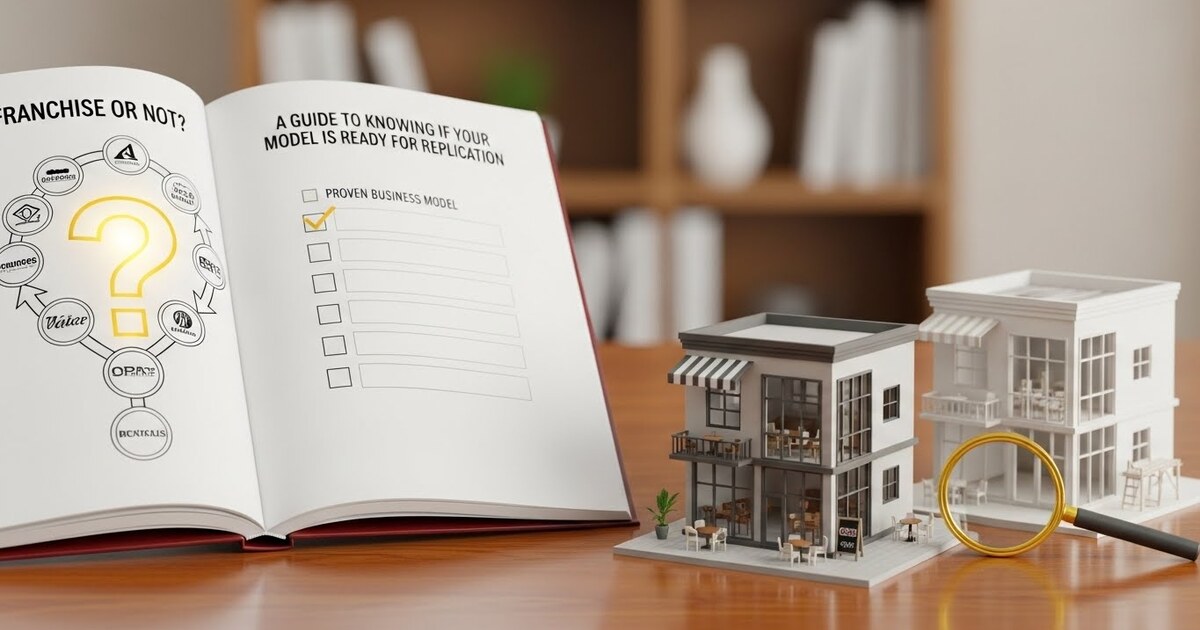
To Franchise or Not? A Guide to Knowing if Your Model is Ready for Replication.
You have built a successful business. The customers are happy, the reviews are glowing, and the cash register is ringing. Inevitably, a loyal customer or an impressed friend asks the question that changes everything: “When are you going to open one of these in my town?”
The seed is planted. You start dreaming of the “Ray Kroc” model hundreds of locations bearing your name, royalty checks hitting your bank account while you sleep, and a brand that dominates the map.
But here is the cold reality: A successful business is not the same thing as a franchisable business.
Running a pizzeria is a completely different industry than running a franchise company that sells pizzerias. One involves making dough; the other involves selling intellectual property, compliance, and support systems.
Franchising is one of the most powerful levers for growth in the capitalist toolkit, but it is also a graveyard for businesses that expanded too soon or for the wrong reasons. This guide acts as your feasibility study. Before you call a lawyer, you need to pass the “Replicability Test.”
I. The Fundamental Shift: From Operator to Licensor
The first hurdle isn’t financial; it’s psychological.
When you franchise, you stop being a practitioner. You are no longer the baker, the consultant, or the mechanic. You become a Teacher and a Policeman.
- The Teacher: Your product is no longer the pizza; your product is the system that makes the pizza. You are selling a business-in-a-box.
- The Policeman: Your primary job becomes enforcing brand standards. You have to tell a franchisee (who invested their life savings) that they are using the wrong napkins and they need to change them immediately.
If you love the daily craft of your business, franchising might make you miserable. If you love building systems and coaching others, you might be ready.
II. Criteria 1: The “Unit Economics” Stress Test
The most common reason new franchises fail is that the math doesn’t work once you add the “Franchise Load.”
Your flagship location might be profitable, but is it profitable enough?
When a franchisee runs your model, they have extra expenses that you don’t have:
- Royalty Fee: Typically 4-8% of Gross Sales.
- Marketing Fund: Typically 1-3% of Gross Sales.
- Debt Service: They likely took a loan to build the store.
The 20% Margin Rule:
As a general rule of thumb, your prototype location needs to run at a 20% EBITDA margin (Earnings Before Interest, Taxes, Depreciation, and Amortization) after paying a manager a market salary.
- If your margin is only 10%, and you take a 6% royalty, the franchisee is left with 4%. That is not enough ROI to justify their risk. They will fail, and they will sue you.
The Litmus Test: Can your business pay a manager $60k, pay a 6% royalty, pay a loan note, and still return a 15-20% cash-on-cash return to the owner?
III. Criteria 2: The “Teenager Test” (Systematization)
Is your business successful because of your systems, or is it successful because of you?
If the business relies on your personal charisma, your 20-year relationships in the town, or your unique genius at solving problems, it is not franchisable. You cannot clone your charisma.
You are ready only if:
- The Process is Documented: Every task from opening the store to handling a refund is written in an Operations Manual.1
- The Skill Floor is Low: Can you teach an average person with no industry experience how to run the business in 2 weeks?
- Franchisable: A burger joint (Process-driven).
- Not Franchisable: A high-end art restoration studio (Talent-driven).
IV. Criteria 3: Transferability of the Market
Just because it works in Austin, Texas, doesn’t mean it will work in Des Moines, Iowa.
The “Hometown Hero” Bias:
Many businesses succeed because they are local institutions. They have generational brand equity.
- The Test: Open a second corporate location in a town 2 hours away where nobody knows your name.
- If that location succeeds purely on the strength of the product and the branding, you have a transferable model.
- If it struggles because “people here just don’t get it,” you have a niche business, not a franchise.
V. The Cost of Entry: It Takes Money to Make Money
There is a myth that franchising is a “cheap” way to expand because you use other people’s money (OPM).
While the franchisee pays for the new store construction, you (the franchisor) have massive upfront costs to become legal.
The “Franchise Launch” Budget (Estimated):
- Legal (FDD Creation): $25,000 – $50,000. You need a specialized franchise attorney to draft the Franchise Disclosure Document (FDD). This is non-negotiable.
- Operations Manuals: $10,000 – $30,000 (if hiring consultants to write them).
- Audited Financials: $5,000 – $10,000 per year. You must show audited books to sell franchises in registration states.
- Marketing for Franchisees: $10,000/month. It costs money to find people to buy your franchise. The average “Cost per Lead” for a franchise buyer is high.
Total: Expect to spend $100,000 to $150,000 before you sell your first unit.
VI. The Structure: Franchise vs. Licensing vs. Corporate
If the section above scared you, consider the alternatives. Franchising is not the only path to scale.
| Feature | Franchising | Licensing | Corporate Chain |
| Control | High (Strict uniformity) | Low (Use of logo/product) | Absolute (You own it) |
| Cost to Scale | Low (Franchisee pays CapEx) | Low | High (You pay CapEx) |
| Speed | Fast (once established) | Fast | Slow (Cash constrained) |
| Regulation | Heavy (FTC regulated) | Light (Contract law) | None |
| Revenue | Royalties (4-8%) | Flat Fees or wholesale markup | 100% of Profits |
The Licensing Loophole:
Some companies try to avoid the cost of franchising by calling it a “License.” They say, “You can use my logo and sell my coffee, just pay me $500/month.”
- Warning: If you exert significant control over their operations OR provide significant assistance, the Federal Trade Commission (FTC) will deem you a franchise, regardless of what you call it. If you sold “licenses” without an FDD, you are breaking federal law.
VII. The First Franchisee: The “Beta Tester”
Your first franchisee is not a customer; they are a partner.
Do not sell your first franchise to a wealthy investor who wants passive income. Sell it to an operator who is hungry and willing to forgive your mistakes.
- The “Founding Member” Deal: Consider waiving the initial Franchise Fee (often $30k-$50k) for the first 1-3 partners.
- The Trade: In exchange for the discount, they agree to provide feedback on the manual, serve as a reference for future buyers, and tolerate the hiccups of a new system.
VIII. Conclusion: The Mirror Test
Look in the mirror. Are you ready to stop being the star of the show?
Franchising is an act of ego death. You have to accept that a franchisee will never care about the business quite as much as you do. They will never clean the floor quite as perfectly as you do.
But if you build a robust system, they can do it good enough to make a profit and build a brand.
If you have the capital, the patience, and the documented processes, franchising can turn a local shop into a national legacy. But if your model is still reliant on your personal touch or razor-thin margins, keep the secret sauce to yourself. Expanding a flaw just creates a bigger disaster.