
Contractor vs. Employee: The Defining Lines That Shape Your Business and Career
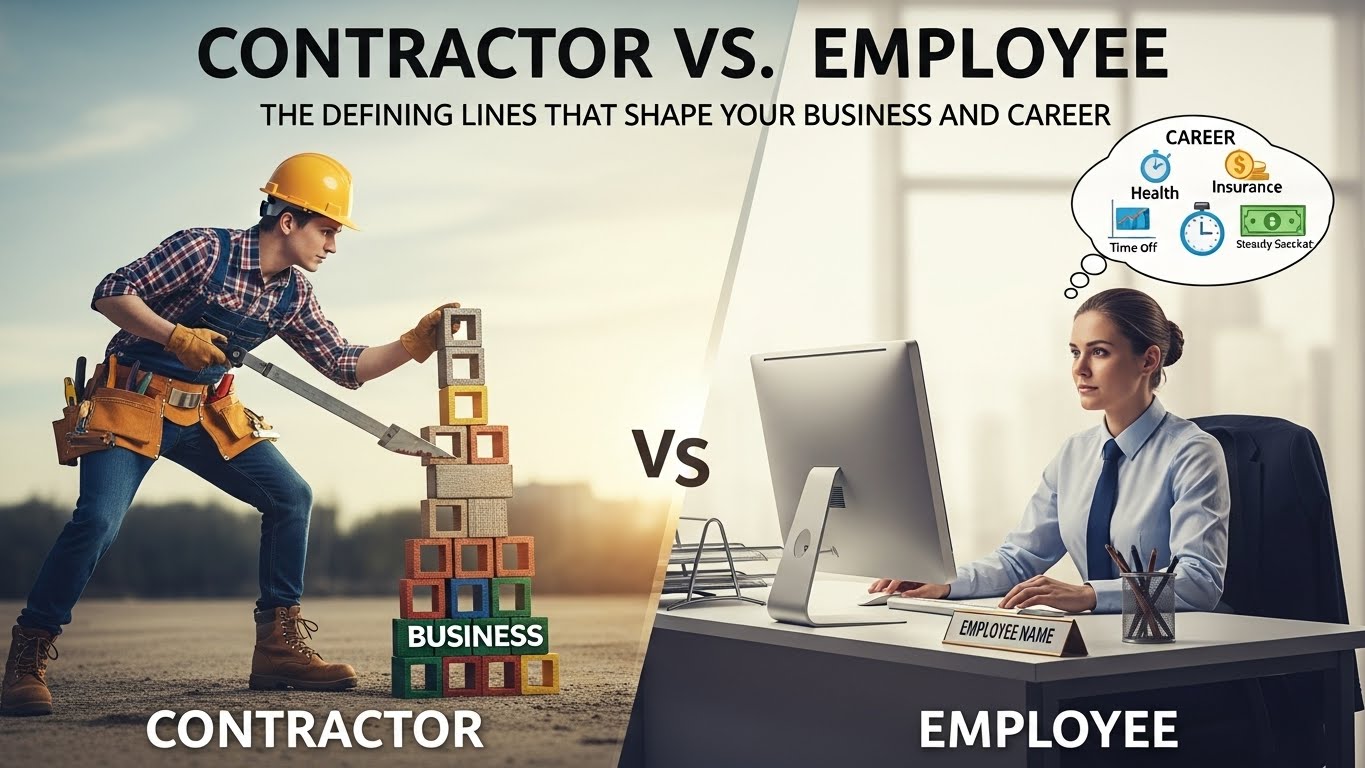
You are drowning in work.
It starts as a good problem—you have more customers than you can handle. But then it becomes a bad problem. You are answering emails at midnight, skipping lunch, and missing your kid’s soccer game.
You know you need help. But what kind of help?
Do you hire a freelancer to take a few tasks off your plate? Or do you hire a full-time employee to sit in the chair next to you (or on the Zoom call) and build the business with you?
This isn’t just a paperwork decision. It’s not just about checking “W-2” or “1099” on a tax form.
This decision shapes the soul of your company.
It defines how much control you have, how much money you spend, and frankly, how much risk you take on. Get it right, and you build a flexible, profitable machine. Get it wrong, and you might find yourself facing a surprise audit from the IRS that could wipe out your profit for the year.
Let’s strip away the legal jargon and talk about the real-world difference between a contractor and an employee, and how to decide which one you actually need right now.
The “Control” Trap
Here is the thing about being a business owner: We are usually control freaks.
We built this thing from scratch. We know exactly how the emails should sound, how the product should be packaged, and what time the work should start.
And that is where the trouble begins.
You might want to hire a contractor because it’s cheaper and easier. No payroll taxes, no benefits, no workers’ comp. It sounds great. But if you hire a contractor and then treat them like an employee, you are walking into a trap.
The IRS doesn’t care what your contract says. They care about how you act.
If you tell them when to work, how to do the work, and provide the computer they work on… congratulations, you have hired an employee. And if you haven’t been paying payroll taxes for them, you are in debt to the government.
Deep Dive: The Three Rules of the Road
So, where is the line?
The IRS uses a set of criteria to determine who is who. It basically boils down to three categories of control.
1. Behavioral Control (The “How”)
This is the big one.
- Employee: You train them. You give them instructions. You dictate the process. “Here is the SOP, follow it exactly.”
- Contractor: You hire them for the result. “I need a website. Here is the deadline.” You don’t tell a plumber how to fix your sink; you just pay them to fix it.
2. Financial Control (The “Money”)
- Employee: They are paid a salary or hourly wage. You provide the tools and equipment. They generally don’t lose money if your business has a bad month.
- Contractor: They have a significant investment in their own equipment. They can market their services to other clients. They can realize a profit or a loss.
3. The Relationship (The “Commitment”)
- Employee: There is an expectation of permanence. They get benefits (vacation, insurance). They are a core part of the business operations.
- Contractor: The relationship is usually project-based or for a specific time period.
Solutions: Which One Do You Actually Need?
Okay, forget the IRS for a second. Let’s talk about your business strategy. Because honestly, the legal stuff matters, but the growth strategy matters more.
Scenario A: The Specialist (Go Contractor)
You need a logo designed. Or you need your monthly bookkeeping done. Or you need someone to run Facebook ads. These are specialized skills. You don’t need a full-time designer sitting in your office 40 hours a week unless you are a design agency.
- The Win: You get high-level expertise without the overhead. You can turn the cost on and off as needed.
Scenario B: The Core Builder (Go Employee)
You need someone to handle customer support daily. Or you need a project manager to oversee operations. You want them to bleed your company colors. You want to build culture. You want them to grow with you.
- The Win: Loyalty. You are buying their brain space, not just their output. You can mold them into the leader you need them to be.
If you are unsure about the financial implications, take a moment to crunch the numbers. We have a great tool for this—check out our calculator for the true cost of hiring your first employee. It might shock you to see how much more an employee costs beyond just the salary.
Actionable Tips for Staying Safe
If you decide to go the contractor route (which most small businesses do at first), you need to protect yourself.
1. The “Business Entity” Rule Try to hire contractors who have their own LLCs. It is a strong signal to the IRS that they are a legitimate separate business, not a disguised employee.
2. Stop Providing Equipment I see this all the time. A business owner hires a “virtual assistant” contractor but buys them a laptop. Stop. Contractors provide their own tools. If you buy the laptop, the line gets blurry.
3. Put It in Writing This sounds obvious, but handshake deals are dangerous. Have a solid Independent Contractor Agreement. It should explicitly state that they are responsible for their own taxes and benefits. This is part of building a secure legal foundation for your small business.
4. Let Go of the “When” If you hire a contractor, you generally can’t tell them “You must be at your desk from 9 AM to 5 PM.” You can set deadlines, but you can’t set hours. If you need coverage during specific hours, you might need an employee.
The FAQ Section
Q: Can I transition a contractor to an employee later? A: Absolutely. This is often the best way to hire. It’s like dating before marriage. “Let’s try this project for 3 months.” If they crush it and you want them full-time, make the offer.
Q: What if I just call them a contractor to save money? A: Don’t. The fines can include back taxes, interest, and penalties up to 100% of the tax due. It is a business-killing risk.
Q: Is it harder to manage contractors? A: It requires a different style. You manage outcomes, not activities. If you struggle with letting go, read our guide on how to manage a team without micromanaging.
The Bottom Line
There is no “better” option. There is only the right option for the stage you are in.
Contractors give you agility. They let you move fast, access high-level skills, and keep costs variable. Employees give you stability. They build the foundation that allows you to scale up without the whole thing collapsing.
Look at the work that needs to be done. If you need a soldier to follow orders and man the fort, hire an employee. If you need a mercenary to come in, conquer a specific hill, and leave, hire a contractor.
Just make sure you know which one you are hiring before you sign the check.
Ready to structure your team? If you are leaning toward employees, especially if they will be working from home, you need a plan. Check out our remote vs. on-site HR framework to set yourself up for success from day one.