Australia’s Card Surcharge Ban: What It Means for Small Businesses
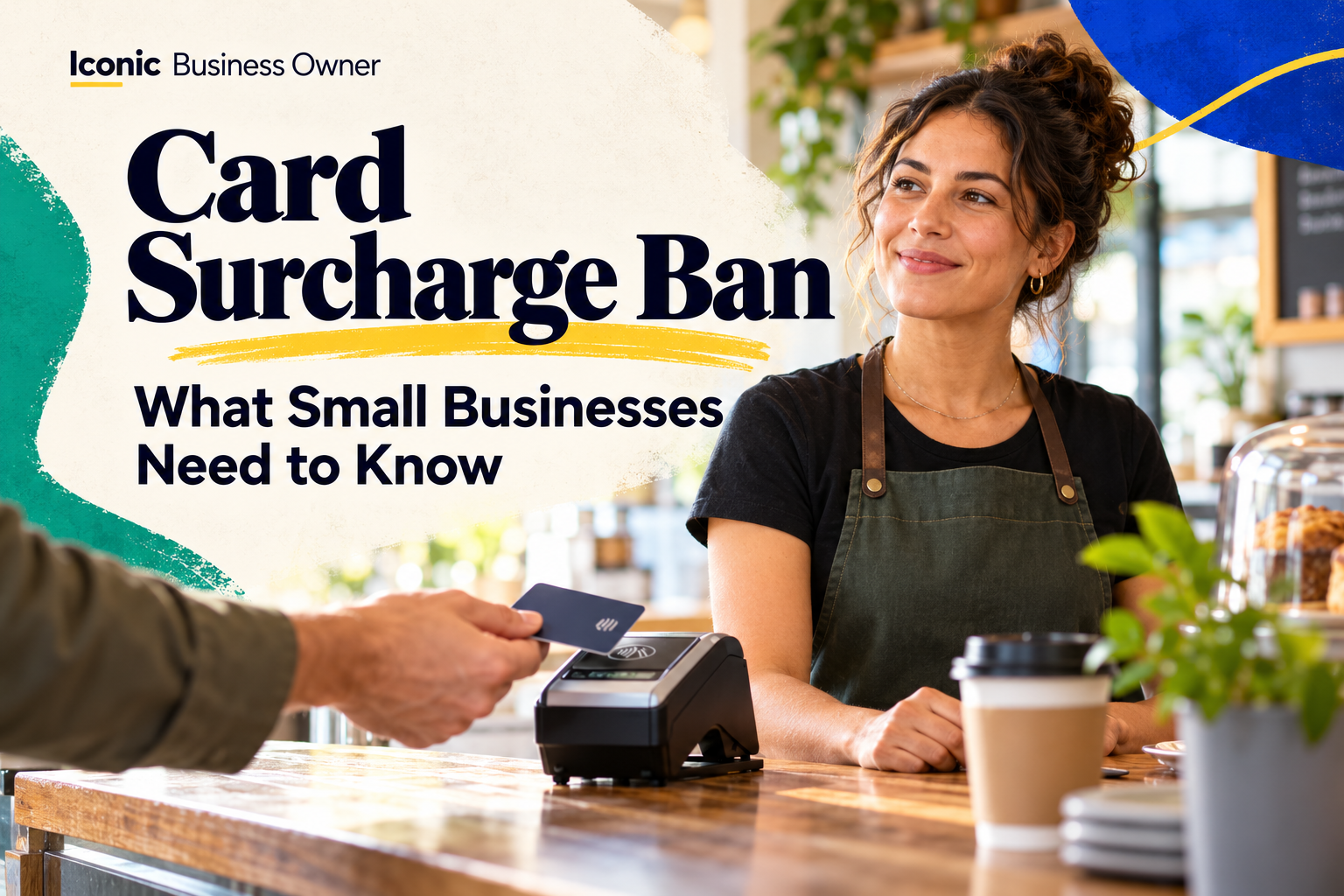
The card surcharge ban Australia introduced on 1 October 2026 changes how small businesses recover payment-processing costs. If you accept card payments, I would use this change to review your checkout settings, provider fees and pricing.
The price on the menu says $6. The customer taps a card, and the total becomes $6.09.
For many customers, that little extra charge has been a familiar frustration. For some small businesses, it has helped cover the cost of accepting payments.
Under the new rules, Australian businesses generally can no longer add payment surcharges for Visa, Mastercard and eftpos transactions. American Express, UnionPay and PayPal have also introduced no-surcharge rules, although specific exceptions can apply.
The surcharge may disappear from the receipt. The cost of accepting payments does not automatically disappear from the business.
This article provides general information. Confirm the rules for your payment services and industry with your provider and relevant official guidance.
What changed on 1 October 2026?
The RBA removed its prohibition on no-surcharge rules for the designated eftpos, Mastercard and Visa networks. Those networks then introduced restrictions on surcharging.
American Express, UnionPay and PayPal separately chose to remove surcharging; they are not currently subject to the same formal RBA regulation. RBA
For an ordinary merchant, the practical task is to check the current network rules through the payment provider and remove prohibited card-linked charges across all payment channels.
This goes further than the old rule limiting a surcharge to the cost of accepting a payment. The current rules generally remove the ability to impose the surcharge in the first place.
Does the ban apply to small businesses?
There is no general exemption just because a business is small.
Specific exceptions can arise under network rules or law. Taxi surcharging, for example, remains a matter for state and territory regulators.
Business-to-business card payments are not automatically exempt either. I would confirm any claimed exception before continuing to charge a payment surcharge. RBA
Interchange fee caps: what actually changed?
Interchange is one component of the cost of processing a card payment. It is not necessarily the fee shown on your merchant bill.
The relevant domestic caps changed as follows:
| Card category | Previous cap | New cap |
|---|---|---|
| Domestic consumer credit cards | 0.80% | 0.30% |
| Domestic commercial credit cards | 0.80% | 0.80%—unchanged |
| Domestic debit and prepaid cards: fixed-fee cap | 10 cents | 8 cents |
| Domestic debit and prepaid cards: percentage cap | 0.20% | 0.16% |
The debit weighted-average benchmark remains 8 cents. The former credit weighted-average benchmark was abolished. RBA
A lower interchange cap is not your total processing rate
Your provider’s total charge is not capped at 0.30% simply because domestic consumer-credit interchange is.
The total can include network fees, the provider’s charges, terminal rental and other services. The interchange rules also do not apply identically across every network named in the surcharge announcements.
I would ask the provider how the reform affects my actual plan rather than assuming the advertised rate must fall to the interchange cap.
What does this mean for small-business margins?
If your business previously recovered payment costs through surcharges, removing them can affect the amount retained from a sale.
Consider this simplified example:
| Item | Before | After |
|---|---|---|
| Listed price | $40.00 | $40.00 |
| Card surcharge | $0.60 | $0.00 |
| Customer payment | $40.60 | $40.00 |
| Illustrative processing cost | $0.60 | $0.60 |
| Amount retained before other costs | $40.00 | $39.40 |
These are hypothetical figures assuming the same processing cost in both cases. Actual costs and reductions depend on your provider and card mix. The amounts are gross cash figures, not an after-GST profit calculation.
The lesson is to measure the impact before deciding how to respond.
I would check three things:
- How much payment processing actually costs.
- How much the business previously recovered through surcharges.
- Whether lower provider charges offset some of that difference.
1. Check every place a customer pays

I would review:
- In-store terminals.
- Website checkout.
- Invoice payment links.
- Booking and ordering systems.
- Recurring card payments.
- Manual payment processes.
A provider updating one terminal does not prove every integration has changed.
Make a test purchase or review a test transaction where appropriate. Check the displayed price, payment selection and receipt.
Update signs and templates that still describe a prohibited card surcharge.
For clearer invoicing, see How to Create Professional Invoices and Get Paid Faster.
2. Avoid renaming the surcharge
I would not simply relabel a prohibited payment charge as an administration or processing fee.
The ACCC says businesses should not try to avoid network no-surcharge rules by describing a card surcharge as another charge. ACCC
Other legitimate fees require separate assessment.
Weekend and public-holiday surcharges are different from card-linked charges, but disclosure rules still apply. Mandatory fees also need appropriate treatment in the displayed total price.
A new label is not a reliable compliance strategy.
3. Calculate the payment costs you actually pay

Use a representative merchant statement. Add relevant transaction fees and fixed payment-service costs, then divide by processed value.
For example:
$320 total acceptance costs ÷ $20,000 processed value × 100 = 1.6%.
Define what you include and treat refunds consistently. This is an internal comparison measure, not a suggested surcharge.
Check several months if trading is seasonal.
I would separate:
| Cost | What to check |
|---|---|
| Transaction charges | Percentage rates and per-transaction fees |
| Equipment | Terminal rental and related charges |
| Online services | Gateway or account fees |
| Exceptional events | Refund and chargeback charges |
| Contract conditions | Minimum charges, renewal terms and exit costs |
A low headline percentage can look less attractive once the other charges join the conversation.
4. Ask your provider about savings
I would ask:
- Have lower interchange costs flowed through to my plan?
- Are there better plans for my transaction size and volume?
- Which charges are bundled and which are additional?
- Does my card mix affect the rate?
- Are there contract, equipment or exit costs?
- Is least-cost routing available and suitable?
Least-cost routing can help with eligible debit transactions by providing a choice of network. It does not automatically reduce every credit-card transaction’s cost. www.rba.gov.au
Compare total costs, settlement timing, support and integrations rather than choosing from an advertised percentage alone.
5. Review your overall prices carefully

I would review the complete margin: stock, labour, rent, shipping and payment costs.
A blanket increase without that calculation may be unnecessary or insufficient.
If prices change, update menus, labels, websites and advertising consistently. The ACCC requires clear total-price displays, including applicable unavoidable charges. ACCC
I would explain a genuine price change plainly, without presenting my provider’s charges as a new government tax.
Can I offer a cash or PayID discount?
Yes, payment-method discounts can be offered with proper disclosure.
The ACCC says the full undiscounted price must be displayed. If the discounted price is shown too, it should appear alongside the full price and not be more prominent. ACCC
I would also calculate whether the discount costs more than the payment fees it saves.
For example, a hypothetical 2% discount on a $100 sale costs $2. If the avoided processing charge was only $1, the discount reduces the amount retained by another dollar, before considering other costs or benefits.
A discount should have a clear business purpose.
What about weekend and public-holiday surcharges?
These have not disappeared simply because card surcharging changed.
They apply for a different reason and have their own disclosure requirements. Restaurants and cafés have specific rules for displaying applicable weekend and public-holiday surcharges on menus. ACCC
I would check the appropriate guidance before changing signage or introducing another fee.
Does this affect ATO payments too?
The ATO’s direct credit-card transition is a separate development connected to the broader payment reforms.
Treasury says direct acceptance continues until 30 June 2027. That does not give merchants a corresponding extension to their checkout rules. ministers.treasury.gov.au
The distinction is useful: your business accepting customer payments and your business paying tax are different roles.
My small-business surcharge checklist
- Confirm the rules for each payment service.
- Check every checkout and invoice payment channel.
- Remove prohibited card-linked surcharges.
- Update signs, templates and staff instructions.
- Calculate actual acceptance costs.
- Ask how interchange reductions affect your plan.
- Compare suitable providers.
- Review margins before changing prices.
- Disclose prices and genuine discounts clearly.
- Review the next merchant statement.
For ongoing visibility, explore Top Accounting Tools to Manage Cash Flow.
Frequently asked questions
Are all credit-card interchange fees capped at 0.30%?
No. The domestic consumer-credit cap is 0.30%; domestic commercial-credit interchange remains capped at 0.80%. These are interchange caps, not caps on your whole merchant bill.
Can a small business keep charging a surcharge?
Being small is not a general exemption. Confirm any specific exception with the relevant provider or authority.
Do weekend surcharges disappear too?
No. They are different from payment-method surcharges, but the appropriate disclosure and pricing rules still apply.
Will my processing bill automatically fall?
Do not assume so. Check your plan, transaction mix and statements, and ask your provider about pass-through of lower costs.
Turn the change into a useful review
My recommendation is to start with one checkout test and one merchant statement.
The test shows what the customer sees. The statement shows what the business pays.
Together, they give you a practical basis for removing prohibited charges, comparing costs and deciding whether pricing needs attention.
Keep working on this
- Plan: Build a cash-flow forecast.
- Improve: Create invoices that get paid faster.
- Track: Explore accounting tools for cash flow.