Customer Segmentation: Targeting Your Most Profitable Buyers
You know the feeling. You are spending money on ads. You are posting on social media. You are sending emails. And you are getting… some sales.
But it feels like a grind. You are chasing every single lead, hoping something sticks. You are treating every customer the same, whether they spend $50 once or $5,000 a year.
Here is the hard truth: Not all customers are created equal.
Some customers drain your resources, complain constantly, and barely cover your costs. Others buy everything you launch, refer their friends, and never ask for a refund. These are your “Whales.”
If you are trying to market to everyone, you are wasting your time and money. You are shouting into a crowded room hoping someone hears you.
The secret to explosive growth isn’t reaching more people. It is reaching the right people.
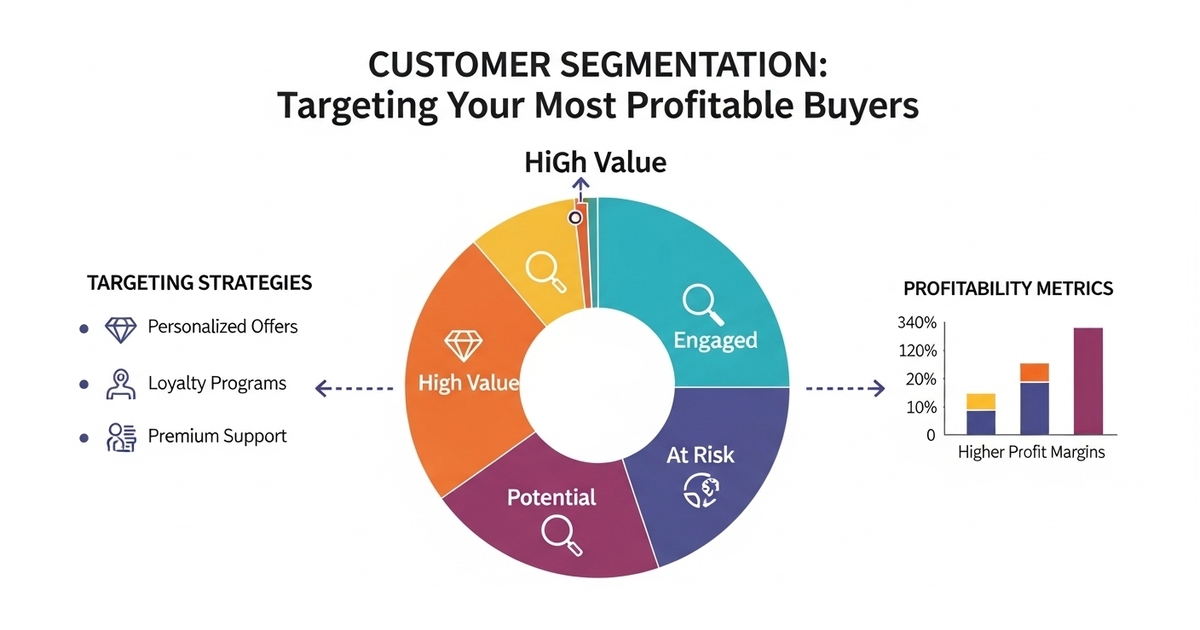
This is where Customer Segmentation comes in. It is the art of slicing your audience into specific groups so you can speak directly to their needs—and their wallets. Let’s break down how to stop guessing and start targeting the buyers who actually build your business.
The “Average Customer” Myth
Imagine you own a shoe store. The average shoe size for men is 10.5. If you only stocked size 10.5 shoes, you would go out of business.
Yet, businesses do this with their marketing every day. They create one “average” offer for an “average” customer.
Real growth happens at the edges.
- Segment A: Price-sensitive. They only buy on sale. (Treat them with discounts).
- Segment B: Value-driven. They buy full price but need high-touch service. (Treat them with VIP access).
- Segment C: Urgent. They need it yesterday and don’t care about the cost. (Treat them with speed).
When you treat Segment A like Segment B, you annoy them. When you treat Segment B like Segment A, you insult them. Segmentation is about respect. It is showing your customer that you understand their specific situation.
Deep Dive: 4 Ways to Slice the Pie
You can segment your customers in a hundred ways, but these four are the most practical for small businesses.
1. Demographic (The Basics)
Who are they?
- Age, Gender, Income, Location, Job Title.
- Example: “Male homeowners in Chicago aged 35-50.”
- Verdict: Necessary, but usually not enough on its own.
2. Psychographic (The “Why”)
What do they care about?
- Values, Interests, Lifestyle, Personality.
- Example: “Eco-conscious homeowners who value sustainability over cost.”
- Verdict: Powerful for messaging and brand voice.
3. Behavioral (The “What”)
What have they done?
- Purchase history, website visits, email opens.
- Example: “Customers who bought a coffee maker in the last 6 months but haven’t bought beans.”
- Verdict: Gold mine. This is the most actionable data you have.
4. Firmographic (For B2B)
The demographics of a business.
- Industry, Company Size, Revenue, Tech Stack.
- Example: “SaaS companies with 50-200 employees using Salesforce.”
- Verdict: Critical for B2B sales teams.
How to Find Your “Whales” (Your Best Buyers)
You don’t need a data scientist. You need to look at your existing sales data.
The RFM Model is a classic technique used by retailers, but it works for almost anyone.
- Recency: When was the last time they bought?
- Frequency: How often do they buy?
- Monetary Value: How much do they spend?
Rate your customers on a scale of 1-5 for each. Your “5-5-5” customers are your Whales.
- They bought recently.
- They buy often.
- They spend a lot.
The Strategy: Stop spending ad money trying to find “new people.” Spend money trying to find more people who look like your Whales.
- Upload your Whale email list to Facebook/Google to create a “Lookalike Audience.”
- Interview 5 of your Whales. Ask them, “Why did you choose us?” Their answer is your new marketing headline.
Actionable Tips for Segmented Marketing
1. The “Welcome” Fork In your welcome email series, ask a question. “What are you looking for today? A) I’m just browsing, B) I need a solution ASAP, C) I’m comparing options.” Based on their click, tag them in your CRM and send them down a different path.
2. The “Win-Back” Campaign Target customers who haven’t bought in 6 months (Low Recency). Send them a specific “We miss you” offer. Don’t send this to your active customers; it trains them to wait for coupons.
3. The VIP Tier Identify your top 10% of spenders. Send them a handwritten note or a surprise gift. Do not ask for anything. Just thank them. This builds insane loyalty and prevents churn. Check out our guide on building a customer loyalty program for more on this.
Customer Segmentation FAQ Section
Q: Can I have too many segments?
A: Yes. If you have 20 segments but only one marketing person, you will drown. Start with 2 or 3. (e.g., “New Prospects,” “Active Customers,” “Lapsed Customers”).
Q: I don’t have enough data yet. What do I do?
A: Start with qualitative research. Talk to your customers. Or, look at your competitors’ reviews. Who is leaving the 5-star reviews? That is the segment you want to target.
Q: Does this work for service businesses?
A: Absolutely. A plumber might segment by “Emergency Repair” (needs speed) vs. “Bathroom Remodel” (needs design advice). You wouldn’t send a “design trends” email to someone whose toilet is overflowing.
The Bottom Line
Customer Segmentation isn’t just a marketing tactic. It is a business strategy.
It allows you to allocate your limited resources (time, money, energy) to the places where they will generate the highest return. It stops you from chasing bad revenue and helps you double down on good revenue.
So, open your spreadsheet. Look at your list. Who are your Whales? Who are your time-wasters? Draw the line. And start marketing to the people who actually pay the bills.
Ready to find your best buyers? Before you segment, you need good data. Make sure you are using one of the best CRM tools for small businesses to capture and organize your customer info.