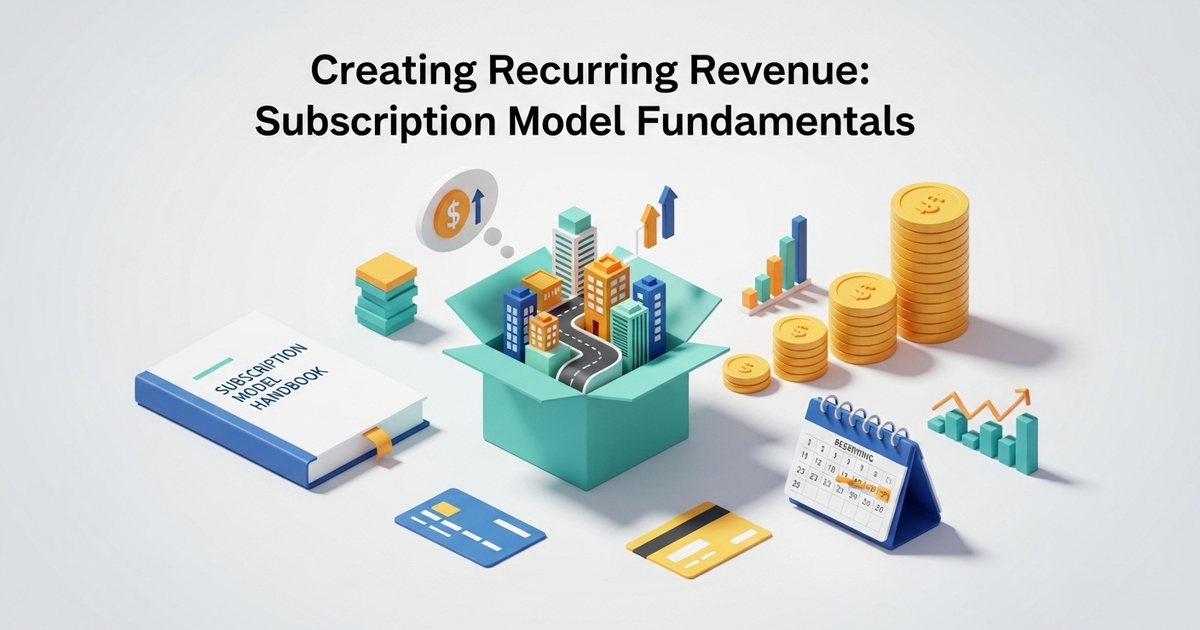
Creating Recurring Revenue: Subscription Model Fundamentals
There is a reason Netflix, Spotify, and even your local car wash want you to subscribe.
It is not just because they want your money every month (though they do). It is because recurring revenue is the holy grail of business.
When you sell one-off products or services, you wake up on the first of the month with $0 in sales. You have to hustle, grind, and sell just to get back to where you were last month. It is exhausting. It is stressful. And it makes planning for the future nearly impossible.
With a subscription business model, you wake up on the first of the month, and 80% of your revenue is already booked. You aren’t starting from scratch; you are building on a foundation.
This shift—from “hunting” for sales to “farming” relationships—changes everything. It changes your valuation (investors love recurring revenue), it changes your cash flow, and it changes your sleep quality.
But slapping a “Subscribe & Save” button on your website isn’t enough. You have to design a business that people want to pay for, month after month.
Let’s break down the fundamentals of building a subscription engine that actually works.
The “Forever Transaction”
The core of a subscription isn’t the billing cycle; it is the promise.
You aren’t selling a product; you are selling an outcome.
- Dollar Shave Club doesn’t sell razors; they sell “never running out of razors.”
- Costco doesn’t sell bulk goods; they sell “access to the best prices.”
- Adobe doesn’t sell software; they sell “always having the latest creative tools.”
If you want to build recurring revenue, stop asking, “How can I charge monthly?” and start asking, “What ongoing problem can I solve forever?”
Deep Dive: The 3 Types of Subscription Business Models
Most successful subscriptions fall into one of three buckets. Which one fits your business?
1. The Replenishment Model (Consumables)
This is for things people run out of. Coffee, vitamins, dog food, toilet paper.
- The Hook: Convenience. “Set it and forget it.”
- The Challenge: Competition. Amazon does this very well. To win, you need a brand people love or a product that is better than the generic option.
2. The Access Model (Membership)
This is for exclusive perks. Costco, Amazon Prime, or a VIP club for a clothing brand.
- The Hook: Status and savings. “I pay $100 a year to save $500 a year.”
- The Challenge: You have to constantly prove the value. If they don’t use the perks, they cancel.
3. The Curation Model (Discovery)
This is the “Box of the Month” club. Birchbox, BarkBox, Stitch Fix.
- The Hook: Surprise and delight. “I want to try new things without searching for them.”
- The Challenge: Churn. Novelty wears off. You have to keep the unboxing experience magical every single month.
How to Pivot to Recurring Revenue (Even if You Are a Service Business)
“But I run a plumbing company! I can’t sell subscriptions.”
Yes, you can.
Service businesses are actually the best candidates for recurring revenue because labor is expensive and trust is hard to build.
- The Plumber: Sell a “Home Wellness Plan.” For $29/month, the customer gets an annual inspection, priority booking, and 10% off all repairs.
- The Graphic Designer: Instead of charging $2,000 for a logo, charge $1,000/month for “unlimited design assets.” (This is the “productized service” model).
- The Consultant: Stop selling hours. Sell a “Retainer” for access to your brain and a monthly strategy call.
Actionable Tips for Reducing Churn
The enemy of subscriptions is Churn (cancellations). If you add 100 customers but lose 10, you grew by 90. If you lose 90, you are running in place.
1. The “dunning” Process This is a boring word for an important thing: what happens when a credit card fails? Up to 40% of churn is “involuntary”—meaning the customer didn’t want to cancel; their card just expired. Use tools like Stripe or ProfitWell to automatically email them and retry the card.
2. Remind Them of Value Don’t be the “silent” subscription that hopes they forget to cancel. Be the loud one. Send a monthly email: “Here is what you saved this month,” or “Here is what we did for you.” Remind them why they pay you.
3. The “Pause” Button Allow people to pause their subscription for a month instead of cancelling. Often, people just need a break (maybe they have too much coffee piled up). If you force them to cancel, you might never get them back. If you let them pause, they stay in the ecosystem.
The Financial Magic of MRR
Once you have this running, you track Monthly Recurring Revenue (MRR).
MRR is the heartbeat of your business. It allows you to:
- Forecast with accuracy: You know you can hire that new employee because the money is already booked.
- Invest in growth: You know your Customer Lifetime Value (LTV) is higher, so you can afford to spend more on ads to acquire customers (CAC).
If you need help calculating these metrics, check out our guide on KPI dashboards.
The Bottom Line
Recurring revenue isn’t just a billing preference; it is a relationship upgrade.
It transforms your business from a vending machine (transactional) into a partner (relational). It stabilizes your cash flow and builds an asset that is worth significantly more if you ever decide to sell.
So, look at your business. What problem are you solving once that you could be solving forever? Find that, and you find your subscription.
Ready to calculate your potential? Before you launch, run the numbers. Use our break-even analysis guide to see how many subscribers you need to cover your base costs and start profiting.