Net Promoter Score (NPS): Measuring and Improving Customer Satisfaction
We all want happy customers. We want 5-star reviews, glowing testimonials, and people shouting our brand name from the rooftops.
But how do you know if your customers are actually happy?
You might look at sales, but sales are a lagging indicator. A customer might buy from you today because they have no other choice, but hate the experience and plan to leave tomorrow.
You might look at support tickets, but most unhappy customers never complain. They just silently disappear.
This is where the Net Promoter Score (NPS) comes in. It is a simple, standardized metric used by everyone from Apple to your local coffee shop to measure customer loyalty.
It answers one brutal, honest question: “How likely are you to recommend us to a friend?”
If you aren’t tracking this, you are flying blind. You might be losing customers faster than you can find them and not even know why. Let’s break down exactly what Net Promoter Score is, how to measure it, and most importantly, how to improve it.
The Problem: Silence is Not Golden
The biggest myth in business is that “no news is good news.”
If your phone isn’t ringing with complaints, you assume everyone is satisfied. But studies show that for every customer who complains, 26 others remain silent. They just leave.
Net Promoter Score is your early warning system. It detects the smoke before the fire burns down your house. It gives a voice to the “silent majority” of your customer base, allowing you to fix issues before they become churn statistics.
Deep Dive: How NPS Works (The Math)
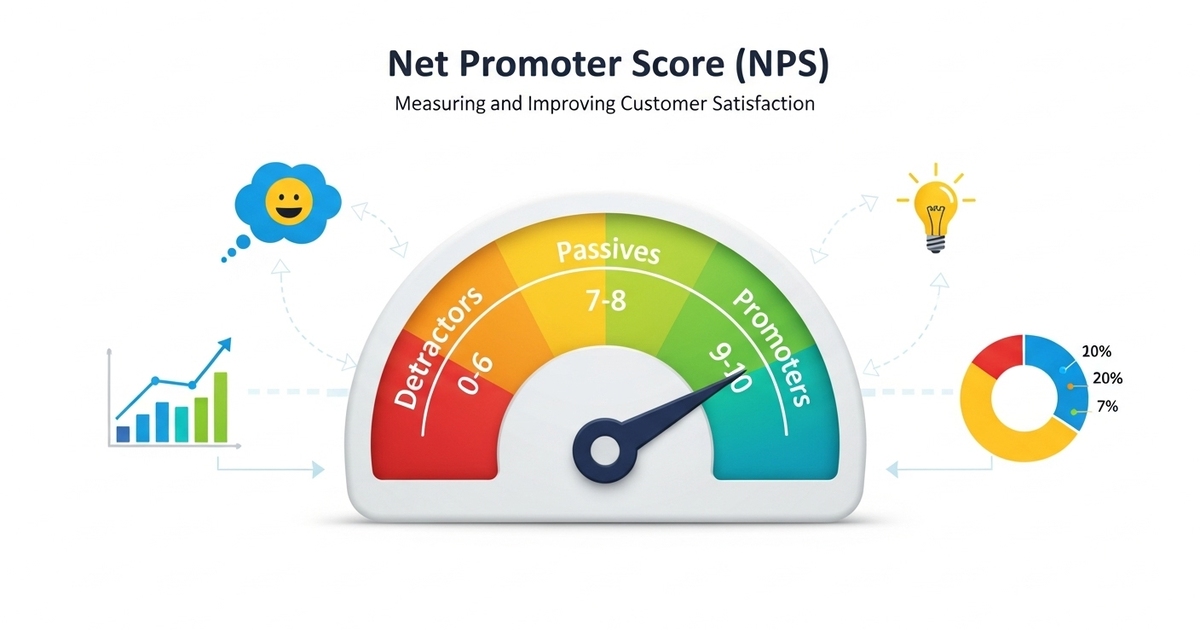
NPS is based on a single survey question: “On a scale of 0 to 10, how likely are you to recommend [Company Name] to a friend or colleague?”
Based on their answer, customers fall into three buckets:
- Promoters (Score 9-10): These are your superfans. They love you. They will keep buying and refer others.
- Passives (Score 7-8): These people are “meh.” They are satisfied but unenthusiastic. They are vulnerable to competitive offers.
- Detractors (Score 0-6): These represent trouble. They are unhappy and can damage your brand through negative word-of-mouth.
Calculating Your Score: Take the percentage of Promoters minus the percentage of Detractors. (Passives are ignored in the math).
- Example:
- 50% are Promoters
- 30% are Passives
- 20% are Detractors
- NPS = 50 – 20 = 30
Your score can range from -100 (everyone hates you) to +100 (everyone loves you).
What is a “Good” Score?
This is the most common question. It depends heavily on your industry.
- Software/SaaS: A good score is 40+. (Excellent is 60+).
- Retail: A good score is 50+.
- Internet Service Providers: A good score is… well, usually negative. (Sorry, Comcast).
Don’t obsess over the industry benchmark. Obsess over your trend line. Is your score higher today than it was last quarter? That is the only comparison that matters.
Improving Your Score: The “Close the Loop” Strategy
Measuring Net Promoter Score is useless if you don’t act on it. The magic happens in the follow-up.
1. The Detractor Strategy (Firefighting)
When someone gives you a 0-6, your system should trigger an immediate alert. Reach out within 24 hours. “I saw you weren’t happy with your experience. I’m the owner/manager. Can you tell me what happened?”
- The Goal: You probably can’t fix the past, but listening turns a Detractor into a Passive. Sometimes, just showing you care turns them into a Promoter.
2. The Passive Strategy (Activation)
These people are indifferent. You need to wow them. Ask them: “What is the one thing we could do to earn a 10 next time?” Their answers will build your product roadmap. They will tell you exactly what feature or service gap is holding you back.
3. The Promoter Strategy (Leverage)
These people already love you. Don’t sell to them. Activate them.
- Ask for a referral.
- Invite them to join your loyalty program.
- Most importantly, ask them to leave a review. Check out our guide on how to get more Google reviews to turn these promoters into a marketing engine.
Actionable Tips for Small Business Owners
1. Don’t Over-Survey Do not send an NPS survey after every single interaction. It is annoying. Send it once a quarter, or after a major milestone (like shipping a product).
2. Keep it Short The magic of NPS is its brevity. One question. Maybe one optional follow-up text box (“Why did you choose that score?”). That is it. If you add 10 more questions, your response rate will tank.
3. Share the Score with the Team Put your NPS score on a dashboard where everyone can see it. Read the comments out loud in your weekly meeting. Both the good and the bad. It connects your team to the reality of the customer experience.
4. Use Tools to Automate You don’t need to do this manually. Tools like Delighted, AskNicely, or even simple plugins for Shopify/WordPress can automate the sending and calculating. If you have a CRM tool, see if it has this feature built-in.
The FAQ Section
Q: Can I use NPS for employees?
A: Yes! It is called eNPS (Employee Net Promoter Score). “How likely are you to recommend working here to a friend?” It is a great pulse check on culture.
Q: My score is negative. Should I panic?
A: Panic? No. Act? Yes. A negative score means you have serious structural issues. You are likely burning cash on customer acquisition only to lose them. Stop selling and start fixing.
Q: Is NPS the only metric that matters?
A: No. It is a sentiment metric. You still need to track financial metrics like LTV. Review our guide on strategies to double customer lifetime value to see how sentiment translates to dollars.
The Bottom Line
Net Promoter Score is more than a number. It is a philosophy.
It forces you to acknowledge that your business exists to serve the customer, not the other way around. It keeps you honest.
So, set up the survey. Send it out. And be ready to listen to what comes back. The truth might hurt, but it is the only thing that will help you grow.
Ready to start measuring? Once you have your NPS system running, you need to ensure you have the right systems to manage the feedback. Make sure you have the essential tech infrastructure in place to handle the data.