E-commerce Expansion: From Local to National Shipping
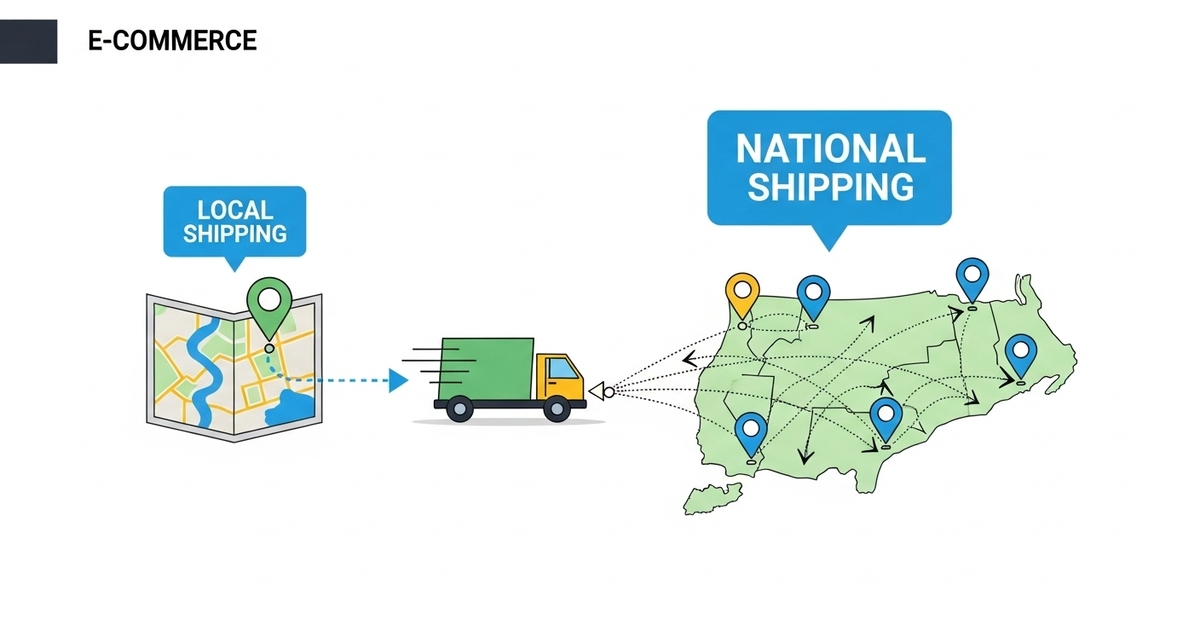
You have conquered your backyard.
People in your town know your brand. Your local delivery driver knows your name. You have mastered the art of the “porch drop-off.” It feels good.
But you know there is a ceiling. There are only so many customers in a 20-mile radius.
You look at your analytics and see people visiting your site from California, Texas, and New York. They add items to the cart, get to the shipping calculation, and… vanish.
That is the “National Expansion Gap.”
Crossing it is terrifying. Suddenly, you aren’t just competing with the shop down the street; you are competing with Amazon. You are dealing with shipping zones, dimensional weight, and the nightmare of a package getting crushed in a truck halfway across the country.
If you get this wrong, shipping costs will eat your margins alive. If you get it right, your Total Addressable Market (TAM) explodes from 50,000 people to 330 million.
Let’s talk about how to make Ecommerce Shipping Strategy that leap without losing your shirt.
The “Amazon Effect” Problem
Here is the brutal truth: Amazon ruined it for everyone.
Customers have been trained to expect two things:
- Fast shipping (2 days or less).
- Free shipping.
As a small business, offering both feels impossible. You don’t have a warehouse in every state. You don’t have Jeff Bezos’s negotiating power with UPS.
When you try to ship nationally, you run into the Zone Problem. Shipping a 2lb box to Zone 1 (nearby) might cost $8. Shipping that same box to Zone 8 (across the country) might cost $22.
If you charge the customer $22, they abandon the cart. If you charge $8 and eat the difference, you lose money on every sale.
This isn’t just a logistics issue. It is a math issue. You have to figure out how to move physical goods across a continent in a way that doesn’t bankrupt you.
Deep Dive: The Logistics of Scale
Before you buy a label printer and start praying, you need to understand the mechanics.
1. Dimensional Weight (The Silent Killer)
Carriers don’t just weigh your package; they measure it. If you ship a light item (like a pillow) in a huge box, they charge you for the space it takes up, not the weight.
- The fix: Your packaging strategy matters. You need the smallest box possible that still protects the product.
2. Fulfillment Strategy
You have three options:
- In-House: You pack boxes in your garage. (Good for control, bad for scaling).
- Dropshipping: The manufacturer ships it. (Low margin, zero control).
- 3PL (Third-Party Logistics): You send inventory to a warehouse, and they ship it. (Good for scale, but adds cost).
3. The “Unboxing” Experience
When you ship locally, maybe you hand-deliver it with a smile. When you ship nationally, the box is the smile. If it arrives dented or looks generic, you lose that brand connection.
Solutions: Structuring Your National Operations
You don’t need to be a logistics expert, but you do need a system.
Step 1: Audit Your Margins
Before you ship a single box to California, know your numbers. Cost of Goods Sold (COGS) + Customer Acquisition Cost (CAC) + Packaging + Shipping = Total Cost. If that number is higher than your selling price, stop. You need to either raise prices or lower shipping costs.
Step 2: Choose Your Shipping Software
Stop using the carrier’s website directly. It is too expensive and slow. Use tools like ShipStation, Shippo, or Easyship. They give you access to “commercial rates” (discounts) that are usually 20-40% cheaper than retail rates.
Step 3: Define Your Shipping Policy
You have three choices here:
- Real-Time Carrier Rates: The customer pays exactly what it costs. (Safe for you, bad for conversion).
- Flat Rate: “Shipping is $10 everywhere.” (Simple, but you lose money on far-away orders).
- Free Shipping: The conversion goldmine. But you have to bake the shipping cost into the product price.
Pro Tip: If you are wondering if your business is actually ready for this complexity, check our guide on the signs your business is ready to expand.
Actionable Tips to Win the Shipping Game
1. The “Free Shipping Threshold” Don’t offer free shipping on everything. Offer it on orders over $75. This forces the customer to add more items to their cart to “unlock” the deal. It covers your shipping cost and boosts your revenue. We have a whole guide on how to increase average order value using tactics like this.
2. Regional Carriers UPS and FedEx aren’t the only game in town. Look at regional carriers like LaserShip or OnTrac. They are often cheaper and faster within specific regions.
3. Split Your Inventory (Eventually) Once you have volume, use a 3PL with multiple warehouses (e.g., one in New York, one in Los Angeles). This keeps almost every customer in “Zone 1-3,” which slashes your shipping costs and delivery times. This is the core of a multi-region supply chain.
4. Insure High-Value Items If you sell expensive goods, porch pirates are a real risk. Carrier liability is limited. Third-party shipping insurance is cheap (often 1% of value) and saves you from eating the cost of lost packages.
5. Automate Returns National customers will return things. Make it easy. Include a prepaid return label in the box (you only pay if they use it) or use a returns portal. A difficult return policy is a conversion killer.
The FAQ Section
Q: Should I offer international shipping right away?
A: Honestly? No. Master national shipping first. International involves customs, duties, and massive delays. Don’t fight a two-front war.
Q: When should I hire a 3PL?
A: When you are spending more time taping boxes than working on marketing. Usually, around 100-300 orders a month is the tipping point where your time is worth more than the fulfillment fee.
Q: How do I handle “Remote Area Surcharges”?
A: Carriers charge extra for delivery to the middle of nowhere. You can’t avoid them easily. Just absorb it as the cost of doing business, or use a flat-rate margin buffer to cover the occasional expensive shipment.
The Bottom Line
Going national changes your business from a “shop” to a “brand.”
It is a logistical challenge, yes. But it is mostly a mindset shift. You stop being the person who hands the bag to the customer and start being the architect of a system that delivers your brand promise to a doorstep 2,000 miles away.
Start small. Test your packaging. Watch your margins like a hawk. And once you dial it in, the whole country is open for business. Ready to calculate the risks? Before you sign that contract with a shipping carrier, make sure you understand the liability. Check out our insights on protecting your business from legal risks to ensure your terms of service cover shipping disputes.