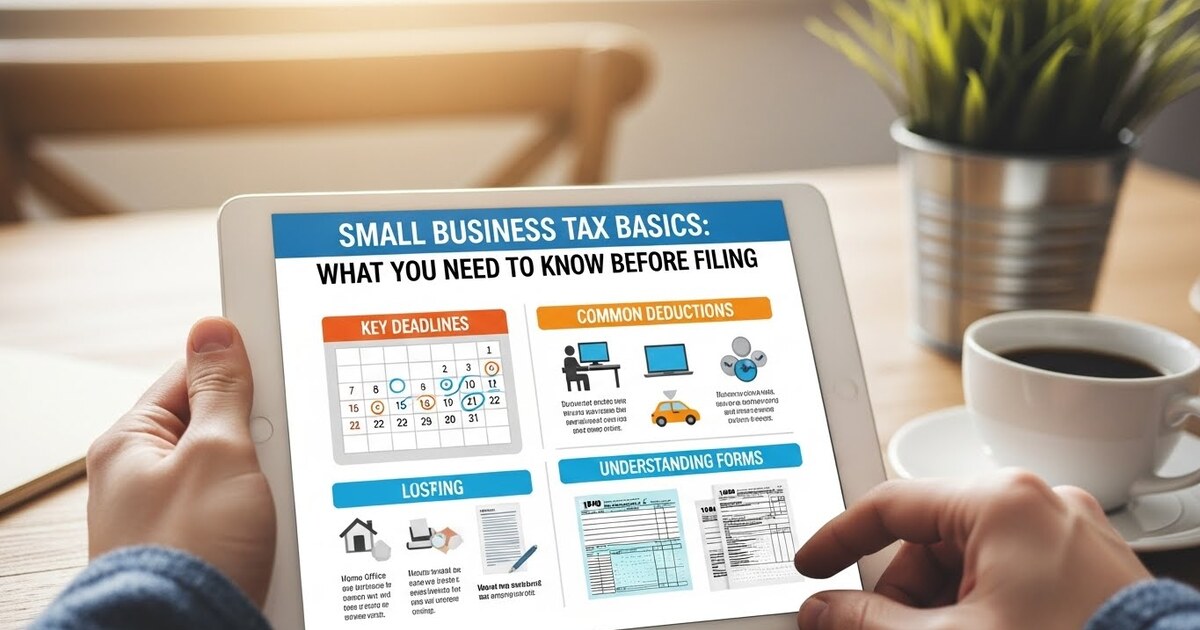
Small Business Tax Basics: What You Need to Know Before Filing
For the small business owner, taxes often feel like a once a year thunderstorm—a period of frantic scrambling, overwhelming paperwork, and a fearful glance at the bottom line. This reactive approach is not only stressful but financially perilous. Tax compliance is not an annual event; it is a continuous, integral part of your business strategy. Understanding the fundamentals is not about becoming a tax expert, but about becoming a prepared and proactive business leader. It is the difference between being a victim of a complex system and being an active participant who leverages the rules to build a more resilient enterprise.
This guide walks you through the essential landscape of small business taxation, providing the map you need to navigate confidently, minimize liability legally, and avoid the common pitfalls that can derail a thriving business.
Filing Small Business Taxes:
The Foundational Mindset: Taxes as a Year Round Operational Cost
The most critical shift is to stop viewing taxes as a singular, painful annual bill. Instead, treat your tax obligation as a recurring operational cost, like rent or payroll. This mindset dictates behavior: you must plan for it, account for it monthly, and fund it consistently. Money collected for sales tax or estimated to cover income tax is not your profit; it is a held liability. Adopting this perspective is the first and most important step toward financial control and peace of mind.
Your Business Structure: The Tax Identity Blueprint
The legal structure you chose at inception is not just about liability; it is your tax blueprint. It dictates how and when your business income is taxed.
- Sole Proprietorship/Partnership: The business is not a separate tax entity. Profits and losses “pass through” to your personal tax return (Schedule C for sole props, Form 1065 for partnerships, with a K 1 flowing to your personal return). You pay income tax and self employment tax (Social Security and Medicare) on the net profit. This is simple but offers no separation between business and personal income for tax purposes.
- Limited Liability Company (LLC): By default, a single member LLC is taxed as a sole proprietorship, and a multi member LLC as a partnership. However, an LLC can elect to be taxed as an S Corporation or a C Corporation, providing flexibility.
- S Corporation: This is a tax election, not a structure. It allows profits (and losses) to pass through to shareholders’ personal tax returns, avoiding the double taxation of a C Corp. However, owners who work in the business must be paid a “reasonable salary” subject to payroll taxes; remaining profits can be distributed as dividends, which are not subject to self employment tax. This can offer significant savings but comes with strict eligibility and payroll formalities.
- C Corporation: The corporation is a separate taxpayer. It files its own return (Form 1120) and pays corporate income tax on its profits. If profits are then distributed to owners as dividends, the shareholders pay personal income tax on those dividends. This “double taxation” is a key drawback, but C Corps can be advantageous for businesses planning to reinvest profits or seek venture capital.
Understanding your structure’s tax implications is essential. A consultation with a tax professional when forming your business or experiencing significant growth is a strategic investment.
The Core Tax Obligations: Beyond the Income Tax Return
Your yearly income tax filing is only one piece of the puzzle. Small businesses typically navigate a triune of tax responsibilities.
1. Income Taxes (Federal & State)
This is the tax on your business’s annual profit. For pass through entities (sole props, partnerships, S Corps, most LLCs), this is paid as part of your personal income tax. Because no tax is withheld from business profits, the system requires quarterly estimated tax payments. You must estimate your annual tax liability and pay it in four installments (April, June, September, and January of the following year). Failure to do so can result in underpayment penalties. This is why setting aside a percentage of all income is non negotiable.
2. Self Employment Taxes (or Payroll Taxes)
This is the how you pay into Social Security and Medicare. For sole proprietors and partners, this is the self employment tax (Schedule SE), calculated on your net business earnings. For corporations (S or C) and LLCs electing corporate treatment, these taxes are handled through payroll. Owners and employees pay half via withholding, and the business pays the other half. Managing payroll taxes accurately and on time is critical, as the penalties for errors or late deposits are severe.
3. Employment Taxes (If You Have Employees)
The moment you hire an employee, you become a tax collector for the government. You are responsible for:
- Withholding federal and state income tax from their wages.
- Withholding and matching Social Security and Medicare (FICA) taxes.
- Paying Federal and State Unemployment Insurance (FUTA & SUTA).
- Filing quarterly payroll tax returns (Form 941) and annual forms (W 2, W 3).
Using a dedicated payroll service (like Gusto, OnPay, or ADP) is highly recommended to automate calculations, filings, and payments, ensuring compliance and avoiding costly mistakes.
4. Sales Tax (If You Sell Taxable Goods or Services)
This is a state and local tax, not federal. If you sell physical products or certain services, you likely need a seller’s permit from your state and must collect sales tax from customers at the point of sale. You then hold that money in trust and remit it to the state, usually quarterly or monthly. The rules are complex, varying by state and even by city, and have been further complicated by online sales. Knowing your “nexus” (a physical or economic presence requiring collection) is essential.
The Strategic Tool: Deductible Business Expenses
The tax code allows you to subtract ordinary and necessary business expenses from your revenue to arrive at your taxable profit. This is not about “creative accounting”; it is about accurately reflecting the true cost of doing business. Key categories include:
- Cost of Goods Sold (COGS): Direct costs of your product (materials, wholesale inventory, direct labor).
- Operating Expenses: Rent, utilities, marketing, software subscriptions, professional fees (including legal and accounting), insurance, bank fees.
- Vehicle Expenses: Either the actual costs of business related miles or the standard mileage rate.
- Home Office Deduction: If you have a dedicated, regular space used exclusively for business, you may deduct a portion of your home expenses (mortgage interest, rent, utilities, insurance).
- Equipment & Depreciation: Computers, machinery, and furniture are typically not fully deducted in the year purchased. They are “capitalized” and depreciated over their useful life, though “Section 179” expensing may allow a full write off in the purchase year.
The Golden Rule: Documentation is everything. You must have receipts, invoices, mileage logs, and bank/credit card statements to substantiate every deduction. A digital system using apps like Dext or Expensify to capture receipts is invaluable.
The Annual Cycle: A Timeline for Sanity
To avoid the annual storm, integrate these tasks into your business calendar.
Ongoing (Every Month):
- Reconcile your books in your accounting software (QuickBooks, Xero, etc.).
- Set aside 25 30% of net income for taxes in a separate savings account.
- File and pay sales tax (if applicable).
- Run and remit payroll taxes (if applicable).
Quarterly (January, April, June, September):
- Prepare and pay estimated federal and state income tax payments (Form 1040 ES).
- File quarterly payroll tax return (Form 941).
Annually (January March):
- Provide W 2 forms to employees and 1099 NEC forms to contractors (by January 31st).
- Gather all your financial records, reconciled books, and expense documentation.
- Work with your accountant to file your business and personal tax returns (due April 15th, with extensions possible).
The Non Negotiable Partnership: Working with Professionals
You are an expert in your business, not in tax law. A qualified, proactive accountant or enrolled agent is not an expense; they are a strategic partner. Their value extends far beyond filing a return. They can:
- Ensure you are using the most advantageous business structure.
- Identify all legitimate deductions you may miss.
- Guide your estimated tax payments to avoid penalties without overpaying.
- Represent you in the event of an audit.
- Provide strategic advice on timing purchases or other financial decisions for tax efficiency.
Invest time in finding a professional who understands small business taxes in your industry and communicates clearly. Provide them with clean, reconciled books—this saves you money in their fees and ensures accuracy.
Mastering these basics transforms your relationship with business taxes. It moves the process from the shadows into the clear light of strategy. You stop fearing the unknown and start managing a known, planned for operational cost. This knowledge empowers you to build a business on a foundation of compliance and clarity, freeing you to focus on what you do best: growing your enterprise with the confidence that its financial and legal foundations are sound. The goal is not to eliminate your tax bill, but to understand it, plan for it, and ensure you never pay a dollar more than you legally should.
Also Read: How to Read Financial Reports Without an Accounting Background