Essential Tech Infrastructure Every Small Business Needs
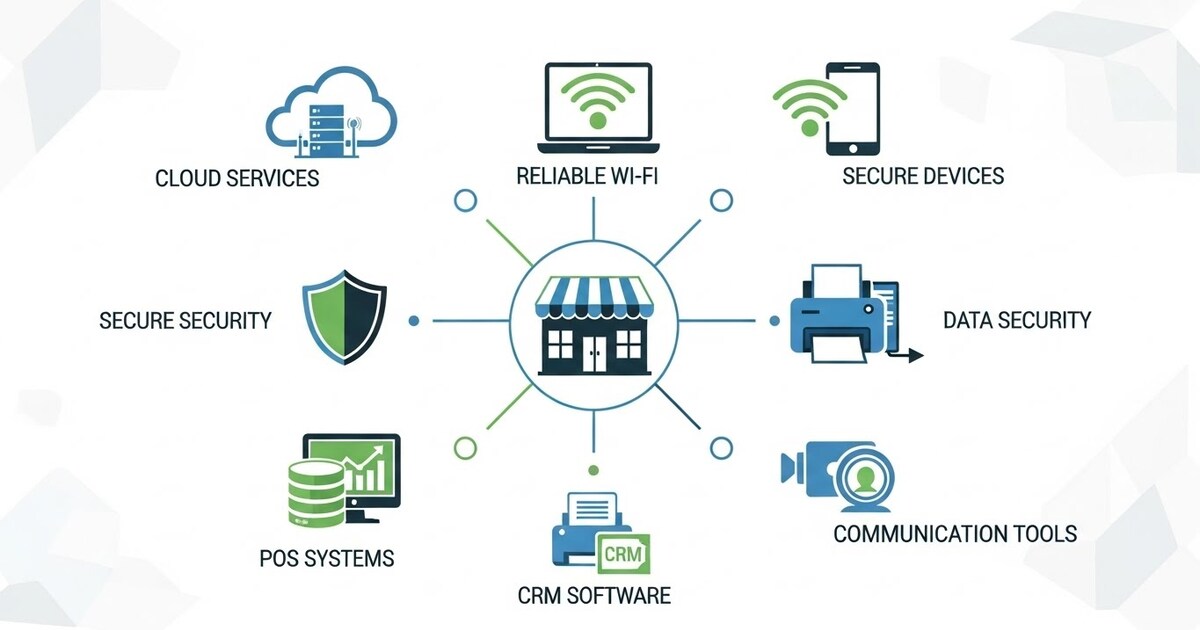
For a small business, technology is rarely the star of the show. The focus is rightly on the product, the service, the customer. Yet, beneath every successful modern enterprise hums an invisible engine—a foundational tech infrastructure. This is not about flashy gadgets or chasing trends; it is about the fundamental, often unseen, systems that provide stability, security, and scalability. Without this foundation, a business operates on digital quicksand, vulnerable to disruption, inefficiency, and catastrophic loss.
Investing in this core IT infrastructure is the single most important technical decision an owner can make. It is the difference between a hobby that uses email and a professional entity built to last. This framework outlines the non-negotiable layers of technology that form the bedrock of a resilient, modern small business.
Setting Up IT Infrastructure for Small Business:
The First Layer: Professional Communication and Identity
Before a single sale is made, a business must establish a credible, consistent identity. This begins with how you present yourself to the world.
A Custom Domain and Professional Email is the absolute baseline. Using a generic email address (e.g., yourbusiness@gmail.com) instantly erodes trust and appears amateurish. Purchasing a domain (yourbusiness.com) and connecting it to a professional email service like Google Workspace or Microsoft 365 is the first step toward legitimacy. These platforms provide more than just email; they offer custom addresses (you@yourbusiness.com), integrated calendars, professional video meeting tools (Google Meet, Microsoft Teams), and cloud storage. This creates a unified professional identity and becomes the hub for all internal and external communication.
A Reliable Business Internet Connection is the artery of this system. A residential-grade internet plan is insufficient. Invest in a business-class connection from your local provider. These plans typically offer higher reliability, better customer support with service level agreements, and static IP addresses if needed for hosting services. Your business cannot afford to be offline during a critical client video call or while processing transactions.
The Second Layer: Secure Operations and Data Integrity
Once you have an identity, you must protect the lifeblood of your business: its data. This includes financial records, client information, proprietary processes, and intellectual property.
Cloud-Based Storage and Backup is the modern standard. Relying on a single physical computer is a recipe for disaster. A service like Google Drive, Dropbox Business, or Microsoft OneDrive acts as your primary, secure file repository. It allows for easy collaboration, version history, and access from any device. Crucially, this must be paired with a separate, automated backup solution. A tool like Backblaze or Carbonite performs continuous, encrypted backups of all company devices to an offsite location. This follows the 3-2-1 backup rule: three copies of your data, on two different media, with one copy offsite. A fire, theft, or ransomware attack can destroy your hardware, but with this system, your business data remains intact and recoverable.
Cybersecurity Fundamentals are not optional. This infrastructure includes a business-grade firewall/router (often provided by your internet service provider for business accounts), reliable antivirus/anti-malware software on all devices, and the systematic use of a Password Manager like 1Password or LastPass. A password manager generates and stores complex, unique passwords for every service you use, protecting you from the domino effect of a single password breach. This layer is your digital lock and key, and it must be robust from day one.
The Third Layer: Financial and Customer Management Systems
With secure operations in place, you need systems to manage your commercial reality. This is the software that tracks money and relationships.
Cloud Accounting Software is the ledger of the 21st century. Platforms like QuickBooks Online, Xero, or FreshBooks do far more than bookkeeping. They connect to your business bank accounts, automate transaction imports, streamline invoicing with online payment options, track expenses via mobile receipt capture, and generate real-time financial reports. This gives you an instantaneous, accurate view of your profitability and cash flow—the most vital signs of your business’s health.
A Customer Relationship Management (CRM) System is the organized memory for your client interactions. For a small business, this can start simply within your email and calendar system, but quickly evolves into a dedicated platform like HubSpot CRM (which has an excellent free tier), Copper, or Pipedrive. A CRM ensures no lead falls through the cracks, tracks communication history, and manages sales pipelines. It turns ad hoc relationships into a scalable, manageable process.
The Fourth Layer: Core Productivity and Collaboration Tools
This layer is about how your team works together effectively, whether that team is two people or twenty. It replaces chaotic, ad-hoc methods with clear, efficient processes.
A Centralized Project and Task Management tool is essential. Even a solo entrepreneur needs to track projects. Tools like Asana, Trello, or ClickUp provide a single source of truth for what needs to be done, by whom, and by when. They eliminate the chaos of sticky notes, forgotten email promises, and unclear priorities.
A Dedicated Business Communication Platform separates work from personal chatter. While email is for formal, external communication, an internal tool like Slack or Microsoft Teams is for quick coordination, team announcements, and focused project channels. This drastically reduces internal email clutter and creates a searchable archive of team decisions and discussions.
The Fifth Layer: Your Digital Front Door – Online Presence
This is the part of your IT infrastructure that customers and prospects actually see. It must be stable, professional, and aligned with your brand.
A Professional Website is your always-open storefront. Using a modern website builder like Wix, Squarespace, or WordPress with a reliable hosting provider, you can create a site that is mobile-friendly, secure (HTTPS), and easy for you to update. This site must clearly articulate what you do, who you serve, and how to contact you.
A Consistent Social Media Presence is an extension of this front door. Claim your business name on relevant platforms (e.g., Facebook, Instagram, LinkedIn) to protect your brand identity. Use tools like Buffer or Later to plan and schedule content consistently, making this manageable within a busy schedule.
Implementing the Infrastructure: A Phased Approach
Building this engine need not be overwhelming. Implement it in phases, starting with the fundamentals that protect and legitimize your business.
Phase 1: Identity & Security (Weeks 1-2)
Purchase your domain, set up professional email with Google Workspace/Microsoft 365, and establish a cloud backup system. Install a password manager for all founders.
Phase 2: Financial Core (Month 1)
Subscribe to and set up your cloud accounting software. Connect your business bank account and begin categorizing transactions.
Phase 3: Operations & Collaboration (Month 2)
Implement your core project management and internal communication tools. Migrate team discussions and task tracking into these systems.
Phase 4: Visibility & Growth (Ongoing)
Launch your professional website. Establish your social media profiles. As you grow, deepen your use of the CRM and explore more advanced features of your existing tools.
This IT infrastructure is not a cost center; it is the platform upon which all growth is built. It provides the stability to withstand shocks, the clarity to make smart decisions, and the efficiency to scale without proportional increases in chaos. By deliberately constructing this invisible engine, you ensure that your business’s creative energy and hard work are supported by a foundation that is as professional, resilient, and ambitious as you are. You move from working in your business to working on it, with the confidence that your operational base is secure, allowing you to focus entirely on serving your customers and realizing your vision.