Community Events & Sponsorships: Building Brand Authority Locally
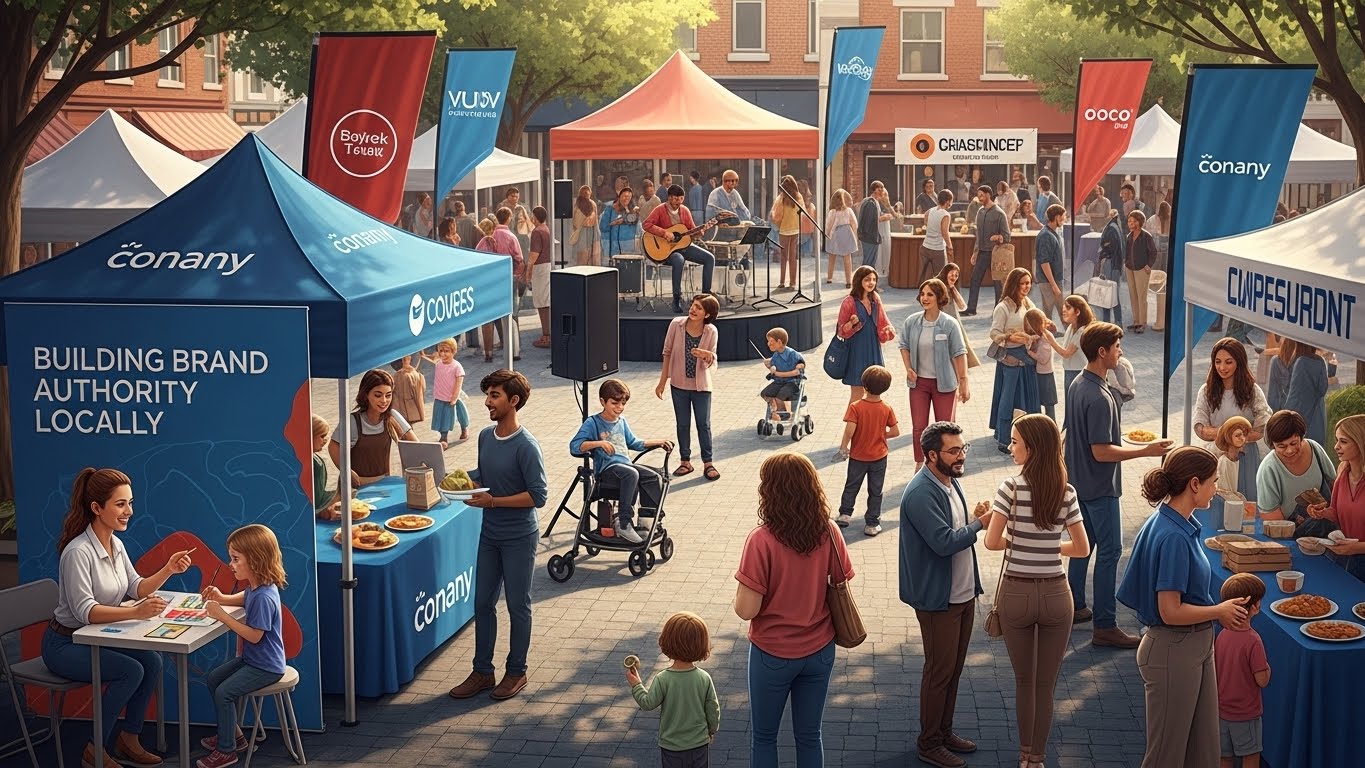
In the digital age, we obsess over click-through rates, bounce rates, and algorithm updates. We spend thousands of dollars on invisible ads served to strangers who scroll past them in milliseconds. Yet, for local businesses plumbers, real estate agents, dentists, law firms the most potent marketing weapon is often sitting right in their backyard, completely ignored.
It is the Community Event.
However, most businesses get this wrong. They write a check for $500 to the local Little League, get their logo slapped on a dusty banner in the outfield, and call it “marketing.” Then they wonder why they didn’t get any leads. That is not sponsorship; that is charity. And while charity is noble, it is not a business strategy.
True local authority is built when you transition from being a “Passive Donor” to an “Active Partner.”
This guide will deconstruct how to leverage community events and sponsorships to dominate your local market. We will explore how to choose the right partners, how to extract powerful SEO value (backlinks) from these relationships, and how to turn a handshake at a Saturday fair into a signed contract on Monday morning.
Phase 1: The Philosophy of Hyper-Local Authority
Why do community events work when Facebook ads are getting more expensive? The answer lies in Trust and Proximity.
When a homeowner sees your truck wrapped in the driveway of their neighbor, they notice. When they see you shaking hands at the town charity gala, they trust. When they see your logo on the local high school’s football schedule, they recognize.
This creates the “Everywhere Effect.”
The goal of local sponsorship is not immediate direct response (though that can happen). The goal is to occupy mental real estate so that when the need arises when the pipe bursts or the house needs to be sold you are the only option that feels safe and familiar.
The “E-E-A-T” Connection
From an SEO perspective, Google prioritizes Experience, Expertise, Authoritativeness, and Trustworthiness (E-E-A-T).
- Trustworthiness: Being listed on the website of a local Chamber of Commerce or a local non-profit signals to Google that you are a legitimate, active entity in that specific geolocation.
- Relevance: A backlink from a local high school (often a .edu domain) or a local charity (a .org domain) is geographically hyper-relevant. It tells Google, “This business belongs to this city.”
Phase 2: The Selection Filter (Stop Wasting Money)
You cannot sponsor everything. If you try to be everything to everyone, you end up being nothing to anyone. You need a filter to decide where to invest your marketing dollars.
1. The Audience Overlay
Does the event attendee match your Ideal Client Profile (ICP)?
- Bad Match: A high-end custom home builder sponsoring a college frat party.
- Good Match: A high-end custom home builder sponsoring a local “Architecture & Garden Tour.”
2. The “Digital” Deliverables
Before you sign the check, ask what digital assets come with the sponsorship.
- Do they have a website?
- Will they link to your website? (This is non-negotiable).
- Do they have an email list? Will they send a blast featuring your brand?
- Do they have active social media? Will they tag you?
If the event organizer says, “We will put your logo on the flyer,” negotiate harder. You want the digital footprint, not just the paper one.
3. Exclusivity
Avoid “Logo Soups.” A “Logo Soup” is a banner with 50 different business logos, all the size of a postage stamp. No one reads these.
- The Strategy: Offer to pay double the entry fee to be the Exclusive Sponsor of a specific element. Instead of being one of 10 “Gold Sponsors,” be the “Exclusive Sponsor of the Wi-Fi” or the “Exclusive Sponsor of the Hydration Station.” Dominate a specific touchpoint.
Phase 3: The SEO Goldmine (Extracting the Link)
This is the step 90% of business owners miss. A sponsorship is the easiest, safest, and most powerful way to build local backlinks (citations).
The “.edu” and “.org” Strategy
Links from educational institutions (.edu) and non-profits (.org) carry massive weight with search engines because they are highly trusted and rarely link to spam.
- The Play: Sponsor a specific program at a local school (e.g., “The [Your Brand] Science Scholarship”).
- The Ask: Require that the school lists the scholarship on their website with a direct link back to your “Community” or “About” page.
The “Media Sponsor” Hack
If you don’t have the cash to sponsor an event, sponsor it with service.
- The Scenario: A local charity 5K run needs photos.
- The Offer: You (or a photographer you hire) will provide high-quality photos of the event for free.
- The Exchange: In return, the charity lists you as the “Official Media Partner” on their site with a do-follow backlink.
- The Bonus: When they post the photos on Facebook, they tag your business page. “Photos provided by [Your Business].”
Creating a “Community” Page on Your Site
To complete the loop, create a dedicated page on your website titled “In The Community.”
- List every organization you support.
- Write a short paragraph about why you support them.
- Link out to them.
- Why? This creates a “hub” of local relevance. It proves to Google (and customers) that you are deeply embedded in the local fabric.
Phase 4: Activation (Boots on the Ground)
You’ve paid the money. You’ve got the link. Now, it’s showtime. Do not just set up a folding table with a bowl of candy and a stack of brochures. That is invisible.
You need an Activation Strategy.
The “Value Exchange” (Data Collection)
Your goal is to get names, emails, and phone numbers. People will not give you this information for a newsletter subscription. They will give it to you for something they want now.
- The Roofer: Don’t give away pens. Set up a “Cornhole Competition” where the winner gets a Yeti cooler. To enter, they scan a QR code.
- The Chiropractor: Don’t hand out flyers. Bring a massage chair. To get a 5-minute free massage, they fill out a digital waiver (lead capture).
- The Realtor: Don’t hand out business cards. Sponsor a “Pet Photo Booth” at a local festival. You take professional photos of their dogs. To get the photo emailed to them, they provide their email address.
The “Human” Element
Send your best people. Do not send the grumpy intern who sits on their phone the whole time. Send the owner or the top sales rep someone who can look a potential client in the eye, shake their hand, and build rapport.
- Uniforms: Wear branded polo shirts. Look professional, approachable, and cohesive.
Phase 5: Hosting Your Own Event (The Ultimate Authority)
Once you have mastered sponsoring other people’s events, the next level is creating your own. This shifts the dynamic from “Participant” to “Leader.”
The Educational Seminar
If you are in a service industry (Finance, Real Estate, Law, Solar), education is your best sales tool.
- Example: A “First-Time Homebuyer Workshop” hosted at a local brewery.
- The Hook: Buy the first round of drinks.
- The Authority: You stand at the front of the room. You control the slides. You are the expert.
The “Client Appreciation” Event
Retention is cheaper than acquisition. Host an annual BBQ, a “Movie Night in the Park,” or a “Pumpkin Patch” day for your past clients.
- The Viral Effect: Encourage them to bring a friend. Now you are meeting warm referrals in a low-pressure, high-fun environment.
- The Social Proof: Hire a photographer. The photos from this event become your social media content for the next three months. It shows prospects: “Look how many happy people trust this business.”
Phase 6: Measuring ROI (Did It Work?)
The biggest criticism of event marketing is that it is hard to track. It isn’t, if you prepare.
1. The QR Code / UTM Method
Never put your generic homepage URL (e.g., smithplumbing.com) on a flyer or banner.
- Create a specific landing page:
smithplumbing.com/fall-festival. - Or use a tracked QR code.
- This allows you to see exactly how many people scanned or visited from that specific event.
2. The “Offer Code”
Create a discount code specific to the event.
- “Mention ‘LITTLE LEAGUE’ for $50 off your first service.”
- Track usage in your CRM.
3. The “How Did You Hear About Us?” Field
This is mandatory. Every time a new lead calls or fills out a form, this question must be asked.
- If they say, “I saw your tent at the Strawberry Festival,” attribute that revenue to the event budget.
Phase 7: The “Social Amplification” Cycle
The event lasts for one day. The content should last for one month.
Pre-Event
- Post on social media: “We are excited to see everyone at the County Fair this Saturday! Come by Booth 42 for a chance to win a TV.”
- Tag the event organizer. (They will likely share your post).
During Event
- Go Live on Facebook/Instagram. Show the crowd. Interview happy visitors.
- Take photos of your team having fun.
Post-Event
- Write a blog post: “Recap of the 2024 County Fair.” Include photos.
- Send an email blast to the leads you collected: “It was great meeting you on Saturday! Here is the info you requested…”
Also Read:
Conclusion: It’s About Planting Flags
Building brand authority locally is a game of territory. You want to plant your flag in as many high-quality locations as possible both physical (events) and digital (backlinks).
When you combine the SEO power of local sponsorships with the relationship-building power of face-to-face activation, you create a moat around your business. Competitors can buy ads, but they cannot buy the handshake you had with the mayor or the trust you built by supporting the local high school.
Your Action Plan: The Local SEO Checklist: Ranking #1 in Your City Without Ads
- Audit: Look at where you are currently spending sponsorship money. Are you getting a backlink? Are you getting leads?
- Research: Find 3 local non-profits or events that align with your ideal customer.
- Outreach: Contact them today. Do not ask for a sponsorship package. Ask: “How can we partner to help you, and how can we get visibility on your digital channels?”
Start showing up. Start shaking hands. Start building your empire, one community event at a time.
Frequently Asked Questions (FAQ)
Q: How much should a small business budget for sponsorships?
A: There is no fixed rule, but a healthy marketing budget is usually 5-10% of gross revenue. Of that marketing budget, dedicate 15-20% to local brand/community building. The rest should go to direct-response channels (SEO, PPC).
Q: What if the event organizer doesn’t have a website?
A: This is a red flag. In the modern era, if an event doesn’t have a website, it likely lacks the organization and reach to bring you value. Unless it is a tiny, hyper-local gathering that gets you face-to-face with your exact high-value clients, skip it. You need the digital signal.
Q: Is it better to sponsor one big event or ten small ones?
A: Generally, depth beats width. Sponsoring one major event where you can be the “Title Sponsor” (e.g., “The Smith Plumbing Main Stage”) usually generates more recall and authority than being a tiny logo on ten different flyers. However, ensure that one big event perfectly matches your target demographic.
Q: How do I say “No” to sponsorship requests without looking like a jerk?
A: You will get asked constantly. Have a polite, pre-written script: “Thank you for thinking of us. We have already allocated our community budget for this year to [Charity A] and [Charity B], which align with our company’s mission. We wish you the best of luck!” This shows you are charitable, just strategic.
Q: Can I sponsor an event if I don’t have a physical storefront?
A: Absolutely. Service area businesses (plumbers, roofers, mobile detailers) benefit more from events because they don’t have a storefront for people to see. The event tent becomes your temporary storefront. Bring your branded truck and park it nearby for extra visibility.