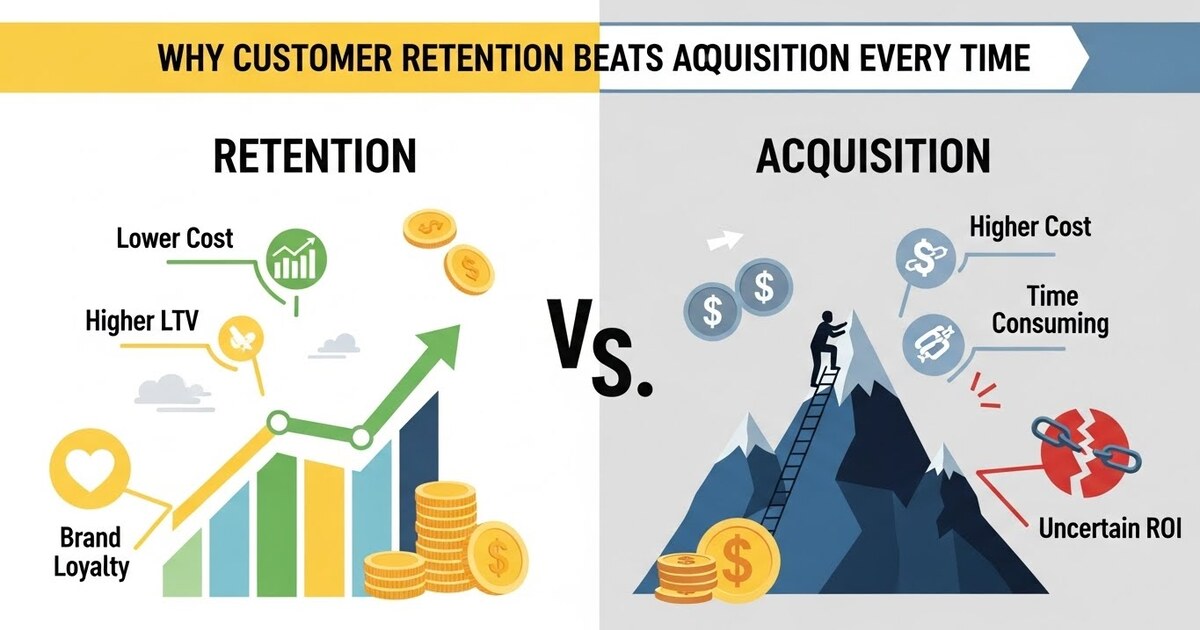
The Growth Engine: Why Customer Retention Beats Acquisition Every Time
There is an addiction in the business world, and it is fueled by the “Closed Won” notification.
For decades, the glory in business has belonged to the “Hunters” the sales teams bringing in fresh logos, the marketers generating thousands of leads, and the founders ringing the bell for every new signup. We are culturally wired to celebrate the start of the relationship.
But in 2025, the mathematics of growth have shifted. The “Acquisition at All Costs” era is dead, killed by rising ad costs, saturated markets, and a more discerning consumer base.
If you are pouring 90% of your budget into finding new customers and only 10% into keeping them, you are not building a business; you are running on a hamster wheel. You are running faster and faster just to stay in the same place.
This article is the manifesto for the “Farmers.” It is a deep dive into Customer Retention vs Acquisition and why Customer Retention, not Acquisition, is the true engine of exponential growth, backed by the brutal reality of financial metrics.
Customer Retention vs Customer Acquisition
I. The Economic Reality: The “CAC” Crisis
To understand why retention wins, we must look at the cost of the alternative.
Customer Acquisition Cost (CAC) the money you spend on ads, sales commissions, and marketing tools to get one customer has skyrocketed.1 In B2B software alone, CAC has risen by over 60% in the last five years. In e-commerce, changes to privacy laws (like iOS updates) have made Facebook and Google ads significantly less efficient.
The “5x to 25x” Rule
It is a statistic cited so often it has become a cliché, yet few businesses act on it: It costs between 5 and 25 times more to acquire a new customer than to retain an existing one.
Why?
- Friction: A prospect doesn’t trust you yet. You have to pay to educate them, overcome their objections, and incentivize them to switch.
- Trust: An existing customer already knows the product works. The friction is zero.
The Profitability Gap
Consider two companies starting with $100,000 in revenue.
| Feature | Company A (The Hunters) | Company B (The Farmers) |
| Focus | Aggressive Acquisition | Aggressive Retention |
| Strategy | Spend heavily on ads to get new users. | Spend heavily on support & success to keep users. |
| Churn Rate | 15% (High) | 3% (Low) |
| CAC Payback | 12 Months | 4 Months |
| Result | Revenue grows fast initially, but profits are eaten by ad spend. | Revenue grows steadily, but profit margins explode because recurring revenue is “free.” |
The Takeaway: Acquisition buys you revenue. Retention buys you profit.
II. The Leaky Bucket Theory: You Cannot Fill a Sieve
Imagine your business is a bucket.
Acquisition is the water you pour in at the top (New Customers).
Retention is the integrity of the bucket itself.
Churn is the hole in the bottom.
If you have a massive hole in the bottom (high churn), it does not matter how wide you open the tap. You will never fill the bucket. In fact, you will go bankrupt trying to pay for the water bill.
The Silent Killer: Churn
Churn is not just “losing a customer.” It is losing all the future revenue that customer would have generated.
- If you lose a customer who pays $100/month, you didn’t just lose $100. You lost their Customer Lifetime Value (LTV). If the average customer stays for 3 years, you just lost $3,600.
The “Negative Churn” Holy Grail
The ultimate goal of a retention strategy is Negative Churn (or Net Dollar Retention > 100%).
This happens when the revenue you gain from existing customers (through upsells and cross-sells) exceeds the revenue you lose from cancellations.
- Scenario: You start the year with $1M in revenue from existing clients.
- Churn: You lose $50k in cancellations.
- Expansion: You upsell $150k to the remaining clients.
- Result: You end the year with $1.1M without signing a single new customer.
This is the “Growth Engine.” When your existing base grows by itself, new acquisition becomes the cherry on top, not the meal.
III. The Three Pillars of the Retention Engine
So, if retention is the goal, how do you build the engine? It requires a shift from a “Funnel” mindset to a “Flywheel” mindset.
In a funnel, the customer falls out the bottom and the energy stops. In a flywheel, the happy customer adds energy back into the system, helping you acquire more customers.
Pillar 1: Activation (The First 90 Days)
Retention is often won or lost in the first week. This is the Time to Value (TTV).
- The Mistake: Throwing the product at the customer and saying, “Good luck!”
- The Fix: A structured onboarding process that guarantees a “Quick Win.”
- Example: Slack doesn’t just want you to sign up; they want you to send 2,000 messages. They know that once a team hits that number, retention shoots to 93%. Find your “2,000 messages” metric.
Pillar 2: Engagement (The Habit Loop)
You cannot retain a customer who isn’t using the product. You need to move them from “Novelty” to “Habit.”
- Proactive Success: Don’t wait for them to file a support ticket. Use data. If a customer hasn’t logged in for 10 days, your Customer Success Manager (CSM) should get an alert to reach out.
- Education: Webinars, academies, and newsletters that teach them how to be better at their job, not just how to use your software.
Pillar 3: Delight (The Emotional Bond)
Competitors can steal your features; they cannot steal your relationship.
- Surprise and Delight: Sending a handwritten note, a random swag box, or a personal video message.
- The “Human” Moat: In an AI world, having a dedicated human who actually cares about the client’s success is a massive differentiator.
IV. The Metrics That Matter
To run a retention engine, you need to change your dashboard. Stop staring at “New Leads” and start obsessing over these four numbers.
1. Net Dollar Retention (NDR)
- Formula: (Starting Revenue + Upgrades – Downgrades – Churn) / Starting Revenue.
- Target: >100% is good. >120% is world-class (Snowflake, Zoom, etc.).
2. Net Promoter Score (NPS)
- The Question: “How likely are you to recommend us to a friend?”
- Why it matters: High NPS correlates directly with low churn.3 It is a leading indicator of loyalty.
3. Gross Revenue Retention (GRR)
- The Reality Check: This measures how much revenue you kept without including upsells. It tells you if your core product is actually sticky, or if you are just masking a leaky bucket with aggressive upsells.
4. Customer Health Score
- The Composite: Create a score (0-100) based on usage depth, support ticket volume, and payment history.
- Action: If a score drops below 60, it triggers an “At-Risk” protocol.
V. Case Studies: The Retention Kings
Amazon Prime: The Lock-In
Amazon does not make money on the shipping for a $10 item. They lose money on it.
But Prime is a retention play.
- Prime members spend 4.6x more per year than non-Prime members.
- The “Sunk Cost Fallacy” kicks in: “I already paid for shipping, so I might as well buy everything here.”
- Lesson: Can you create a membership or subscription tier that incentivizes consolidation of spend?
Slack: The Network Effect
Slack is hard to quit because it is not just a tool; it is the company’s historical archive.
- The more you use it, the more valuable it becomes.
- Lesson: Build “Data Gravity.” Make your product a repository of value so that leaving becomes painful (high switching costs).
VI. The Cultural Shift: From Sales-Led to Success-Led
Changing the metrics is easy; changing the culture is hard. Most companies treat Customer Success (CS) as a cost center a glorified support team. To build a Growth Engine, CS must be a revenue center.
1. Align Compensation
- Sales: Do not pay full commission on the signature. Pay 50% on signature and 50% only if the customer is still active after 6 months. This stops salespeople from selling “bad fits” just to hit a quota.
- CSM: Give Customer Success Managers a quota for renewals and upsells. Give them a stake in the revenue.
2. The Feedback Loop
- Usually, Product builds features, Sales sells them, and Success fixes the complaints.
- Invert it: Success hears the complaints first. They should sit in the product meetings. They know what features will actually reduce churn.
Also Read: Empowering Your Team: Strategies for Effective Delegation
Conclusion: Customer Retention vs Acquisition
Acquisition is sexy. It involves launch parties, press releases, and spikes in the graph.
Retention is boring. It involves fixing bugs, answering emails quickly, and improving documentation.
But “boring” is where the billions are made.
When you focus on retention, you stop renting your growth and start owning it. You build a fortress of loyal advocates who do your marketing for you. You insulate yourself from recessions because loyal customers are the last to leave.
Stop obsessing over the top of the funnel. Look at the bucket. Plug the holes. The water will rise on its own.